
Most software systems don't become complex overnight. They grow that way little by little.
A retry is added because a third-party service occasionally fails. A notification is introduced so the team can stay informed. A queue is created to handle increasing traffic. Then a scheduled job is added to clean up old records. Each decision makes perfect sense at the time.
The challenge is that, over months or years, these small improvements begin to connect with one another. What once felt like a simple application slowly turns into a network of dependencies, conditions, and processes that are difficult to see as a whole.
At some point, your team is no longer managing a series of isolated tasks. You're managing a workflow. The problem is that most teams don't realize it.
When workflows remain hidden inside application code, they become harder to understand, troubleshoot, and evolve. New team members take longer to learn how things work. Small changes carry unexpected risks. And when something breaks, finding the root cause can feel like searching for a needle in a haystack.
The workflow was always there. It just wasn't visible.
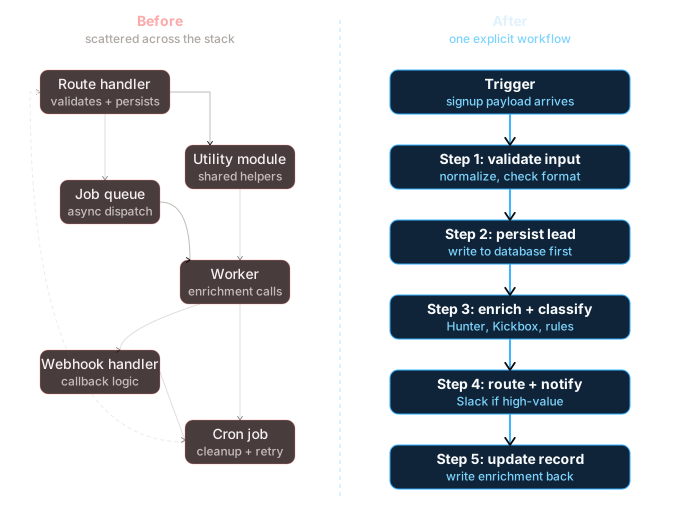
What starts as request handling gradually turns into orchestration spread across queues, jobs, callbacks, and handlers.
The Workflow Exists Whether You Name It or Not
Many teams think of workflows as something formal - something that requires a dedicated orchestration platform, diagrams, or carefully designed processes.
In reality, workflows often appear long before any of those things. The moment one action depends on another, a workflow begins to take shape. When an order is placed, a payment must be processed. When a payment succeeds, inventory must be updated. When inventory changes, notifications may need to be sent.
These steps don't stop being workflows simply because they are hidden across different services, queues, or pieces of code. The workflow exists whether you acknowledge it or not. The difference is visibility. When workflows remain hidden, understanding how your system behaves becomes increasingly difficult. Teams rely on tribal knowledge. Debugging takes longer. Changes become riskier because no one has a complete picture of what happens from start to finish.
Making workflows visible doesn't create complexity. It reveals the complexity that was already there.
How It Gets This Way
Most teams don't end up here because they made bad decisions. It rarely begins with complexity. It begins with progress.
The first version of a system is usually straightforward. It does one thing, and everyone understands how it works. Then reality begins to introduce new requirements.
A vendor becomes unreliable, so retries are added. Another team needs more visibility, so notifications are introduced. A process starts taking longer than expected, so it's moved into a background job. A third-party integration enters the picture, bringing webhooks and additional logic with it.
Each change solves a real problem. In isolation, every decision feels reasonable. But over time, those decisions begin to stack on top of one another.
What was once a single business operation is now spread across multiple services, background workers, queues, and integrations. Not because anyone intended it that way, but because growth rarely follows a neat blueprint. That's what makes this kind of complexity difficult to spot.
There isn't a single broken component pointing to the problem. Instead, there's a process that no longer lives in one place; and a team that becomes a little more hesitant each time they need to change it.
You Probably Already Have These
If any of this sounds familiar, it's because most teams are already managing workflows - they just don't always think of them that way. The thing about workflows is that they rarely announce themselves. They often arrive disguised as features.
A signup flow begins as a simple user creation request. Then validation gets added. Then enrichment. Then qualification, routing, notifications, and CRM synchronization. Before long, a single action is coordinating work across multiple systems. Or consider a Backend-for-Frontend (BFF).
It might have begun as a thin layer between clients and services, but over time it became responsible for aggregating APIs, handling fallback scenarios, coordinating downstream systems, and managing business logic that didn't seem to belong anywhere else.
Support workflows often follow the same path. A straightforward "create ticket" action gradually evolves to include classification rules, priority scoring, assignment logic, escalations, SLA tracking, and internal notifications.
The same pattern appears in order processing. What starts as "place order" eventually expands to include inventory validation, payment authorization, fraud checks, warehouse synchronization, and customer communication.
From the outside, these still appear to be backend features. But beneath the surface, they're coordinating a series of interconnected steps, decisions, and outcomes. In other words, they're already doing orchestration work. The real question isn't whether these workflows exist. It's whether they're visible enough to understand, manage, and evolve - or whether they've become hidden behind layers of code and accumulated assumptions.
What It Actually Costs
Hidden workflows create three specific problems.
Change Is Expensive: One of the first signs of a hidden workflow is how difficult it becomes to make what should be a simple change.
A product request arrives and sounds straightforward enough. But implementing it means touching multiple services, background jobs, integrations, and notification systems because no single part of the codebase owns the process from start to finish.
The API handler knows one piece of the story. The worker knows another. The actual workflow lives somewhere in between.
As a result, even small changes require more coordination, more caution, and more context than they should. What looks simple on the surface often carries hidden complexity underneath.
Debugging Is Painful: When workflows are scattered across different systems, troubleshooting becomes an exercise in reconstruction. One step succeeds. Another silently fails. The database record is created, but the notification never gets sent. The payment goes through, but the follow-up action never happens.
The information needed to understand the problem usually exists somewhere. The challenge is finding it and connecting the pieces together. Logs tell part of the story. Monitoring tools tell another.
Engineers are left stitching together events after the fact, trying to understand what happened between one successful step and the next failed one. It's possible. It's just rarely fast.
Trust Erodes: The most expensive cost isn't technical. It's confidence.
When a workflow becomes too distributed to fully understand, teams naturally become more cautious. Changes take longer because people are unsure what else might be affected. Reviews become narrower because no one can easily see the entire process.
Over time, more of the system depends on tribal knowledge than anyone is comfortable admitting. People know how things work because they've seen them break before - not because the workflow is clear and visible.
That's when software starts to feel heavier than it should. Not because the system is doing more work, but because the people responsible for it trust it a little less each day.
A Concrete Example
Let's take a common example: lead enrichment.
A user signs up. Their email gets validated. A record is written to the database. One service looks up the company associated with the email domain. Another checks whether the address belongs to a disposable mailbox. Based on the results, a set of rules determines whether the lead should be routed to sales. If it qualifies, a Slack notification is sent. Finally, the original record is updated with everything that was learned along the way.
There's nothing particularly unusual about this process. Many teams have built something similar. But it's worth looking at it from a different perspective. What appears to be a single feature is actually a sequence of connected steps. There are decisions being made, external services being called, dependencies that can fail, and a clear outcome the business cares about. In other words, it's a workflow.
When those steps are spread across handlers, background jobs, scripts, and integrations, every future change becomes more expensive. Understanding the process requires jumping between different parts of the system and reconstructing how they fit together.
When the workflow is visible in one place, the story becomes easier to follow. It's easier to understand what happens. Easier to debug when something goes wrong. And easier to evolve when the business inevitably changes.
To see what this looks like in practice, we built a complete lead enrichment workflow using Unmeshed and Supabase. It shows how a process like this can be modeled explicitly, making each step easier to understand, monitor, and maintain as requirements evolve.
If you're curious, you can explore the full implementation and see how the workflow comes together from start to finish.
What Changes When the Workflow Is Explicit
When a workflow is made explicit, the system becomes easier to understand.
You can see the order of operations. You can see where retries belong, which steps are optional, and where decisions create different paths. When something fails, you're no longer piecing together logs from multiple services to figure out what happened. You can inspect the path the workflow actually took.
This doesn't remove complexity. Real processes are still real processes.
What it removes is hidden complexity - the kind spread across services, background jobs, and scripts that nobody wants to touch.
The work itself remains the same, It's simply no longer hiding.
This Is Exactly What Unmeshed Is Built For:
Unmeshed gives coordination logic a proper home. Instead of workflows being spread across route handlers, background jobs, queue consumers, and custom scripts, they can be defined in one place. The steps become visible. The decision points become clear.
Integrations become part of the workflow instead of scattered pieces of logic hidden throughout the system. Your services still do what they do best. Your APIs still matter. Your database remains the source of truth.
Unmeshed isn't there to replace them. It exists to bring clarity to the part of the architecture responsible for coordinating everything together.
For teams dealing with workflows that technically work but have become increasingly difficult to understand, change, or maintain, that clarity can make a significant difference. Workflows aren’t the problem. Hidden workflows are.
Still debugging by reconstruction?
Give your workflow a home
Unmeshed brings scattered retries, jobs, and integrations into a single visible, debuggable process, rather than a system nobody fully trusts.
If a backend path touches multiple systems, branches on conditions, needs retries, and triggers follow-up work, you don't just have backend logic. You have a workflow. Make it visible.