If you're reading this, there's a decent chance Temporal is working exactly as advertised, and you're still here looking for a way out. It happens to almost every team running it at some point.
Sometimes it's the bill. Sometimes it's the two services and a pile of boilerplate before anything actually runs.
Sometimes you just want the same durability guarantees without turning half your team into Temporal specialists, which is exactly why teams start looking at Temporal alternatives in the first place.
Good news, you're in familiar company. Here are seven real Temporal alternatives, judged on what they actually trade off, not just what the marketing promises.
1. How We Evaluated These Temporal Alternatives
Five criteria, applied the same way to all seven Temporal competitors on this list:
- Execution model: code-based, embedded library, or cloud-native state machine
- Operational footprint: self-hosted, managed, or embedded in infrastructure you already run
- Migration effort coming from Temporal specifically
- Real, published pricing wherever a vendor discloses it
- Production maturity: how long it's actually been running critical workloads
These same criteria apply whether you're comparing managed services or fully open source Temporal alternatives.
2. Temporal Alternatives at a Glance
Here's how the seven Temporal alternatives compare at a glance:
| Tool | Type | Pricing | Best For |
|---|---|---|---|
| Unmeshed | Durable orchestration with AI, rules, and human steps | Free forever; Premium $20/mo | Teams that want durable execution plus AI, code, APIs, and approvals in one engine |
| Cadence | Open source durable execution engine, Temporal's predecessor | Free and open source, self-hosted only | Teams that want Temporal's model without adopting Temporal itself |
| Restate | Lightweight durable execution runtime | Free; Cloud from $75/mo, or self-hosted (BYOC) | Teams that want durable execution with a smaller operational footprint |
| DBOS | Durable execution embedded as a Postgres-backed library | Free OSS core; Pro $99/mo | Teams that want durability without standing up a separate orchestrator cluster |
| Netflix Conductor | Open source, JSON-defined workflow engine | Free and open source, self-hosted only | Teams already on Conductor, or wanting proven scale with JSON workflows |
| AWS Step Functions | Cloud-native state machine | Pay-per-transition, from $0.000025/transition | AWS-native teams that want durable orchestration without running infrastructure |
| Azure Durable Functions | Stateful orchestration on Azure Functions | Consumption-based, with a monthly free grant | Azure-native teams wanting durable orchestrations, activities, and timers |
3. The Temporal Alternatives, One by One
Unmeshed
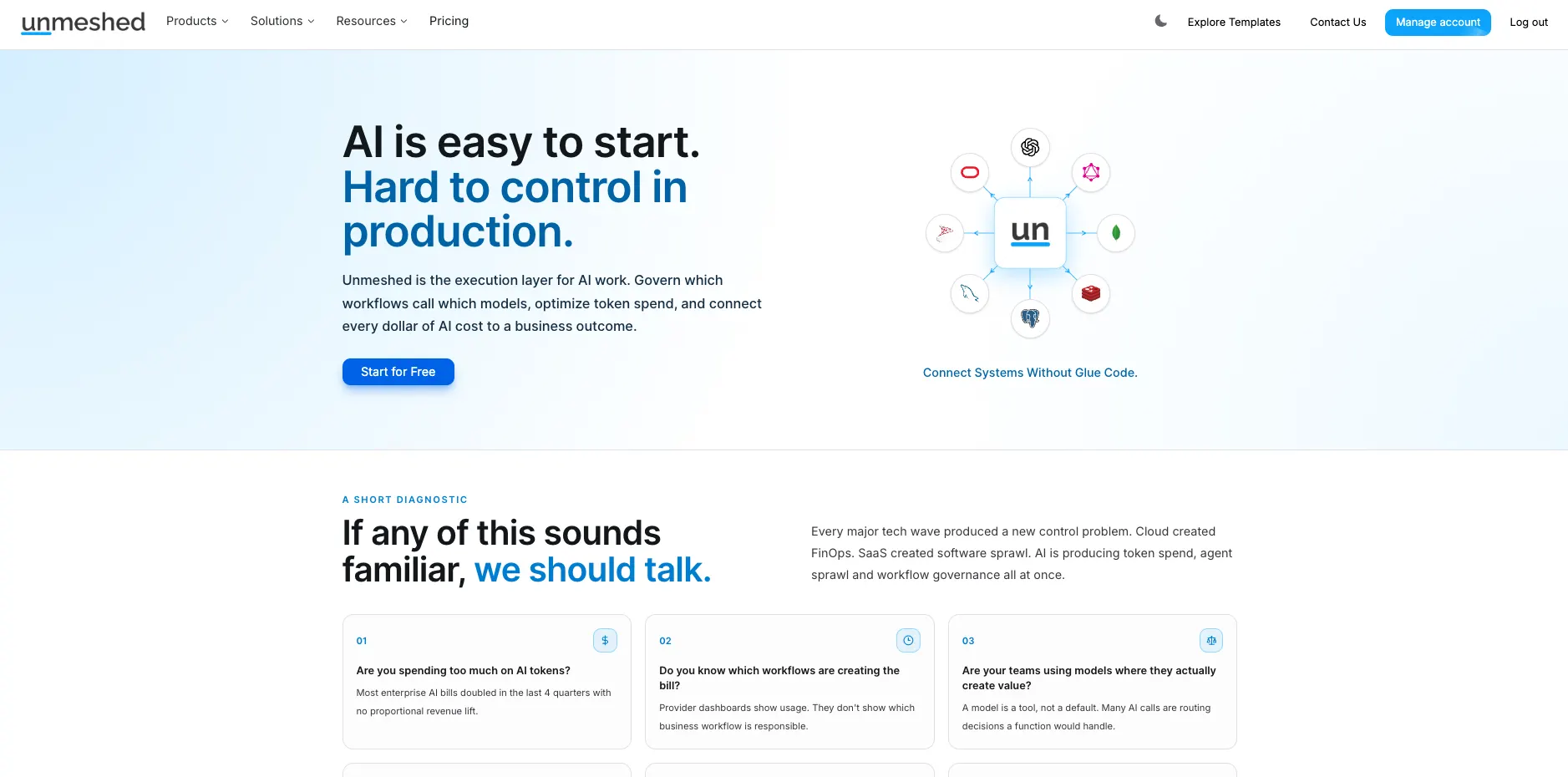
Unmeshed gives you the same core durability guarantees, retries, state recovery, and resumable steps, but treats them as one part of a wider engine instead of the whole product. AI steps, deterministic code, API calls, and human approvals run in the same workflow, not as separate systems bolted together afterward.
Features
- Durable step execution with automatic retries and state recovery across crashes and restarts
- Visual workflow builder backed by a real execution engine, not just a diagram
- Built-in decision tables for rules that would otherwise live in scattered code
- Native human-in-the-loop steps for approvals and manual review
- Agentic AI steps that sit next to regular workflow logic, not bolted on separately
- Changes to workflow logic ship without a redeploy
Pros
- One engine for durable execution, AI, rules, and human steps, instead of Temporal plus three other tools
- Free forever tier covers 1,000 workflow runs and 1,000 AI agent calls a month
- No separate worker service to split your application into; workflow and application logic stay together
- Every step is logged, so debugging means reading one run history, not correlating logs across systems
The alternative most teams reach for first is building durability themselves on top of Temporal: two services, a worker fleet, retry logic tuned by hand, and an operational bill that grows with every workflow you add.
That's a real option, and some teams need exactly that level of control. But most teams evaluating Temporal alternatives aren't looking for more infrastructure to own; they're looking for less. Unmeshed keeps the durability guarantees and removes the second system you'd otherwise have to run alongside it.
Cadence
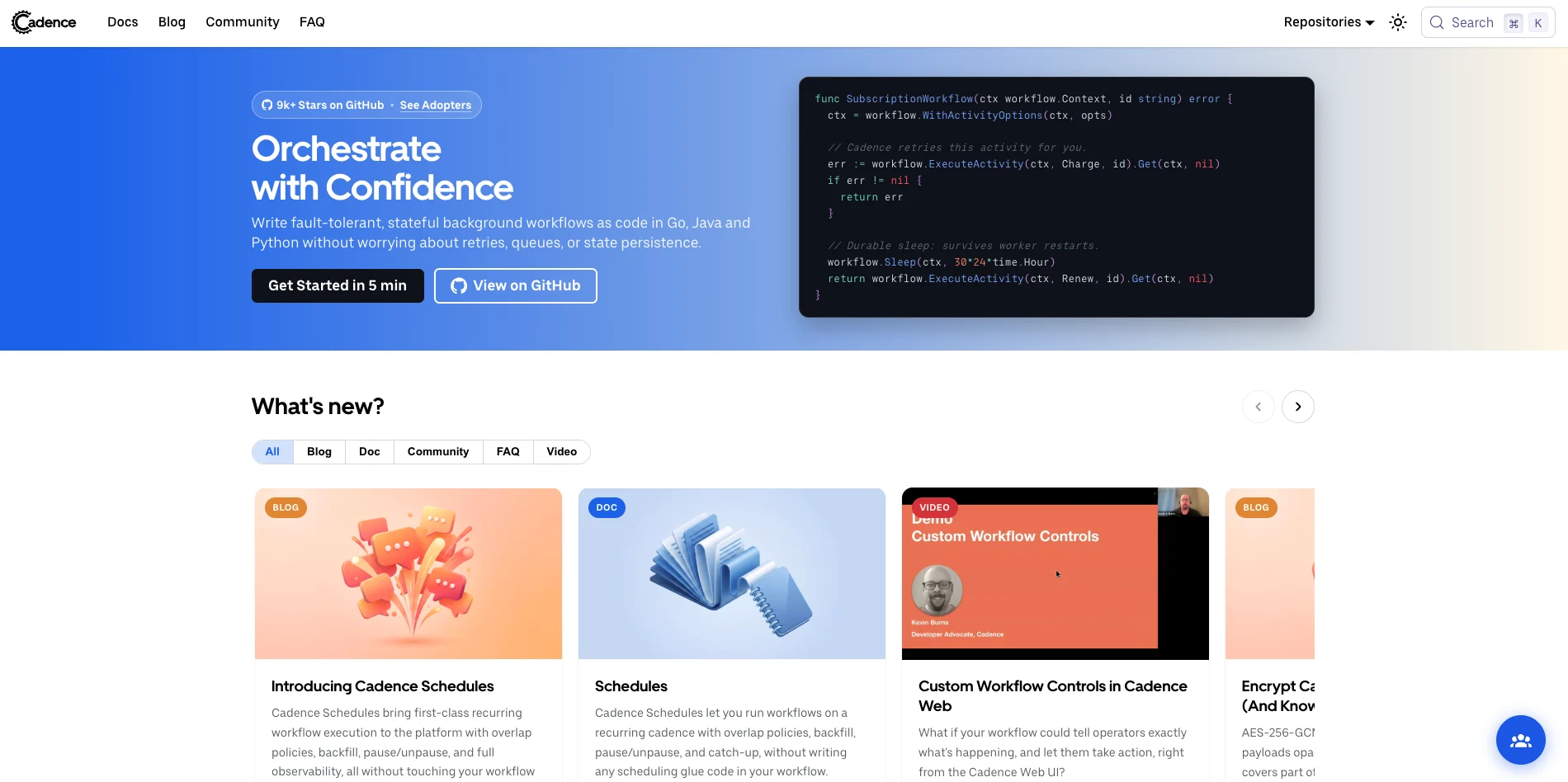
Cadence is Temporal's actual predecessor, built by the same original team at Uber before Temporal forked off as a separate project. It's now maintained as an open source Linux Foundation project, and of every option here, it's the most direct like-for-like of the Temporal alternatives on this list.
Features
- Workflows written as code in Go, Java, or Python, with the same durable-execution model Temporal is known for
- Automatic retries and durable sleep that survives worker restarts
- Self-hostable on SQLite, Docker, or Kubernetes, with an active release cadence and its own web UI
Cons
- No managed cloud offering; this is a self-hosted commitment only
- Smaller ecosystem and community than Temporal's, despite the shared lineage
- Migrating between Cadence and Temporal still means mapping SDK packages and concept renames by hand
Pricing
Free and open source. There's no managed tier to price, since Cadence is self-hosted only.
Restate
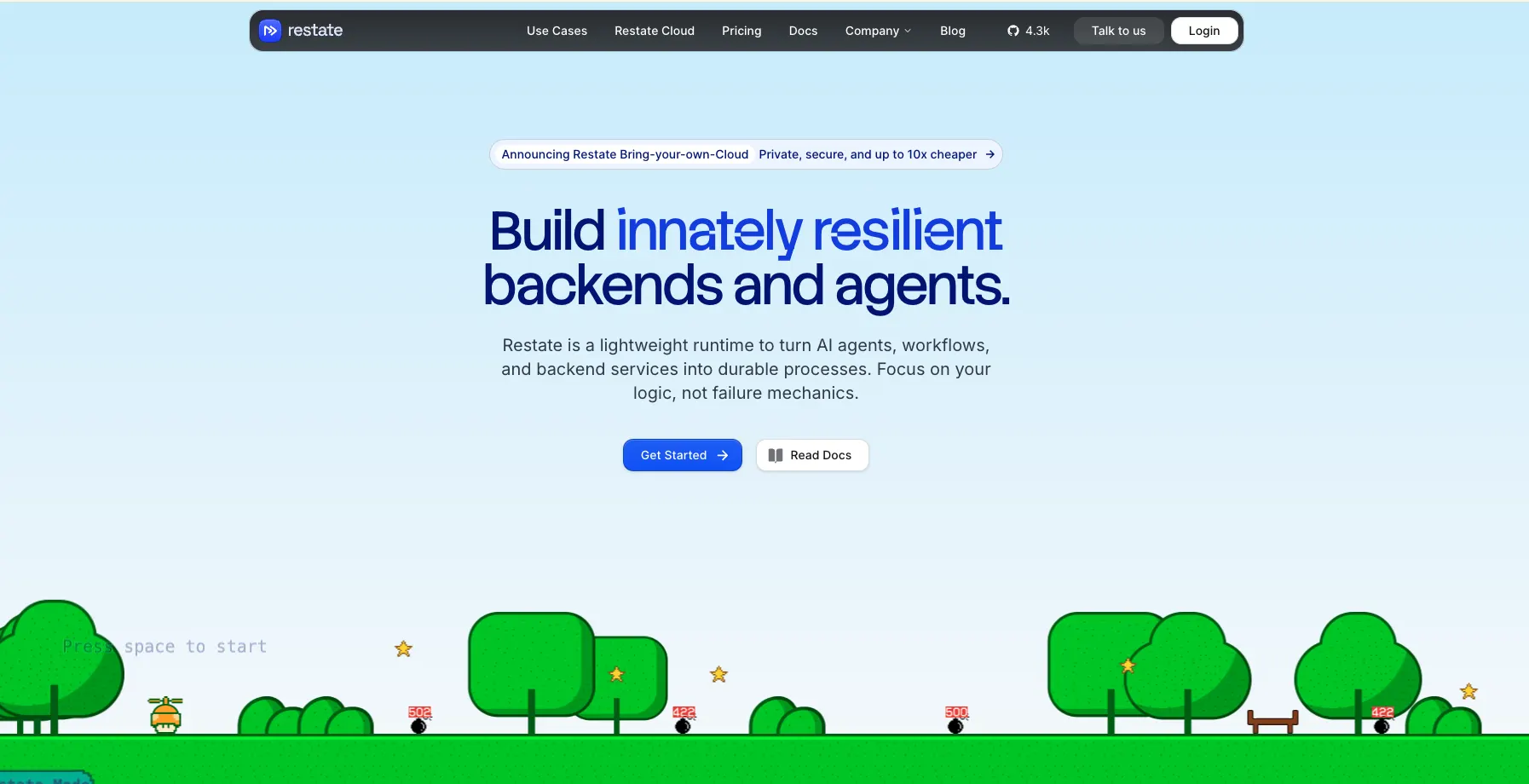
Restate is one of the lighter-weight durable execution alternatives to Temporal, built specifically to cut the operational overhead down without giving up the same replay-based durability model.
Features
- Uses the same journal-and-replay mechanism as Temporal, with a noticeably lighter footprint
- SOC 2 certified, with fully-managed Restate Cloud or a self-hosted, bring-your-own-cloud option
- Positions itself explicitly as simpler to operate than Temporal, not just a rebrand of the same idea
Cons
- Still requires splitting durable logic into a separate worker service, the same architectural shift Temporal asks for
- Newer project, with a shorter production track record at scale than Temporal or Cadence
- Smaller plugin and integration ecosystem so far
Pricing
Restate Cloud starts free with 100K actions included. Starter is $75/month for 5M actions, Business is $300/month for 20M actions, and Premium is $1,000/month for 50M actions. Enterprise is custom. Bring Your Own Cloud (self-hosted, deployed in your own VPC) is also available for teams that don't want Restate hosting it.
DBOS
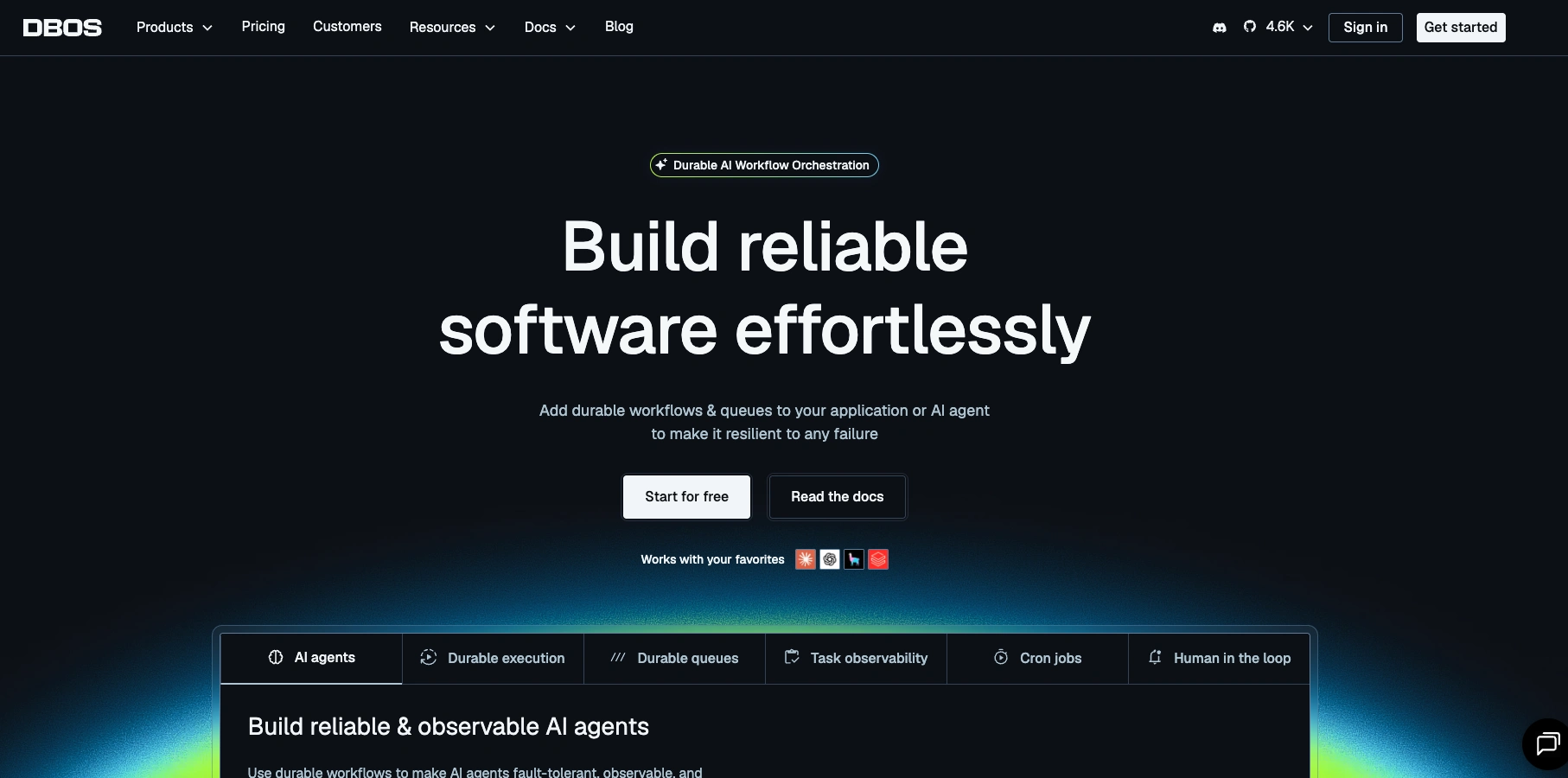
DBOS takes the most different approach on this list. Instead of a separate orchestrator cluster, durable execution ships as a lightweight library that runs inside your existing application, backed by Postgres.
Features
- Durability embedded directly in your app code, with no separate worker service to stand up
- Built-in OpenTelemetry observability and a time-travel debugger for replaying past executions
- Runs on Linux, Windows, or macOS, with Python and TypeScript support
Cons
- Ties your durability layer to Postgres, which is a strength if you're already there and a constraint if you're not
- Fewer language SDKs than Temporal, which also supports Go, Java, and .NET
- Smaller ecosystem and community than either Temporal or Cadence
Pricing
Free for the open source library. DBOS Pro is $99/month, including deployment tooling, workflow monitoring, and DBOS Cloud with 10M ms of compute time and 100K requests a day. Enterprise is custom.
Netflix Conductor
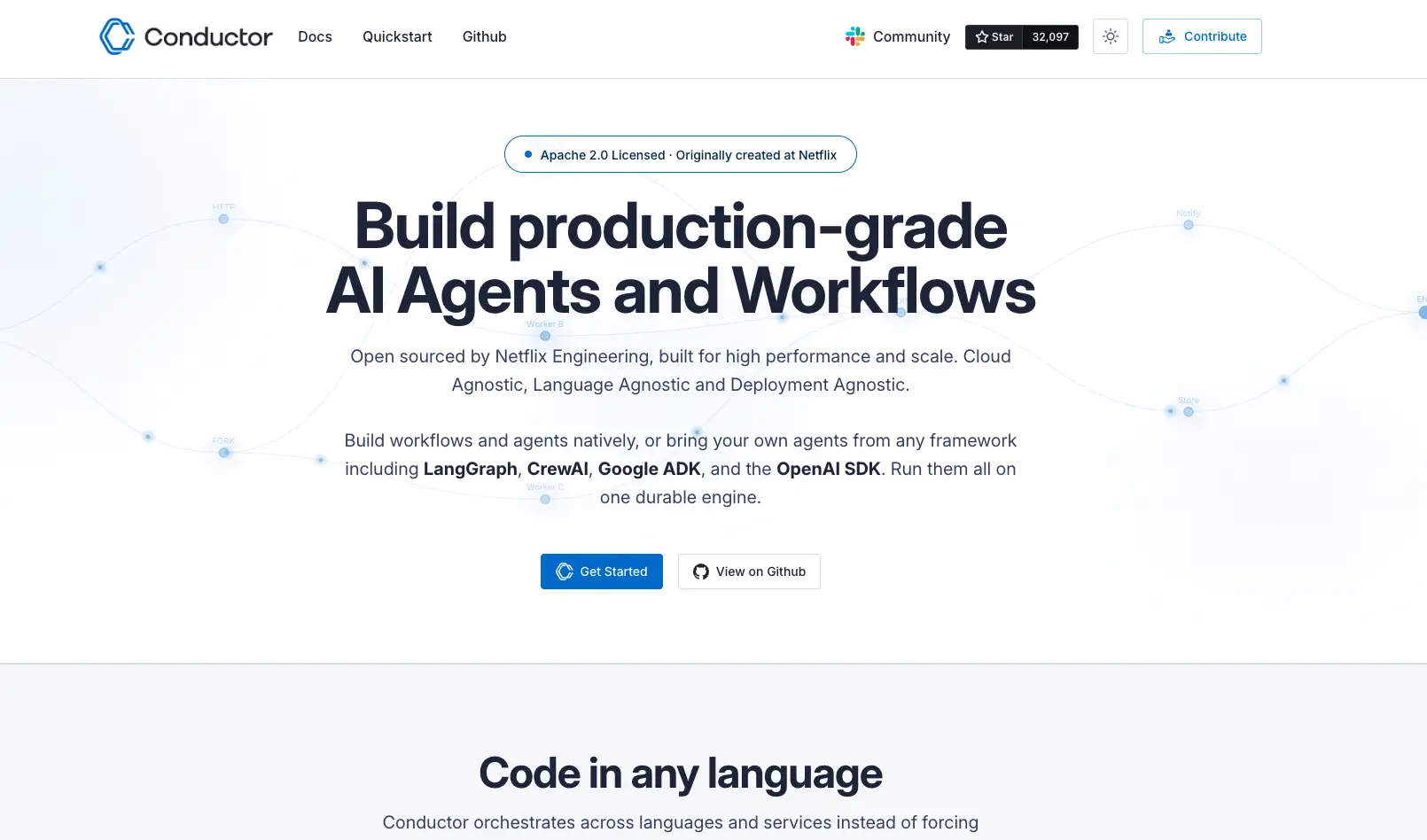
Netflix Conductor is the open source orchestration engine that popularized JSON-defined workflows at scale, originally built to run Netflix's own operations. It continues today as an actively maintained open source project.
Features
- Workflows defined as JSON, with a large library of community task types
- Proven at very large scale in production
- Self-hosted UI for monitoring and debugging workflow runs
Cons
- Running it yourself means owning the full operational overhead; there's no lighter managed path in this comparison
- JSON-based workflow definitions get unwieldy fast for complex branching logic
- Community momentum has shifted toward newer engines like Temporal in recent years
Pricing
Free and open source. This entry covers the self-hosted engine only.
Teams outgrowing a self-hosted Conductor deployment have a direct migration path if they'd rather not keep maintaining it themselves.
AWS Step Functions
AWS Step Functions is Amazon's native state machine service, and it's one of the most common durable execution alternatives to Temporal for teams already running most of their infrastructure on AWS.
Features
- Visual state machine definitions with Standard and Express workflow types
- Deep native integration with Lambda, S3, DynamoDB, and the rest of the AWS ecosystem
- Bedrock AgentCore available alongside it for teams that also need AI agent execution
Cons
- Deterministic orchestration and AI agent orchestration live in two separate services, not one
- Effectively locks workflow logic into the AWS ecosystem
- No low-code builder for non-engineers; this is a developer-first tool
Pricing
After a free tier of 4,000 state transitions a month, Standard Workflows cost $0.000025 per state transition.
Azure Durable Functions
Azure Durable Functions bring durable orchestration to Azure Functions: orchestrator functions, activity functions, durable timers, and stateful entities, all running on Azure's serverless compute.
Features
- Orchestrator functions coordinate activity functions with automatic checkpointing and replay
- Durable timers and stateful entities handle the same long-running, resumable patterns Temporal covers
- A separate managed Durable Task Scheduler tier is available for teams that outgrow the standard consumption model
Cons
- Inherits Azure Functions' execution model, including its cold start and scaling characteristics
- Orchestrator functions must follow strict deterministic-code constraints, which takes some getting used to
- Smaller mindshare in the durable execution space specifically, compared to Temporal or AWS Step Functions
Pricing
On the Consumption plan, each orchestrator replay bills as a separate invocation, at standard Azure Functions rates, with a monthly free grant of 1 million requests and 400,000 GB-s. Billing pauses while an orchestrator is awaiting or yielding, so you're not charged for idle wait time. For heavier orchestration needs, the purpose-built Durable Task Scheduler offers a Dedicated tier (fixed monthly cost per Capacity Unit, each supporting up to 2,000 actions per second) or a pay-per-action Consumption tier, currently in preview.
Worth a read: Why Use Unmeshed Instead of CRON or In-House Workflow Engines covers the same tipping point from a different angle, the exact moment a homegrown durability layer stops being the cheap option.
4. Which Temporal Alternative Actually Fits
Among these Temporal alternatives, if you want the durability guarantees plus AI, rules, and human approval in the same engine instead of stitching Temporal to three other systems, that's what Unmeshed is built for.
If you want Temporal's model with the smallest possible footprint, Restate or DBOS are the strongest fits: Restate if you want a lighter version of the same separate-worker architecture, DBOS if you'd rather skip the separate worker entirely and lean on Postgres.
See where Unmeshed fits your stack
Try Unmeshed free, or talk to us about migrating off Temporal or a homegrown durability layer.
Teams that want Temporal's exact model without adopting Temporal itself should look at Cadence, its own predecessor and the most direct like-for-like swap. Teams already on Netflix Conductor and staying self-hosted should look at Conductor directly rather than starting over. And teams already deep in one cloud should lean on that cloud's native option, AWS Step Functions or Azure Durable Functions, and accept the lock-in that comes with it.
Running your own workflow engine comparison against Temporal is worth doing before committing to any of these, since the tradeoffs that mattered when your team picked Temporal in the first place may not be the ones costing you today. However you frame it, Temporal vs alternatives isn't a question with one right answer. It depends on what's actually costing your team time this quarter, not what was true when you first adopted it.
Frequently Asked Questions
Sources
Still deciding on a durable execution engine?
See where Unmeshed fits your stack
Try Unmeshed free, or talk to us about migrating off Temporal or a homegrown retry layer.