Here's a fun way to ruin someone's afternoon.
A workflow is three steps: charging a customer, updating an order, and sending a confirmation email. Step two finishes. Then the server dies for no reason anyone can explain yet.
Now someone has to answer the actual question. Did the charge go through? Is the order sitting somewhere half saved? Do you retry and risk charging twice, or hold off and risk losing the order completely? Congratulations, you've just met the reason durable execution exists.
Most engineers don't learn this concept from a textbook. They learn it from an incident channel, at the worst possible moment, usually while someone is already asking hard questions in Slack.
This guide skips that part. Here's what durable execution actually means, how it works under the hood, and when you genuinely need it instead of just liking the sound of it.
1. What Durable Execution Actually Means
Durable execution is the guarantee that a workflow survives crashes, retries automatically, and resumes exactly where it left off, without losing state or repeating side effects.
Go back to the order example above. The difference isn't luck. It's whether the engine underneath already knows what happened before the crash.
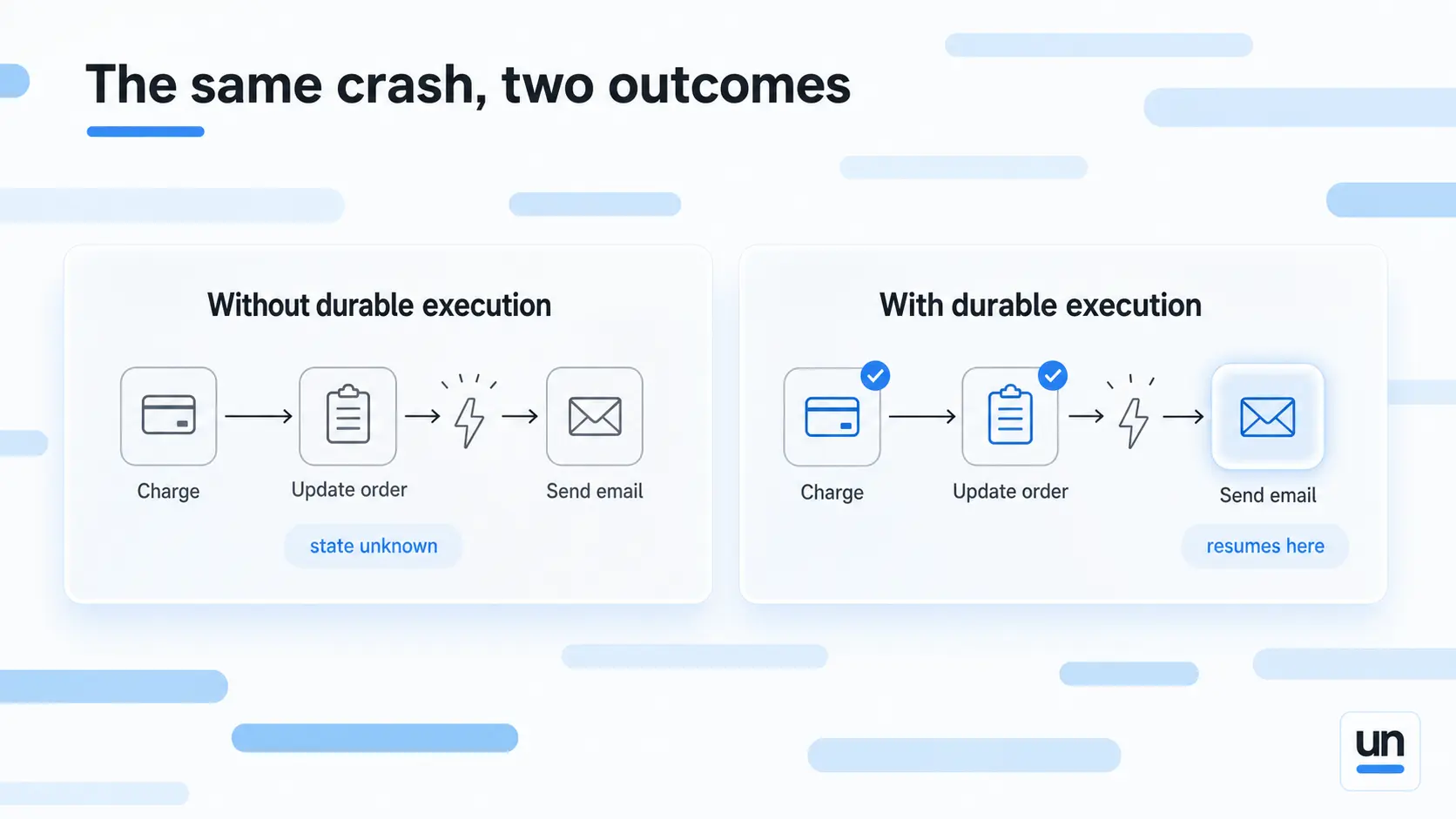
Without it
- The process restarts from scratch, so the charge might run twice
- Nobody's sure what state the order is actually in until someone checks logs by hand
With durable execution
- The engine replays what already succeeded and skips it automatically
- Execution picks back up from the exact step that failed, nothing more, nothing less
2. How Durable Execution Works
Strip away the marketing, and it comes down to one core mechanism: journaling.
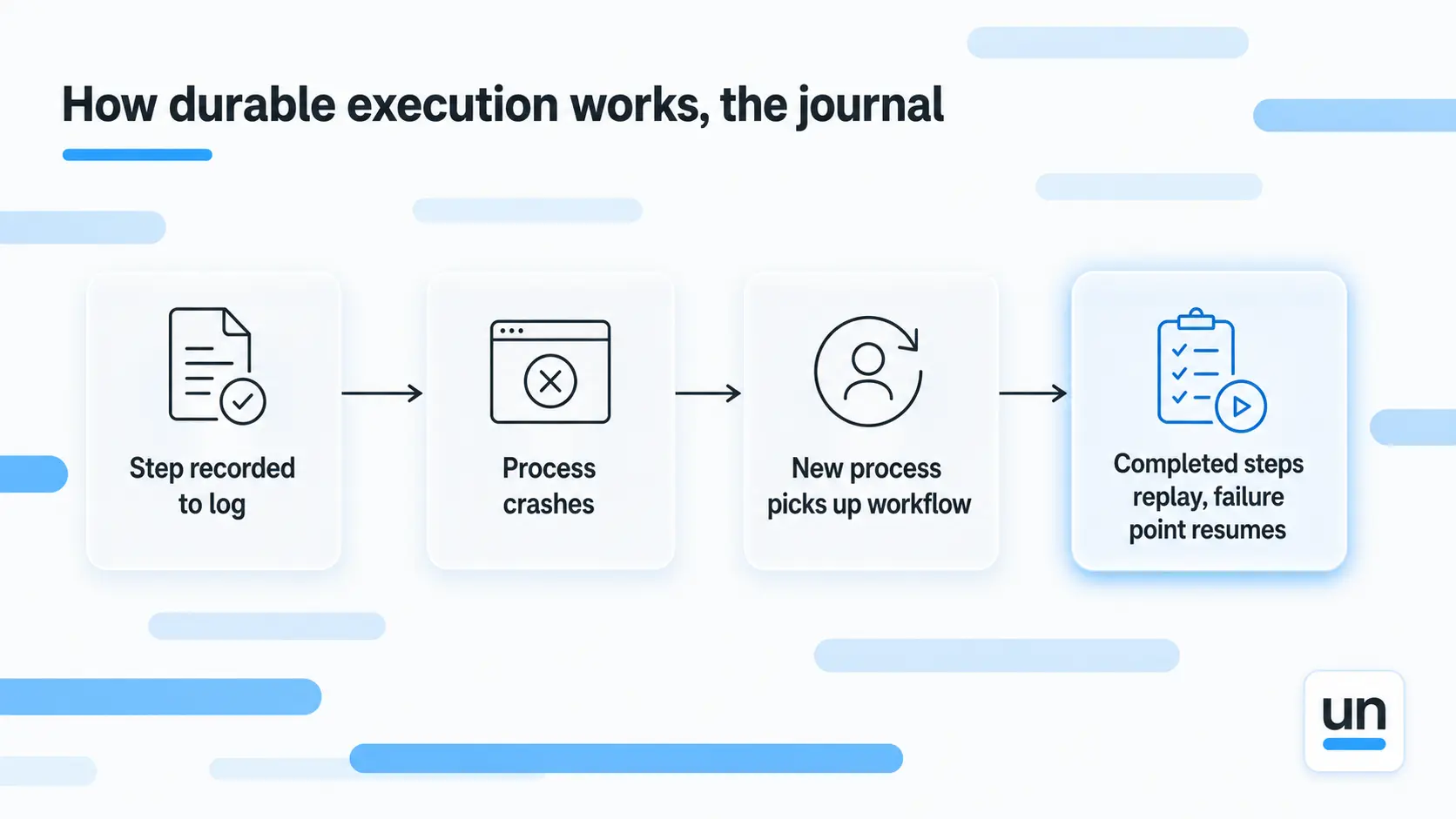
- Every step gets recorded to a persistent log before its result is used anywhere else
- If the process crashes, a new process picks up the workflow automatically
- Completed steps replay instantly from the log instead of running again
- Execution continues from the exact point of failure, not from the beginning
No custom retry logic. No manual state tracking. No scheduler bolted on the side to handle the parts that take days instead of milliseconds.
3. Durable Execution vs. Workflow Orchestration vs. Event-Driven Systems
These three get used interchangeably, and that mix-up has caused more confused architecture diagrams than almost any other reliability concept.
Here's the comparison table:
| Approach | How work is defined | Best for |
|---|---|---|
| Durable execution | Plain code, with the engine handling retries and state | Business logic that needs reliability without giving up code control flow |
| Workflow orchestration | A DSL, visual builder, or rules engine | Well-bounded processes, especially ones non-engineers need to see or edit |
| Event-driven/choreography | Services react to events independently | Loosely coupled, high-throughput systems with no central coordinator |
The short version. It keeps you in code and hands reliability to the engine. Workflow orchestration trades some of that flexibility for a visual or rules-based process.
If you want the deeper breakdown on the event-driven side, we've covered that separately in orchestration versus choreography.
4. The Core Properties of Durable Execution
Temporal, Restate, and every other platform in this space publish their own list of core properties. Strip out the branding and four show up every time.
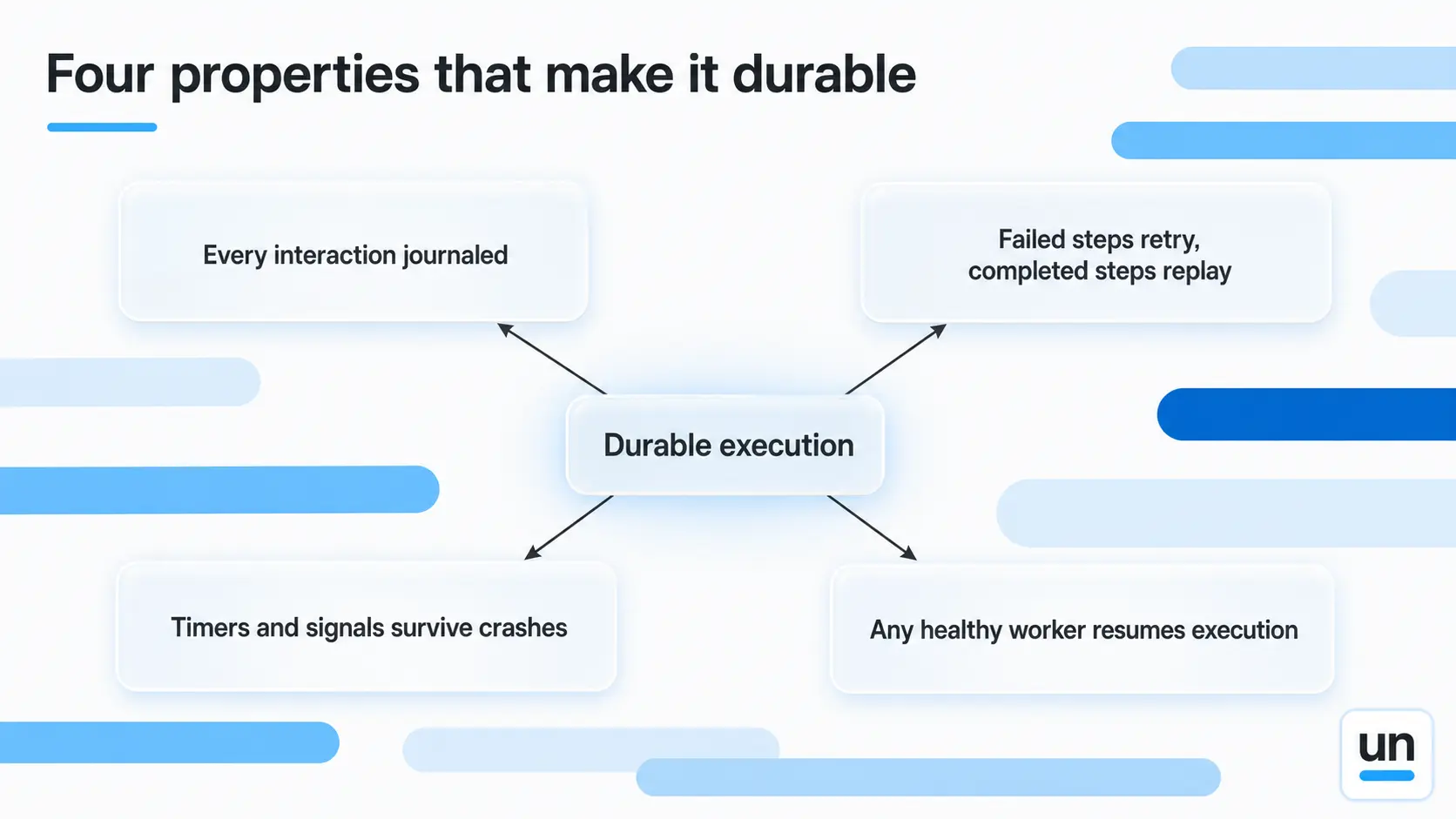
- Every external interaction gets journaled, recorded to a persistent log before its result is used, so the log becomes the single source of truth for what actually happened
- Failed steps retry automatically, and completed steps never re-run, since their recorded result gets replayed instead
- Durable timers and signals survive crashes too, so a workflow can wait days or months for a human approval or a scheduled follow-up without holding a process open
- Any healthy worker can pick up an in-flight execution, so recovery doesn't depend on the original machine coming back
Get those four right and workflow durability stops being a per-project decision; it just becomes the default.
5. When You Need Durable Execution (and When You Don't)
Not every workflow needs it. Here's the honest signal list.
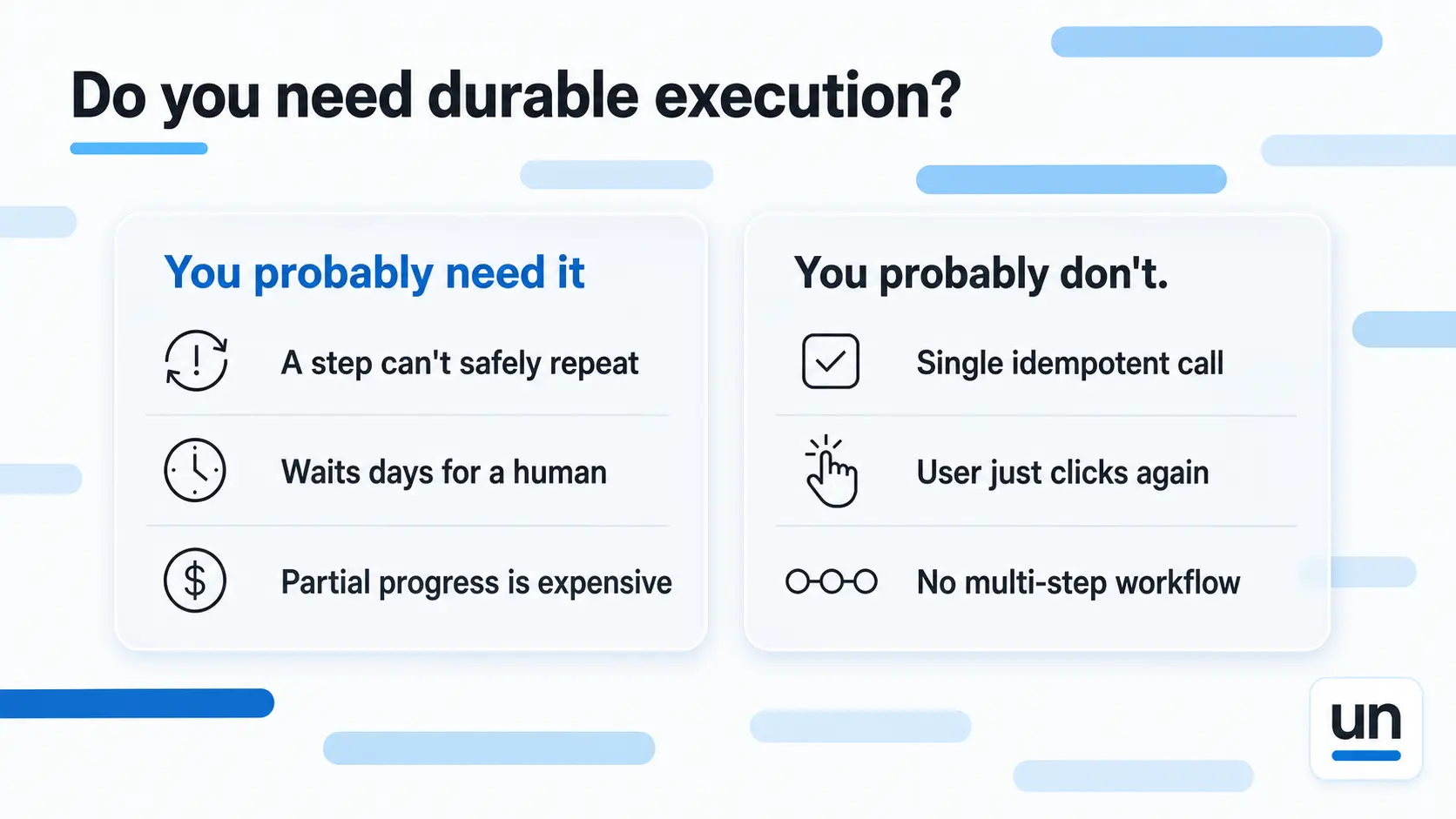
You probably need it if
- A single step failure can't safely repeat, like charging a card or sending a payment
- The process needs to wait days, weeks, or months for a human or an external event
- Losing partial progress on a crash is expensive enough to actually matter
- You want fault-tolerant execution without hand-writing retry and recovery logic for every workflow
You probably don't if
- The operation is a single, idempotent call
- Losing progress just means the user clicks a button again
- You don't have durable workflows that span more than one step or service
If that sounds like your workflows, see it built in
Durable retries, state recovery, and resume-where-it-failed come standard in Unmeshed, with no separate engine to run.
6. How Unmeshed Handles Durable Execution
Unmeshed handles durable execution with the same core guarantee: automatic retries, state recovery, and steps that resume exactly where they left off.
- Durable step execution with automatic retries and state recovery built into every workflow, not bolted on afterward
- Human-in-the-loop steps behave like durable signals; a workflow can wait indefinitely for an approval without holding a process open
- Full run history works like the journal: every step, retry, and recovery is logged and replayable
- AI steps, rules, and API calls run in the same durable workflow instead of a separate engine bolted on the side
| Build it yourself | With Unmeshed |
|---|---|
| A standalone engine like Temporal, Restate, or DBOS | Durability and orchestration in the same engine |
| A separate system for rules, human approval, AI steps | No second system to bolt on for approvals or AI steps |
| Two systems to keep in sync instead of one |
Most teams reach for the first option because it's the default path. Fewer of them actually need to.
If you're comparing standalone engines first, we've laid out Temporal alternatives in more depth, including where each one's durability model differs. And for the deeper case on why purpose-built orchestration beats traditional platforms built for slower workloads, that's covered separately too.
Frequently Asked Questions
Still weighing durable execution options?
See where Unmeshed fits your stack
Try Unmeshed free, or talk to us about migrating off Temporal or a homegrown retry layer.