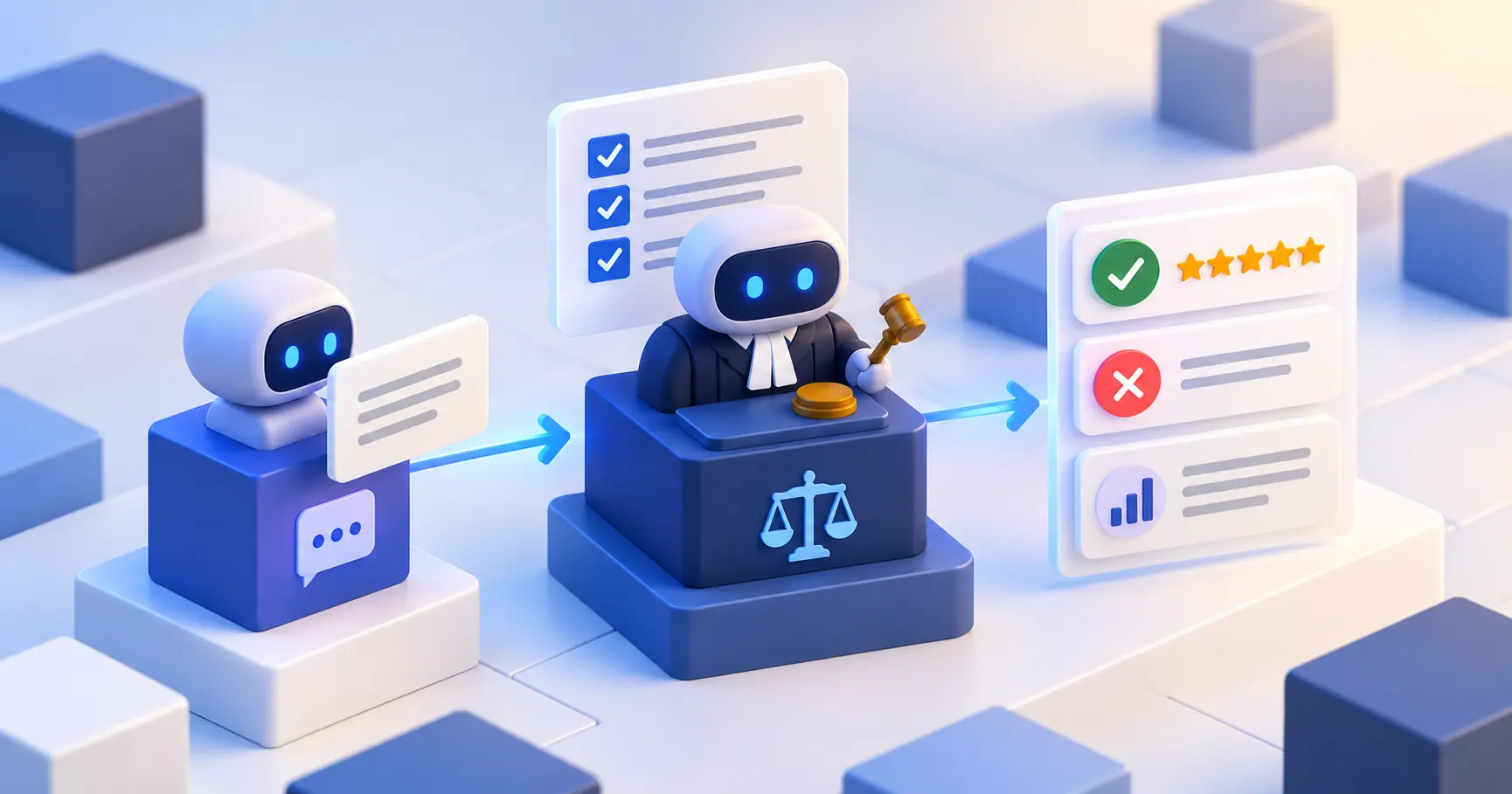
Your agent can be wrong and sound completely sure of itself. Demos never show you that part.
A chatbot that throws an error is annoying, but at least you know something broke. An agent that calls the wrong tool, then explains its wrong answer with total confidence, is a harder problem. Users do not flag confident wrong answers the way they flag broken ones. Nobody complains about an answer that sounds right.
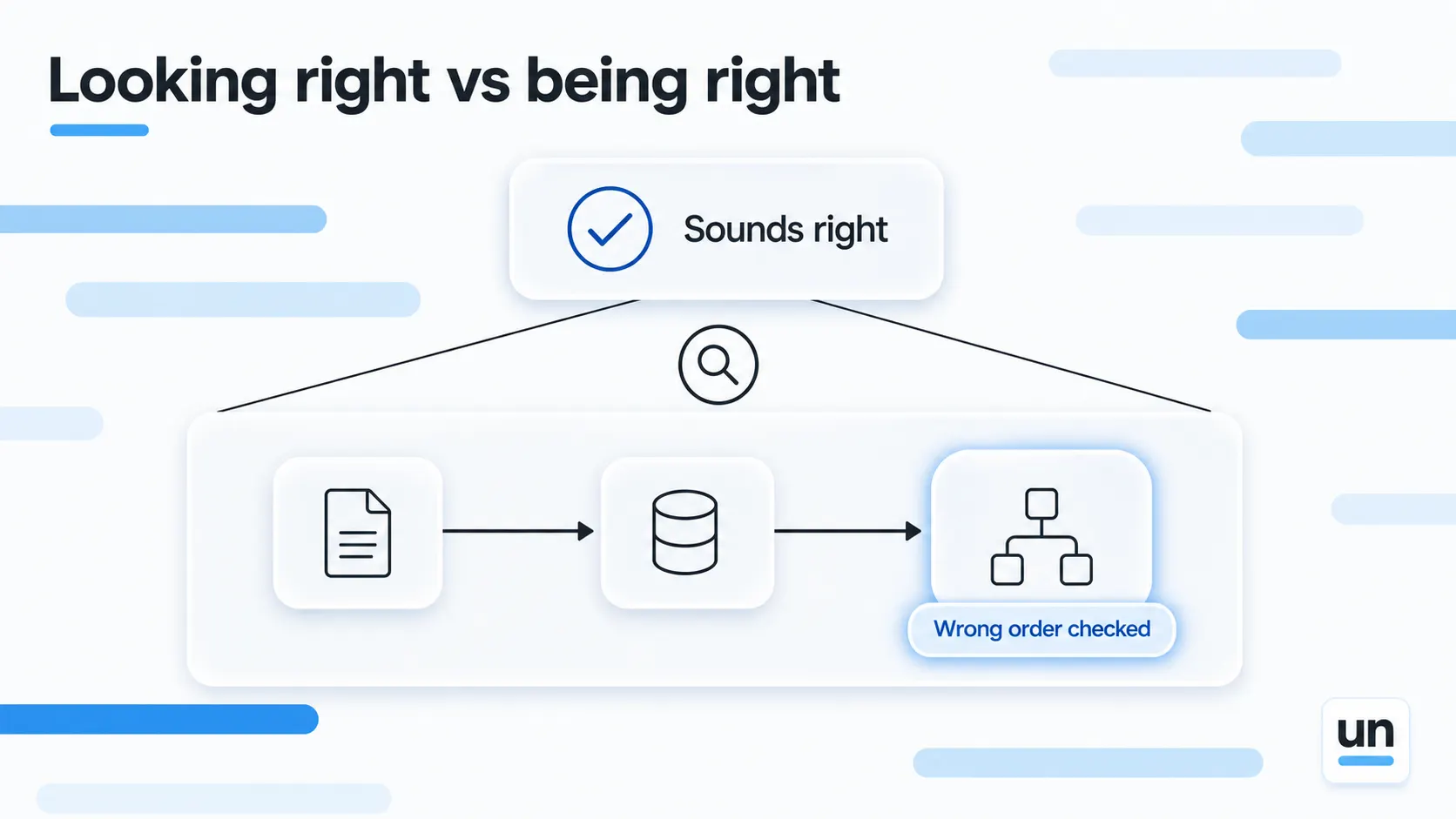
That gap between looking right and being right is what AI agent evaluation exists to catch. It is not about watching what your agent does step by step; that is what observability already gives you. It is about grading whether each step, and the outcome it led to, was actually good.
This guide covers what AI agent evaluation means, how it differs from observability, the metrics and frameworks that matter, and how to build a working evaluation process without turning it into a six-month project.
TLDR
- Agent evaluation grades whether an agent's plan, tool calls, and final output were actually good, not just whether the answer sounded right.
- It's not the same as observability. Observability shows you what happened. Evaluation grades whether what happened was actually good.
- Trajectory-based evaluation matters more for agents than scoring the final output alone, since two runs can reach the same answer through very different, and very differently risky, paths.
- A working evaluation framework needs five things in order: success criteria, test cases across four categories, tracing, a scoring method, and a way to feed production failures back in as new tests.
- Unmeshed doesn't run evals itself, but its full run history and step-level trace data, plus the ability to stream that data out to CloudWatch or SIEM platforms, is exactly what an evals process needs to work off of.
1. What AI Agent Evaluation Actually Means
AI agent evaluation is the practice of measuring how well an agent completes multi-step tasks by grading its plan, its tool calls, and its final output, not just whether the last response looked right.
Standard LLM evaluation scores one prompt against one response. That works fine for a single completion. It falls apart the moment an agent reasons across five steps and calls three tools, because a wrong turn in step two can still produce a fluent, confident, entirely wrong answer in step five.
That is why AI agent evaluation looks at the full path an agent took, not just where it ended up.
Take a support agent that pulls a refund policy, checks an order status, and drafts a reply. If it drafts a correct reply after checking the wrong order, an output-only score still passes it, and the next customer gets the wrong answer with a confident tone.
2. Agent Evals vs. Observability, What's Actually Different
This is the question that trips up most teams building their first agent. Observability and evaluation sound similar. They measure two completely different things.
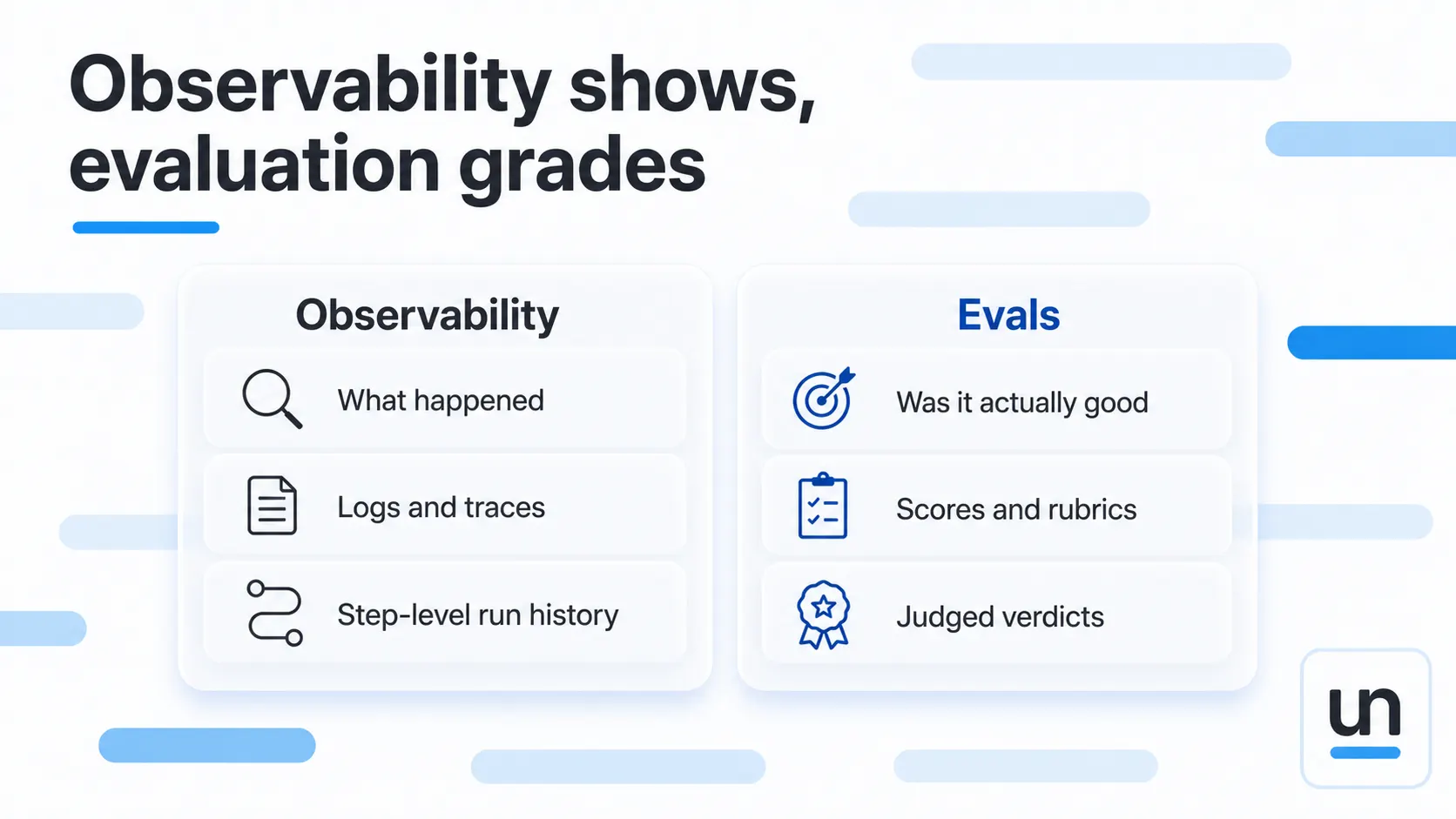
Observability shows you what happened. Every tool call, every retry, every branch the agent took, captured as a trace you can replay after the fact.
Evaluation grades whether what happened was actually good. A rubric score, a pass or fail, a judgment from a human or another model on whether the agent did the right thing.
| Observability | Evals | |
|---|---|---|
| Answers | What happened during this run | Was what happened actually good |
| Output | Logs, traces, step-level run history | Scores, pass or fail rubrics, judged verdicts |
Full visibility with no quality signal tells you your agent ran, not whether it should have run that way. Quality scores with no trace to inspect tell you something went wrong, not why. Production agents need both.
If you want the deeper breakdown on the observability side, we have covered that separately in LLM observability.
3. The Three Ways to Evaluate an Agent
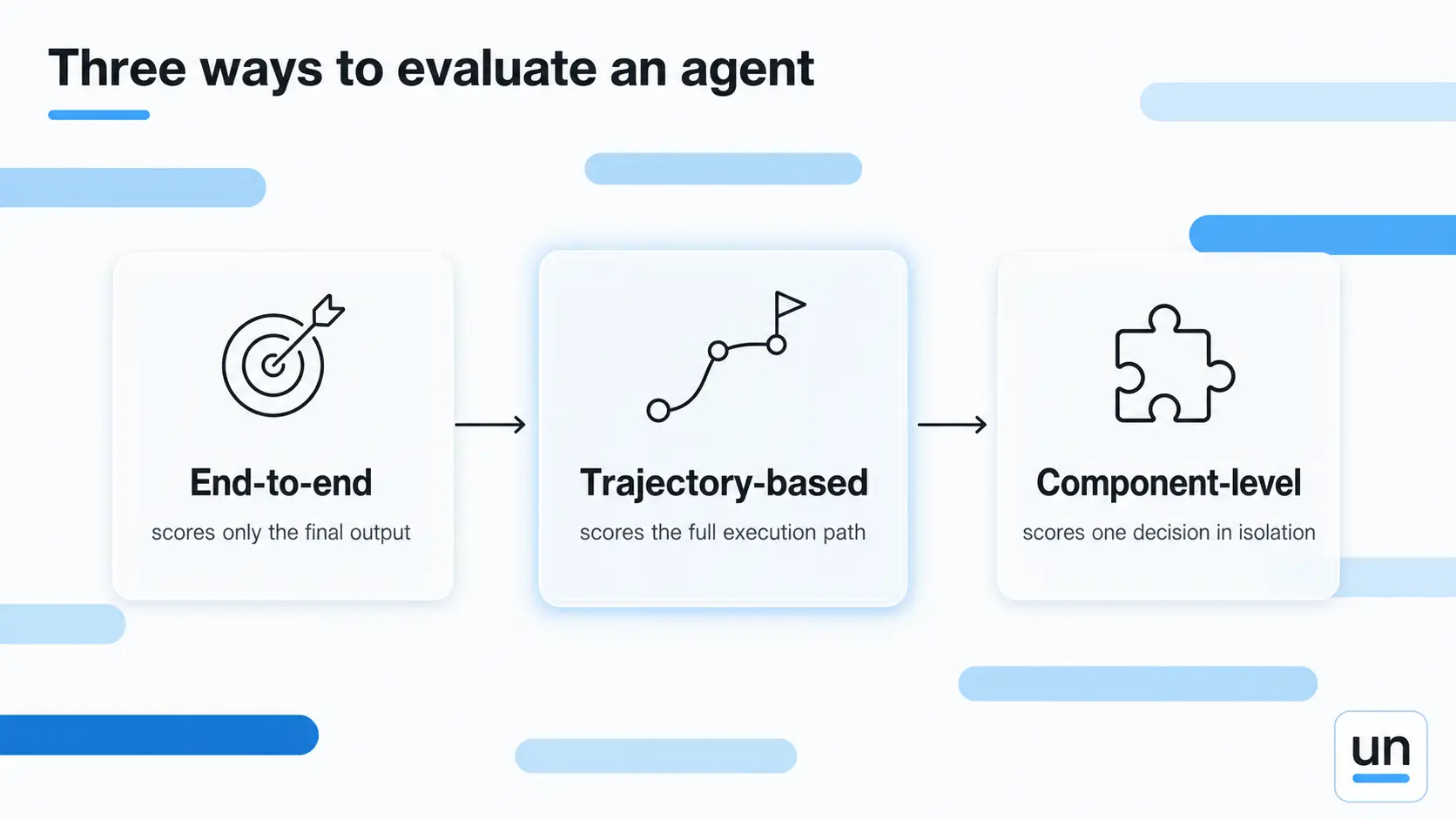
- End-to-end evaluation scores only the final output. Fast to set up, but blind to how the agent got there.
- Trajectory-based evaluation scores the full execution trace, the plan, the tool calls, and the order they ran in.
- Component-level evaluation scores one decision in isolation, like whether a single tool call used the right arguments.
Most teams start with end-to-end scoring because it is the easiest to build. Most teams that actually ship agents to production end up needing trajectory-based evaluation, because two runs can reach the same correct answer through very different paths, and only one of those paths is one you would want to see again.
Say an agent needs three tool calls to answer a question correctly. One run takes three calls and finishes clean. Another takes nine, loops twice, and still lands on the right answer. End-to-end scoring calls both a pass. Trajectory-based scoring is what tells you one of them is a production risk.
4. AI Agent Evaluation Metrics That Matter
Metrics only help if they point at the layer that actually broke.
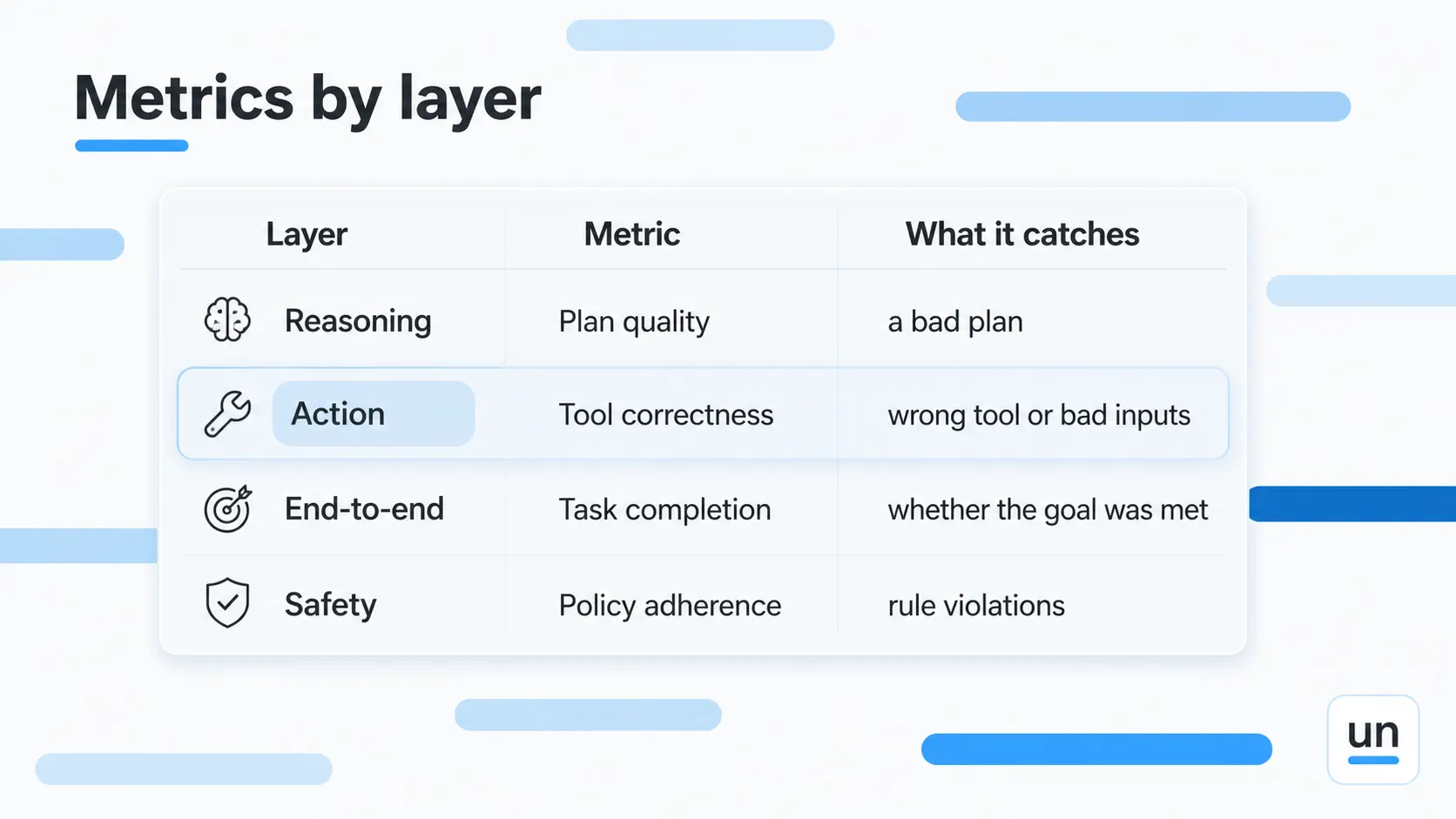
A single quality score tells you something failed. It does not tell you whether the problem was the plan, the tool call, or the output itself.
| Layer | Metric | What it catches |
|---|---|---|
| Reasoning | Plan quality, plan adherence | A bad plan, or a good plan the agent abandoned mid-run |
| Action | Tool correctness, argument correctness | The wrong tool, or the right tool with bad inputs |
| End-to-end | Task completion, step efficiency | Whether the goal was met, and how directly |
| Safety | Policy adherence, injection resistance | Rule violations and hijacked behavior |
Reasoning metrics catch a bad plan before it costs anything. Action metrics catch a plan that was fine until the arguments went wrong. End-to-end metrics catch the outcome a user actually experiences, including cost, since a correct answer that burns ten times the tokens it needed is still worth flagging. We have covered that cost side separately in token efficiency. Safety metrics catch the failures that matter no matter how the task technically scored.
5. Building an AI Agent Evaluation Framework
You do not need a research team to start. A working evaluation framework needs five pieces, built in this order.
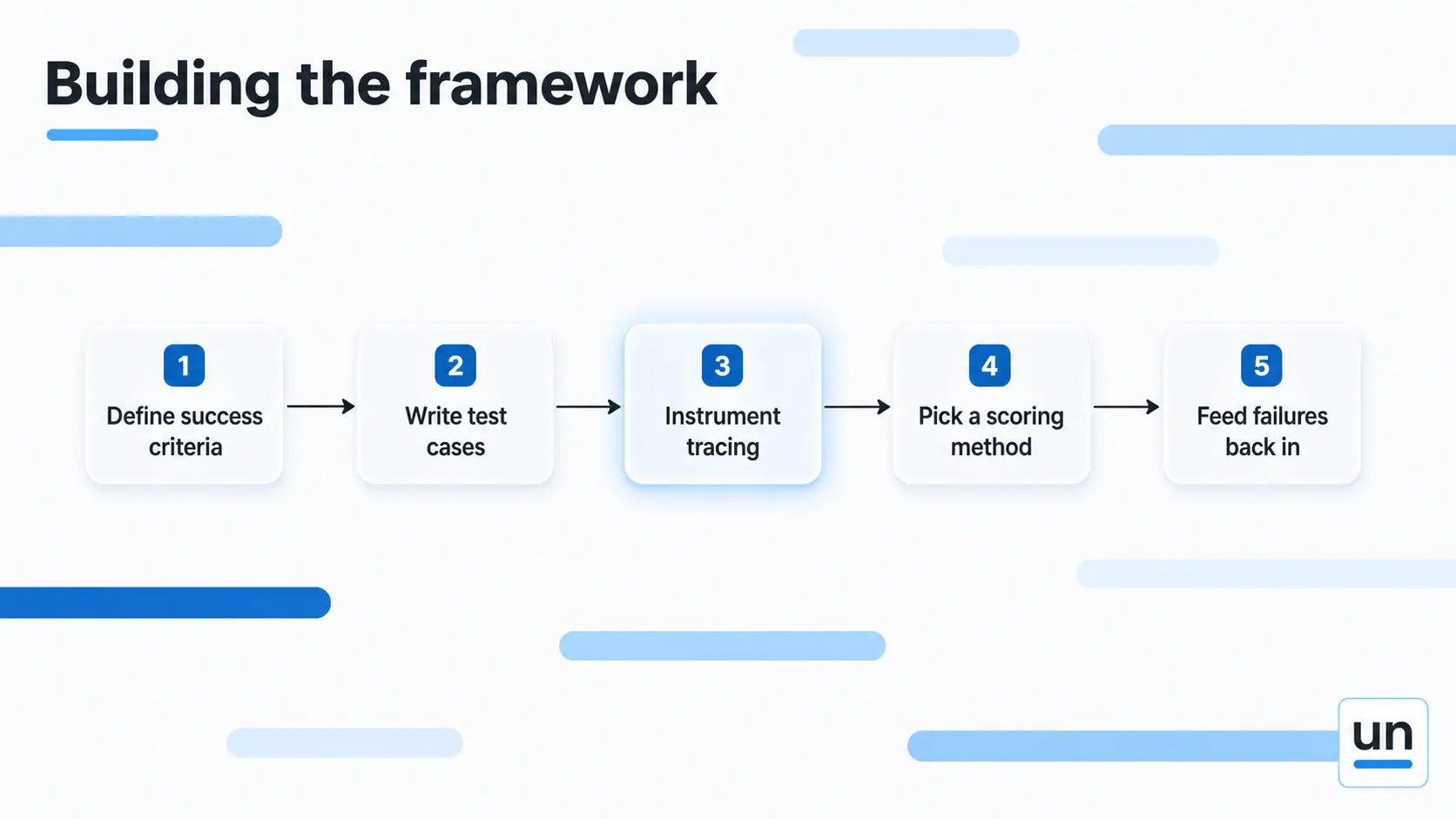
- Define success criteria for each task the agent performs. Use ground truth where you have it, a scoring rubric where you do not.
- Write test cases across four categories: happy path, edge cases, adversarial inputs, and requests the agent should refuse. The refuse category matters more as agents get more autonomy, which is also why more teams are building governed AI into how agents run in the first place.
- Instrument the agent with tracing, so evaluation can score each step instead of only the final output.
- Pick a scoring method. Deterministic checks work for verifiable steps, like whether the right tool got called. LLM-as-judge works for open-ended output, like whether a summary actually answered the question.
- Run the suite on every change, and feed production failures back in as new test cases.
That five-step arc is an agent evaluation tutorial a team can start running this week, not a framework that needs a platform team to operate.
The most common mistake is skipping straight to step four. Teams wire up an LLM-as-judge before they have real test cases or trace data to judge, and end up with scores that sound precise but measure nothing consistent.
No trace, no score. Most evaluation efforts stall right here, trying to grade a step nobody recorded.
Unmeshed captures full run history for every agent action automatically, so the data's already there when you need it.
See The Trace6. AI Agent Evaluation Tools Worth Knowing
A handful of names come up constantly once you start building this out. Each takes a different angle on scoring agent behavior, from CI-gated regression testing to notebook-first experimentation.
| Tool | Known for |
|---|---|
| Braintrust | CI-gated regression testing, versioned datasets |
| Confident AI | Automated scoring on every trace, quality alerting |
| LangSmith | Deepest fit for LangChain and LangGraph stacks |
| Arize Phoenix | Open source, notebook-first experimentation |
| Galileo | High-volume real-time evaluation at scale |
Most follow open-core pricing, a free or open-source tier, then usage-based. Entry paid plans run roughly $20 to $250 a month as of mid-2026. For the fuller breakdown of LLM observability tooling generally, not just the evaluation angle, we have covered that separately in observability tools.
None of these tools can evaluate a step your agent never recorded. Whichever one you pick, it is only as useful as the trace data it gets fed, which is where the tracing layer underneath it starts to matter as much as the scoring layer on top.
7. How Unmeshed Fits Into Your Agent Evals Process
Unmeshed does not score outputs or run evals. That is not what it is built for, and this section will not pretend otherwise.
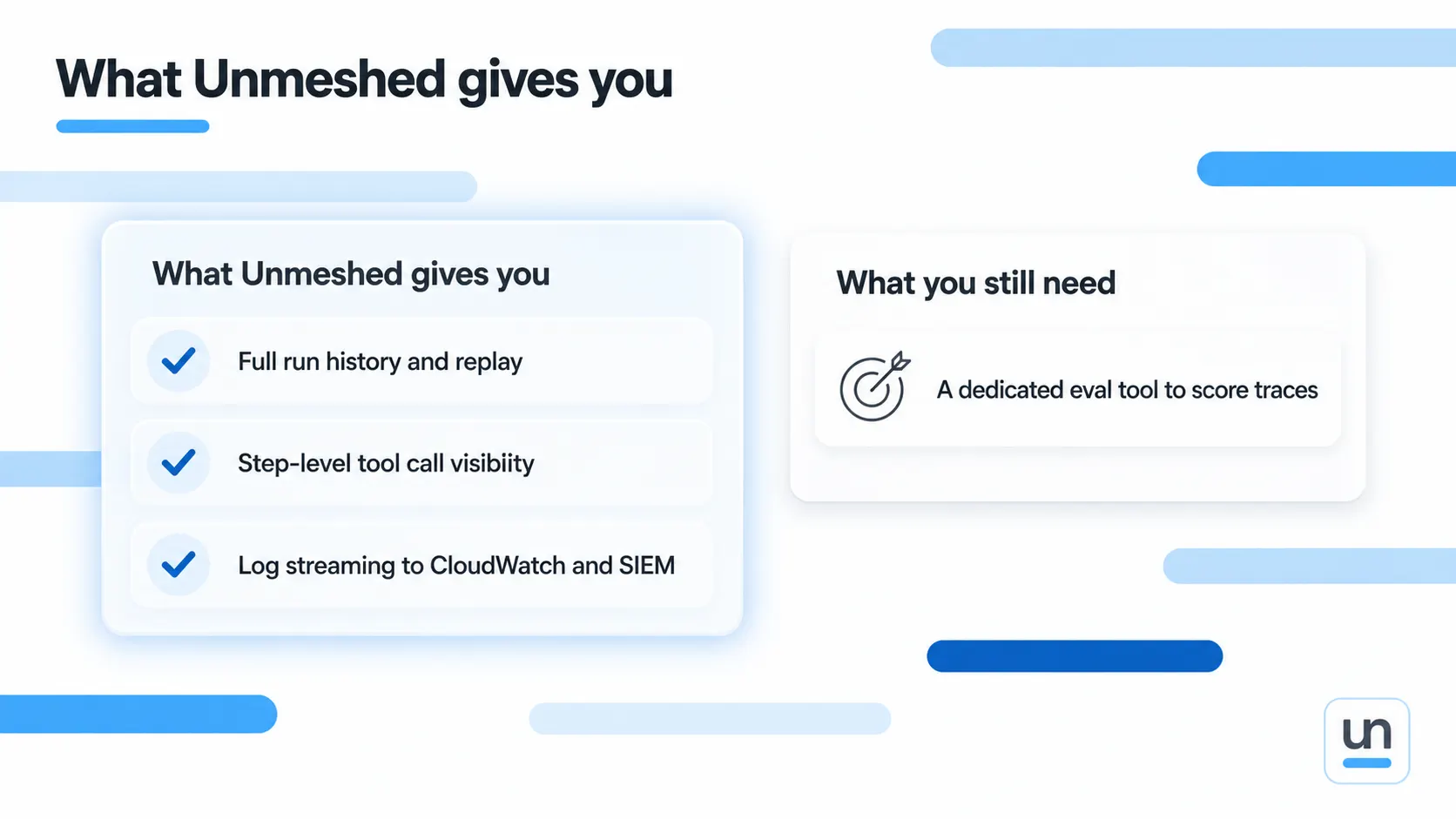
What it gives you is the full execution trace an evaluation process actually needs. Every step your agent takes, every tool call, every retry, every point where a human reviewed a decision, captured and replayable, on every plan including free.
What Unmeshed gives you
- Full run history and replay for every workflow, including AI agent steps
- Step-level visibility into tool calls, retries, and branching, not just the isolated prompt and response
- Log and event streaming to systems like CloudWatch and SIEM platforms, so trace data can feed wherever your evals actually run
What you still need
- A dedicated eval tool to score and grade those traces, like Braintrust or Confident AI
Most teams building agent evaluation from scratch spend weeks solving the tracing problem before they score a single output. If that data already exists as a byproduct of how your Agentic AI actually runs, you skip straight to the part that improves the agent.
That is the practical difference between bolting a tracer onto an agent after the fact and running the agent inside a platform where every step was already being recorded for other reasons: retries, approvals, audit logs, long before anyone asked how to evaluate it. It is the same guarantee behind durable execution, applied to the data your evals process needs instead of just the workflow's own reliability.
Your eval tool can only grade what it sees.
Unmeshed hands it the whole run, every tool call, every retry, nothing left out.
Final Thoughts
Your agent will keep sounding confident whether it's right or not. That part doesn't change on its own.
What changes is whether you have a real answer when someone asks if you can trust it. Evaluation gives you that answer. A demo that went well once doesn't.
Start small. Pick one task, write a handful of test cases, and instrument it with tracing. You don't need every metric in this guide on day one. You need enough to know when your agent is actually getting worse, not just different.
And instrumenting that tracing is the part most teams underbuild. If you want full run history and step-level trace data for every agent action, ready to feed straight into your evals, Try Unmeshed free, or talk to us about what that setup looks like for your stack.
Frequently Asked Questions
Sources
Building an evals process for your agents?
Start with trace data you can actually trust
Try Unmeshed free, or talk to us about streaming full run history into your evaluation stack.