TLDR
- A fraud detection system checks every payment as it happens and decides to allow it, challenge it, hold it for review, or block it.
- It works in steps. It validates the payment, gathers signals like device, identity, and recent behavior, runs rules, adds a risk score, and makes the decision. People review the unclear cases.
- Banks use both rules and machine learning. Rules are fast and easy to explain, and models catch patterns nobody wrote down.
- Speed matters because instant payments can't be pulled back. Running the signal checks at the same time keeps the decision under a second, and Nacha's new fraud monitoring rules are now in effect.
- Unmeshed runs these steps as one workflow with parallel checks, decision rules, human review, and a full history of every case. It doesn't supply fraud models or data.
You tap Pay on a late-night transfer to someone new, and before your thumb leaves the screen, a fraud detection system has already made up its mind about you.
It said yes, or it asked for a code, or it quietly held the payment. That decision took a fraction of a second and a lot of moving parts.
So we'll follow one payment through the whole thing, stage by stage, with a clock running. The example and the timings are ours, built to show structure, not measured on any bank. The payment rules come from Nacha and the Federal Reserve, and none of this is legal advice. If you want the cost angle, our earlier post on fraud workflows covers it.
Think of a bouncer at a club door. He checks your ID, sees who you came with, glances at the guest list, goes with his gut, and then waves you in, asks you a question, or calls the manager. Same job, done faster. We build workflow software, so we'll say where Unmeshed fits near the end. Okay, let's get into it.
1. What Is a Fraud Detection System?
A fraud detection system is software that checks transactions or account activity as they happen and decides whether each one looks legitimate. It gathers signals, applies rules, often scores the risk with a model, and then allows, challenges, holds for review, or blocks the activity.
We mean payments and account activity at banks and fintechs here. The longer build pattern lives on our fraud decisioning page, and this post is the plain English tour.
What a Fraud Detection System Decides
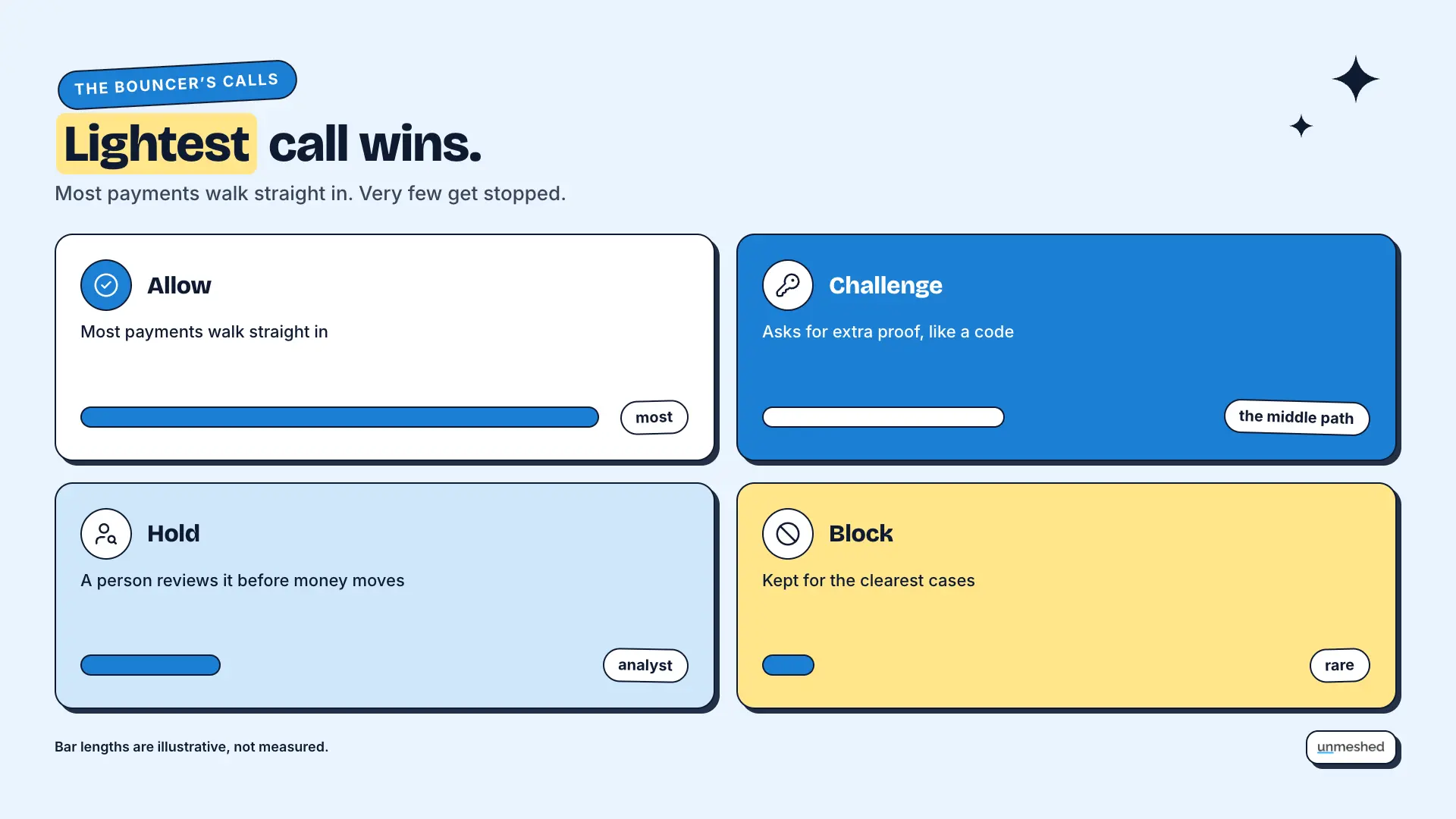
Every check ends in one of four outcomes. Allow the transaction, challenge the customer with extra proof, hold it for a person to review, or block it. A good system picks the lightest outcome that still protects the customer and the bank.
Picture the bouncer again. Most people walk straight in. A few get asked a question. A very small number get a call to the manager. Almost nobody gets turned away, and the whole point is that you don't treat all four the same.
Fraud Detection in Banking Today
Fraud detection in banking covers card payments, ACH, wires, and instant payments, plus account opening and login. The FBI's 2025 report counted nearly $21 billion in reported losses, which shows the scale. Banks run several checks side by side because fraud arrives through many doors.
That FBI number covers complaints sent to the Internet Crime Complaint Center, so it is a floor and not a full count of fraud. Onboarding has its own checks too, and we cover those in our KYC process post.
Why Timing Matters So Much
Timing matters because some payments cannot be recalled. The Federal Reserve notes that instant payments complete in seconds and are final, so the payee can use the money right away. The decision has to happen before the money moves, not after.
That one fact changes how people build these things. With a card payment, you can often dispute it later. With an instant payment, you get one shot, so the check has to be fast, and it has to be good.
2. How Does a Fraud Detection System Work?
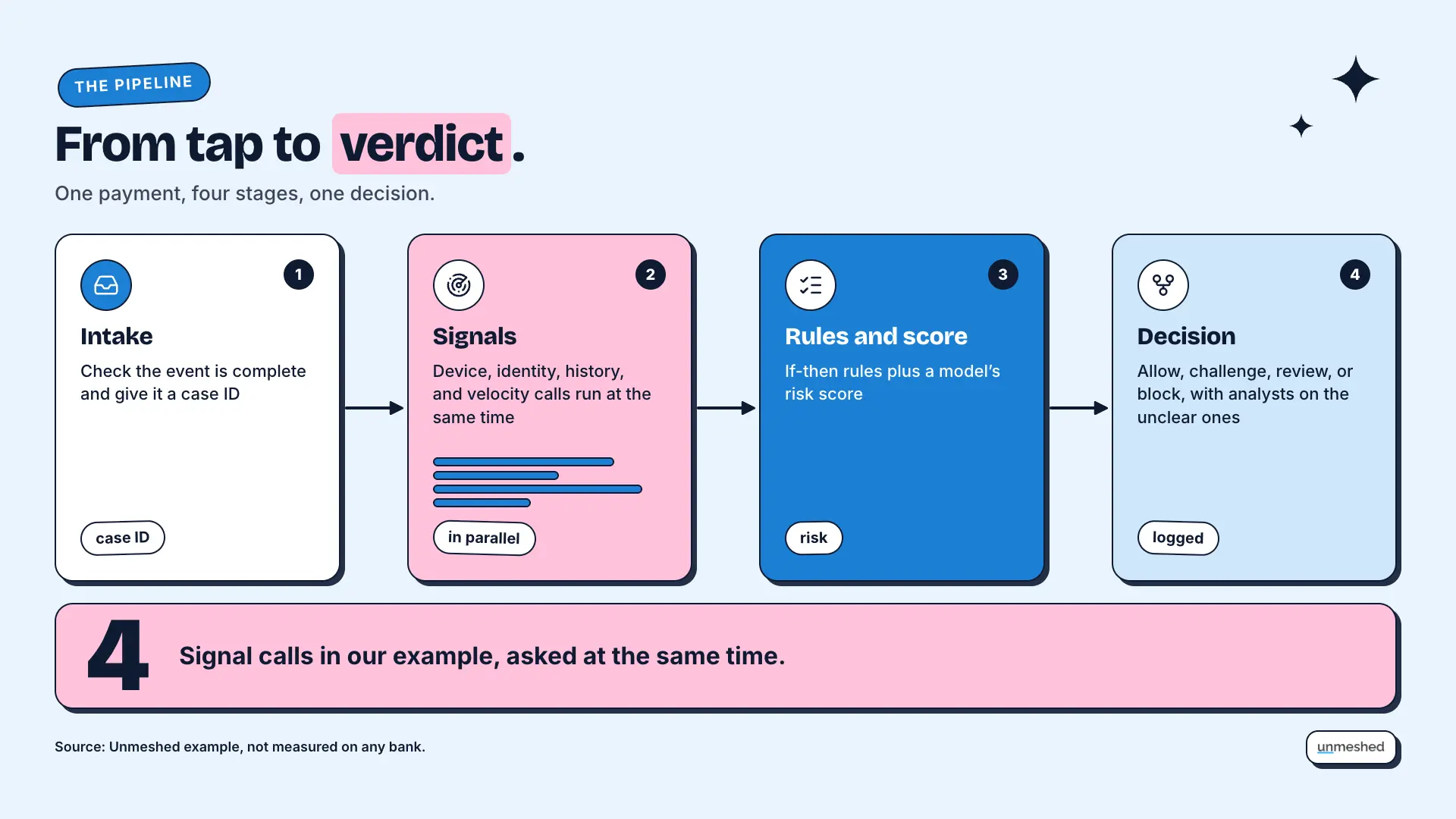
A fraud detection system works as a pipeline. An event arrives and is validated, signals are gathered, rules and a model assess the risk, and a decision comes back as allow, challenge, review, or block. Anything uncertain goes to a person, and outcomes feed back into the rules and models.
Here's our example. A customer sends $2,400 to a payee they have never paid before, at 11:40 at night, from a phone they haven't used in a month. Most of the time that's fine. Sometimes it isn't. Let's walk it through.
1. Intake and Validation
The system first checks that the event is complete and well-formed. It needs the account, the amount, the payee, and the context. Bad or missing data is stopped early so it does not waste expensive checks, and every event gets a case ID so the decision can be traced later.
This is the bouncer looking at your ID. Is it a valid card, is the photo there, is it expired? It takes almost no time, and it saves everyone from doing slow work on garbage. The case ID is the wristband. Everything that happens next gets stamped with it.
2. Signal Enrichment
Next, the system gathers signals about the event. Typical ones are device details, identity checks, the account's past behavior, and velocity checks that count how often something has happened recently. These calls are independent, so a well-built system runs them at the same time.
For our payment, the system asks four questions at once. Is this device known? Does the identity check out? What does this customer usually do? And how many payments has this account sent in the last hour? Nobody should wait for the first answer before asking the second, because they don't depend on each other.
3. Rules
Rules are plain if-then checks written by people. If the payee is new and the amount is far above this customer's norm, add risk. If the account is on a watch list, stop. Rules are fast and easy to explain, which matters when a regulator or a customer asks why.
This is the guest list. If your name is on the banned list, you're done. If you're a regular, you sail through. Our payment trips two rules: a new payee and an unusual amount, so it picks up some risk but isn't blocked.
4. The Risk Score
A model turns many signals into one risk score. A higher score means the event looks more like past fraud. Scores let the system handle gray areas, because a transaction can be mildly odd and still fine. The decision step then applies thresholds to that score.
This is the bouncer's gut feeling, except it's trained on millions of past nights. It notices combinations nobody wrote a rule for. Each system defines its own scale, so a score of 70 means nothing until you know how that system draws its lines.
5. The Decision
The decision engine combines the rules and the score, then routes the event to allow, challenge, review, or block. Keeping this logic in explicit rules, not buried in service code, makes it easy to change thresholds when new fraud patterns appear, without redeploying everything.
For our payment, the score is medium. The system doesn't block it and doesn't wave it through. It asks the customer to confirm with a code. That's the middle path, and it's why good systems have more than two outcomes. You can read how this works in our decision engine notes.
6. Review and Feedback
Cases the system cannot settle go to an analyst for human review, with the full context in one place. The analyst's call is saved, and it flows back to improve the rules and models. Without this loop, a system slowly gets worse as fraud changes.
Say our customer fails the code check. The case lands in a queue, an analyst sees the signals, the rule hits, and the score, and makes the call. Good case management means the analyst never has to hunt across five tools. Our human review feature covers the pause and resume part.
3. Rule-Based Fraud Detection or Machine Learning?
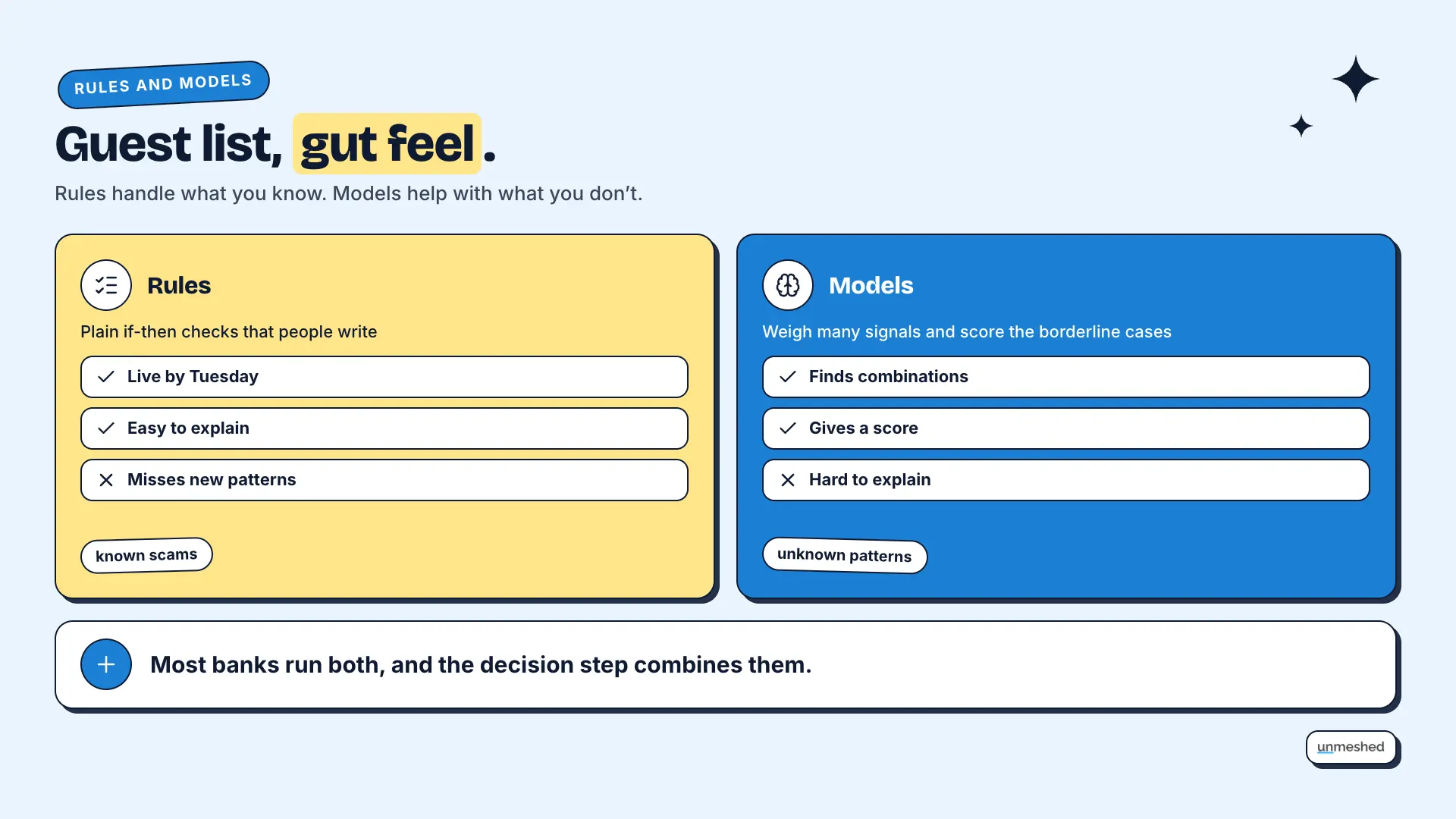
Most banks use both. Rule-based fraud detection is fast, transparent, and easy to change, while machine learning finds subtle patterns people did not write down. Rules catch what you already know about, and models help with what you do not. Together they cover more ground.
People argue about which one is better. The better question is what each one is good at, so you can use it where it fits.
What Rules Do Well
Rules do well where the logic is clear and the reason matters. They are quick to write, quick to run, and simple to explain to a customer or auditor. Blocking a known bad account or flagging a payment that breaks a limit are good examples.
When a fraud team spots a new scam on Monday, a rule can be live by Tuesday. A model usually takes longer to retrain. That speed is why rules never go away, even in systems with fancy models.
What Models Add
A model can weigh many signals at once and notice combinations that no one thought to write as a rule. It gives a score instead of a yes or no, which helps with borderline cases. Its weakness is explanation, so teams often pair it with rules.
Ask a model why it scored a payment high, and you may get a shrug in the form of feature weights. That's fine for a score. It's harder for a customer who wants to know why their payment got held.
Why Banks Run Both
Running both lets each cover the other's gaps. Rules give quick, explainable controls and a fast way to respond to a new scam. Models give coverage for patterns that change. The decision step combines them, so a person can still see why a case was held.
It's the bouncer again. The guest list handles the people you know about. His gut handles the stranger who looks off. You wouldn't fire either one.
4. What Makes Real-Time Fraud Detection Hard?
Real-time fraud detection is hard because the decision must arrive within the payment itself, while the system waits on several outside signals. Instant payments cannot be pulled back, so there is little room to fix a wrong answer later. Speed, accuracy, and reliability all have to hold at once.
Three things make it tricky. The money moves fast, the signals come from outside services you don't control, and the rules around monitoring are tightening. We'll take them in order.
Instant Payments Cannot Be Pulled Back
The Federal Reserve says the speed, finality, and always-on nature of instant payments create particular fraud challenges. If the bad actor is the payee, stopping a payment after the fact is hard. The Fed points to real-time detection, a view across payment types, watch lists, and dual approval as a pause.
That's from the Fed's own fraud guidance for FedNow. It also puts the first line of defense on the financial institution, which is why the pipeline above has to sit in front of the payment and not behind it.
A Latency Budget
A latency budget splits the time you have across the steps. In our own example, four signal calls take 60 to 150 milliseconds each. Run in parallel, the whole decision takes about 280 milliseconds, and run one after another, it takes about 550. Both fit under a second, but only one leaves room for trouble.
These timings are our assumptions, not measurements from any bank or product. We picked round numbers so the structure is easy to see.
| Stage | Run in Parallel | Run One After Another |
|---|---|---|
| Intake and validation | 15 ms | 15 ms |
| Signal calls (device 120, identity 150, history 90, velocity 60) | 150 ms, the slowest one | 420 ms, all four added up |
| Rules | 25 ms | 25 ms |
| Model score | 60 ms | 60 ms |
| Decision and logging | 30 ms | 30 ms |
| Total | 280 ms | 550 ms |
The sequential version still lands under a second on a good day. The trouble comes when one signal call slows down or needs a retry, because every delay stacks. The parallel version only waits for the slowest call, which is why the fan-out-then-gather pattern is so common. Treat 280 and 550 as an illustration of the shape, and swap in your own numbers.
Transaction Monitoring and the New Nacha Rules
Nacha's new rules require risk-based processes to identify ACH entries suspected of fraud. Phase 1 took effect on March 20, 2026. Phase 2 took effect on June 19, 2026, with the practical date June 22, and removed the volume thresholds. Nacha does not prescribe a method.
The rules ask each party to run processes "reasonably intended" to catch fraud in their role, and to review them at least annually. Nacha says every entry doesn't need individual screening, and monitoring isn't required before processing. It also adds a defined term, False Pretenses, which covers things like business email compromise and vendor or payroll impersonation. Details are on Nacha's Phase 2 page.
Nacha is clear that this is not a one-and-done job, and its notice that the rules are now in effect says as much. That's where transaction monitoring comes in, since you can't spot odd activity without a baseline of normal. For receiving banks, Nacha's examples include a burst of similar credits and new, dormant, or mule accounts. This is general information and not legal advice, so check with your compliance team about what applies to you.
5. What Does a Fraud Detection Architecture Look Like?
A fraud detection architecture has four parts. An intake layer receives and validates events, a signal layer gathers data in parallel, a decision layer applies rules and model scores, and an audit layer records every step. A review queue and feedback loop sit alongside.
We'll keep this vendor-neutral. The names change from shop to shop, but the shape stays pretty similar.
Intake and Signals
The intake layer validates each event and assigns a case ID. The signal layer then fans out to the sources that matter, such as device, identity, and history, and gathers the results into one input for the rules. Treat each source as something that can fail or be slow.
That last part matters more than people expect. Every signal source is somebody else's service, and somebody else's service has bad days. Design for it up front.
The Decision Layer
The decision layer holds the rules, the model score, and the routing logic. Keeping them separate from the signal calls means you can change a threshold without touching integrations. It also gives one place to explain a decision, which compliance teams value.
If your thresholds live inside five different services, changing one means five releases. If they live in one decision table, changing one means editing one row.
Audit and Feedback
The audit layer stores each decision with the signals and the rule path that produced it. Analyst outcomes then go back into rule tuning and model training. If you cannot replay a decision later, you cannot explain it, and you cannot learn from it.
Ask yourself a simple test. Six months from now, could you show exactly why payment 48213 was held? If the answer is a long search through logs, the audit layer needs work.
6. Where Do Fraud Detection Systems Go Wrong?
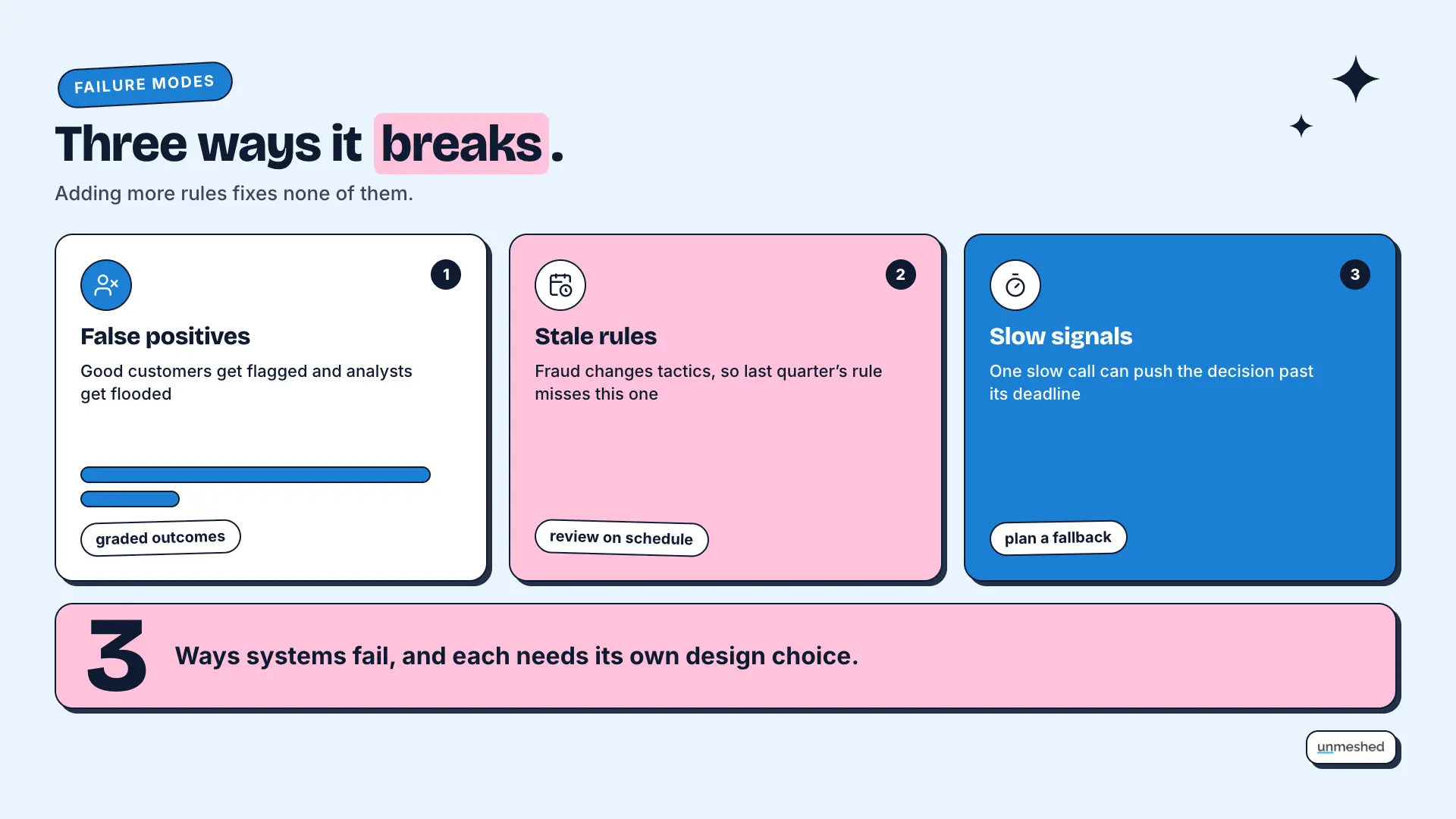
A fraud detection system usually fails in three ways. It flags too many good customers, its rules go stale as fraud changes, or a slow signal call drags the decision past its deadline. Adding more rules doesn't fix any of these, so each needs its own design choice.
We've seen the pattern described across the industry many times, and it's worth planning for all three before you go live.
Too Many False Positives
A false positive is a good customer who gets flagged. Too many of them annoy customers and flood analysts. The fix is graded outcomes, so low-risk cases pass quietly, medium-risk cases get a challenge, and only the hard cases reach a person.
This is why the four outcomes matter. A system with only allow and block has to treat every maybe as a yes or a no. Adding challenge and review gives the maybes somewhere to go.
Rules That Go Stale
Fraudsters change tactics, so a rule that worked last quarter can miss this one. Review rules on a schedule, as Nacha expects for monitoring processes, and retire ones that no longer help. Keep rules in a place where the fraud team can edit them without a release.
Stale rules also pile up. Nobody wants to delete one in case it matters, so the list grows until nobody understands it. A yearly cleanup, with a note on why each rule exists, saves a lot of pain.
Slow or Failing Signal Calls
A slow identity or device service can push the whole decision past its time limit. Decide ahead of time what happens, such as use the signals you have, route to review, or retry once. A failed call should never silently approve a risky payment.
Retries and saved state help here, and that's the idea behind durable execution. The step that failed gets retried while the steps that worked stay done.
7. How Does Unmeshed Fit With a Fraud Detection System?
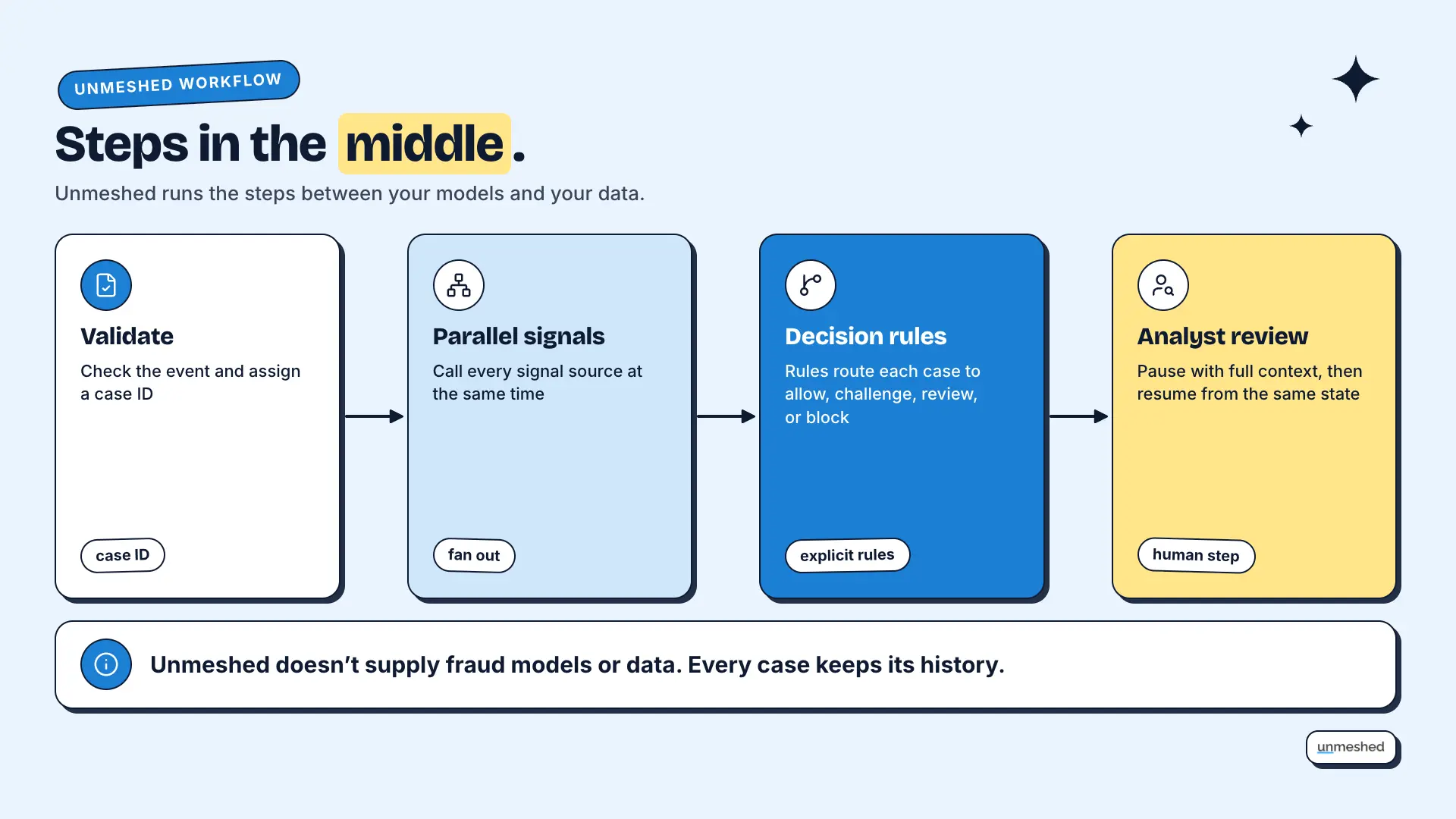
Unmeshed is the orchestration around your fraud detection system. It runs the steps as one workflow, with intake validation, parallel signal calls, decision rules, human review, and a full history of each case. It does not supply fraud models or data, and it works with the ones you already use.
To be clear about scope, we are not a fraud model, a data provider, or a compliance product. We run the steps between them. We also don't make claims here about accuracy or speed, because the right numbers are the ones you measure on your own traffic.
Fan Out, Then Decide
An Unmeshed workflow validates the event, then calls signal sources at the same time and gathers the results into one risk input. A decision step evaluates the rules and routes the case to allow, challenge, manual review, or block. Policy changes stay in the rules, not in service code.
That's the pattern in the pipeline above, built as one flow you can see. The full description is on our fraud decisioning page, and you can build it with workflows you already use for other jobs.
Human Review Without Custom Scheduling
High-risk cases can pause at an analyst checkpoint with the full context, then resume from the same state when the reviewer acts. If more evidence is needed, the case loops back into evaluation with the new data instead of starting over. No custom timers or queues to build.
In our example, the customer who failed the code check would sit at a review step. When the analyst decides, the same case carries on from where it paused.
An Audit Trail for Every Case
Every case ends in a clear state and keeps its execution history and rule path together. Operations, compliance, and model teams can then work from the same record. That makes decisions easier to explain and rule changes easier to test against past cases.
It's the answer to the payment 48213 question from earlier. You open the case and see what ran, what each signal said, and which rule sent it where.
Fan Out The Checks. Keep The Receipts.
Run your signal calls in parallel, route each case by explicit rules, and keep a full history of every decision.
Route My Risk ChecksConclusion
Here's our take. People talk about fraud detection like it's a hardware race, and it mostly isn't. Speed comes from how you arrange the steps. Ask for the four signals together, keep the rules in one place, and give the unclear cases somewhere to go. That does more than a faster server.
Go back to the bouncer. The good ones don't check everything about everyone. They check the right few things fast, trust the guest list for the known cases, and call the manager for the odd ones. A fraud detection system is that, with a clock on it and a regulator reading over its shoulder.
We built Unmeshed to run the steps in the middle: the fan out, the rules, the review, and the history. If you already have models and data sources, we wire them into one flow. A good next step costs nothing. Draw one transaction path on a page this week and mark which calls could run at the same time, then bring it to us if you want a second pair of eyes.
Frequently Asked Questions
Sources
- 1.Risk Management Topics, Fraud Monitoring Phase 2, Nacha
- 2.New Nacha Risk Management Rules Now in Effect, Nacha
- 3.Managing Fraud Risk, FedNow Explorer, Federal Reserve Financial Services
- 4.2025 Internet Crime Report, FBI Internet Crime Complaint Center
- 5.Cryptocurrency and AI Scams Bilk Americans of Billions, FBI
- 6.Fraud Detection and Decisioning, Unmeshed
Risk checks scattered across services?
Show us one transaction path. We'll map it end to end.
Share the checks a payment passes through today and where cases get stuck. We'll sketch it as one workflow with parallel signals, clear rules, and human review.