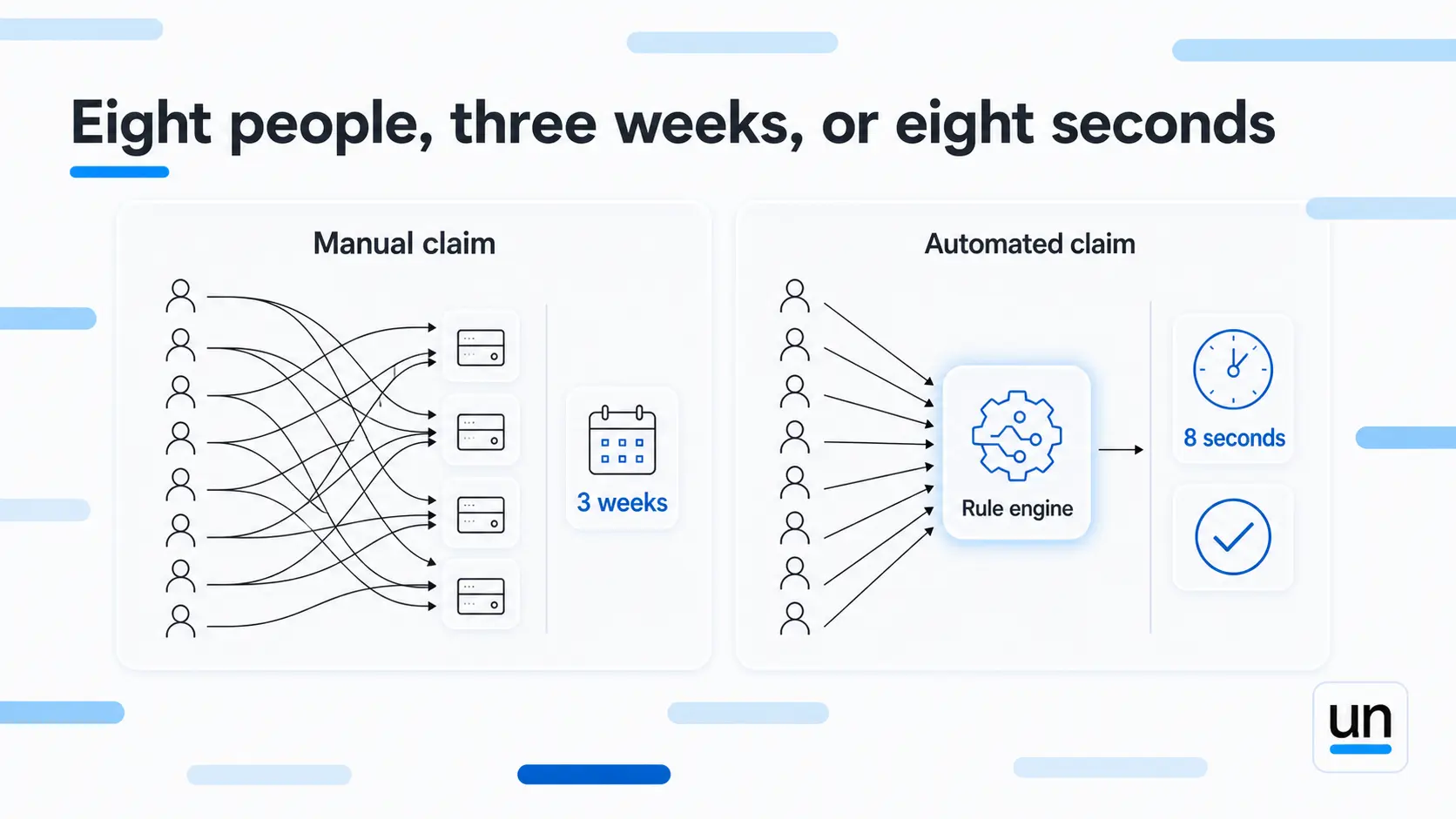
Honestly, a claim doesn't need eight people, four systems, and three weeks to reach a decision; a rule engine could make it in eight seconds. That gap between what claims processing costs today and what it could cost is exactly why insurance claims automation has moved from an IT side project to a board-level priority.
AI-assisted claims handling can cut processing costs by up to 70% and shrink resolution time from days to minutes on the claims that don't need a human judgment call. This piece breaks down what claims automation actually does, where insurers are losing the most time and money right now, and how to build it so it holds up to a regulator's questions, not just a demo.
1. What Insurance Claims Automation Actually Means?
Claims processing automation covers everything that happens between a policyholder reporting a loss and the money landing in their account, including:
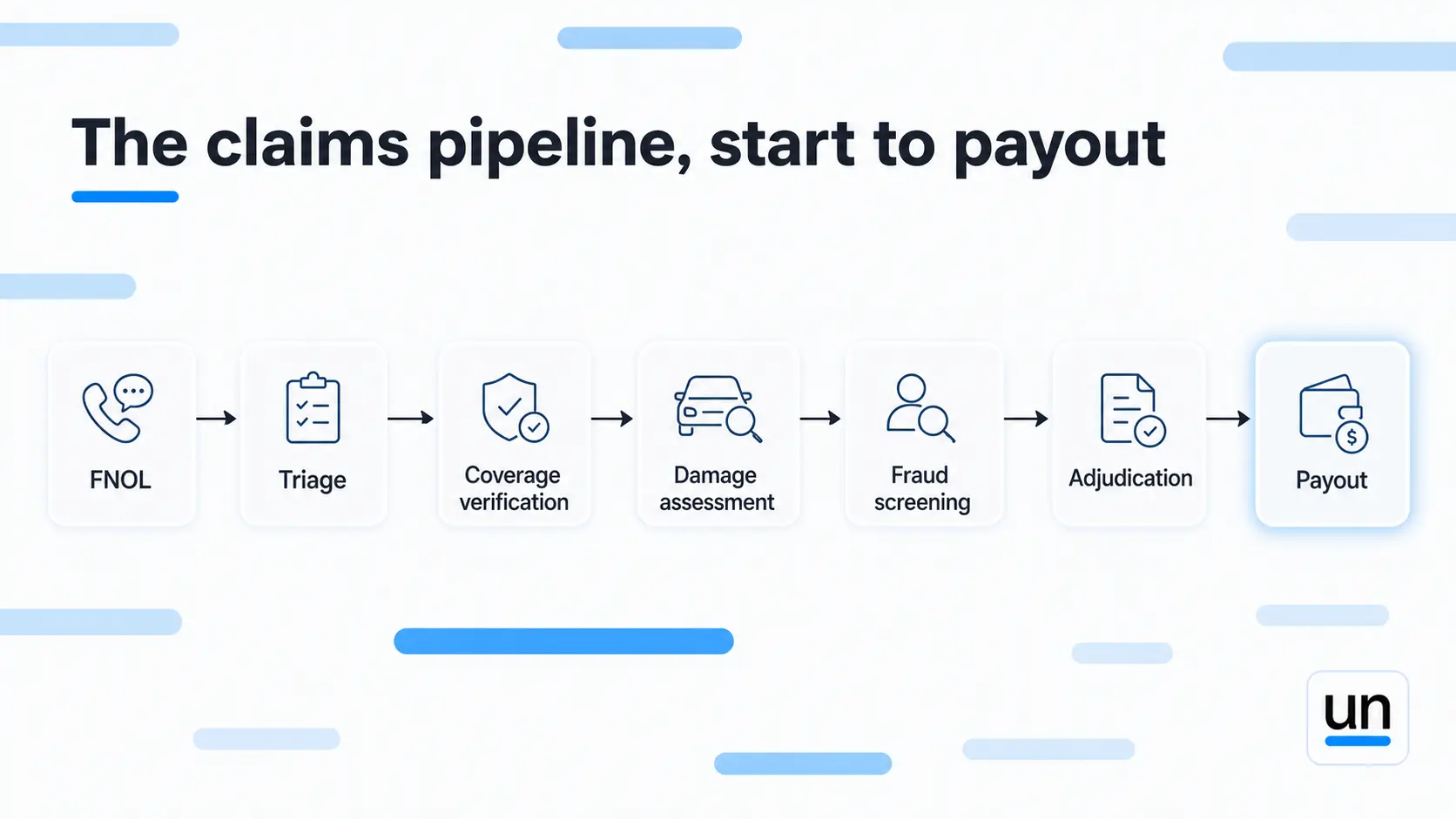
- First Notice of Loss (FNOL)
- Triage
- Coverage verification
- Damage or document assessment
- Fraud screening
- Adjudication
- Payout
Historically, a person touched almost every one of these steps, even when the work was simply looking up information in a policy document.
Real insurance claims automation does not mean handing the entire claim to an AI model. It means identifying which steps genuinely require judgment, language understanding, or interpretation of an ambiguous situation, and which ones simply need a business rule, a database check, or a reliable API call. That distinction is what separates automation that regulators can approve from automation that nobody can fully explain.
This is also where FNOL automation has the biggest impact. The moment a claim is reported is when the clock starts, yet this stage is still handled manually at many insurers. A claimant calls or emails, an agent enters the details into the claims system, and only then does the file move to triage.
2. Where Claims Teams Actually Lose Time and Money Today?
The manual version of claims handling loses time in predictable, well-documented places:
- Document review and data entry alone can eat 15 to 20 hours a week per team
- Manual document processing that could run in seconds can stretch out for days once it's queued behind everything else an adjuster is juggling
- One mid-sized carrier cut document processing time by roughly half and invoice-matching errors by about 80%, just by removing the manual re-keying step, not by replacing adjusters
- Automated triage cuts manual intervention by around 45%, by routing the straightforward 80% of claims through automatically and reserving human attention for cases that actually need it
- Insurers that have pushed FNOL fully digital report average claims cycle times falling by roughly 31%
- Leading carriers now run straight-through processing for insurance claims, meaning zero human touch from intake to payout, on 70 to 90% of low-complexity claims
Worth a read: Insurance Workflow Automation: 7 Processes Insurers Should Automate in 2026
Ping An, one of the more aggressive adopters, now settles roughly 60% of accident and health claims automatically, with some resolved in as little as 51 seconds. That's a production figure from one of the largest insurers in the world, and it's the kind of result that makes claims automation software a genuine board-level conversation.
3. Why Most Insurance Claims Automation Attempts Stall
Every insurer building insurance claims automation runs into the same four walls, and they're worth naming plainly because they're the reason so many pilots never make it to production.
Token costs creep up faster than the ROI case
Calling a premium model on every step of every claim is expensive, and that spend scales with claim volume, not with the value the model is actually adding. Most teams don't know which of their claims steps genuinely need a model call and which ones are just burning budget on a task a lookup table could handle.
Regulators need an explanation, not a vibe
NAIC, NYDFS, and similar bodies expect a full audit trail for every claims decision. When a language model denies or discounts a claim, "the model decided" is not an answer that survives a regulatory review. Pricing and payout logic that runs as code is reproducible and defensible. Pricing that runs as a model's best guess usually isn't.
It's all-or-nothing, and neither extreme works
Most platforms offer fully manual or fully automated, with nothing in between. Routing complex or high-value claims to a senior adjuster while letting clean, low-risk claims move through automatically sounds simple and is genuinely hard to build well, and even harder to maintain as policies and edge cases change.
The engineers to maintain it aren't sitting around idle
Sustaining an AI-driven claims operation takes real in-house engineering capacity, and most claims teams don't have it to spare. That's part of why the governed AI approach, separating what actually needs a model from what should run as a maintainable rule, matters as much for claims as it does for any other production AI workflow.
4. Get the Full Data: Free Insurance AI Brief
Want the underlying numbers behind this piece in one place? We put together a short brief covering where AI actually earns its place in insurance workflows, what stays deterministic, and the cost and cycle-time impact when it's done right.
Get the Insurance AI Brief
Where AI actually earns its place in insurance workflows, what stays deterministic, and the cost and cycle-time impact when it's done right.
Download the brief5. The Right Model: AI Where It Earns Its Place, Rules for Everything Else
The workable version of AI in insurance claims processing treats every step as a separate decision: does this genuinely require judgment, or does it just need a rule executed consistently?
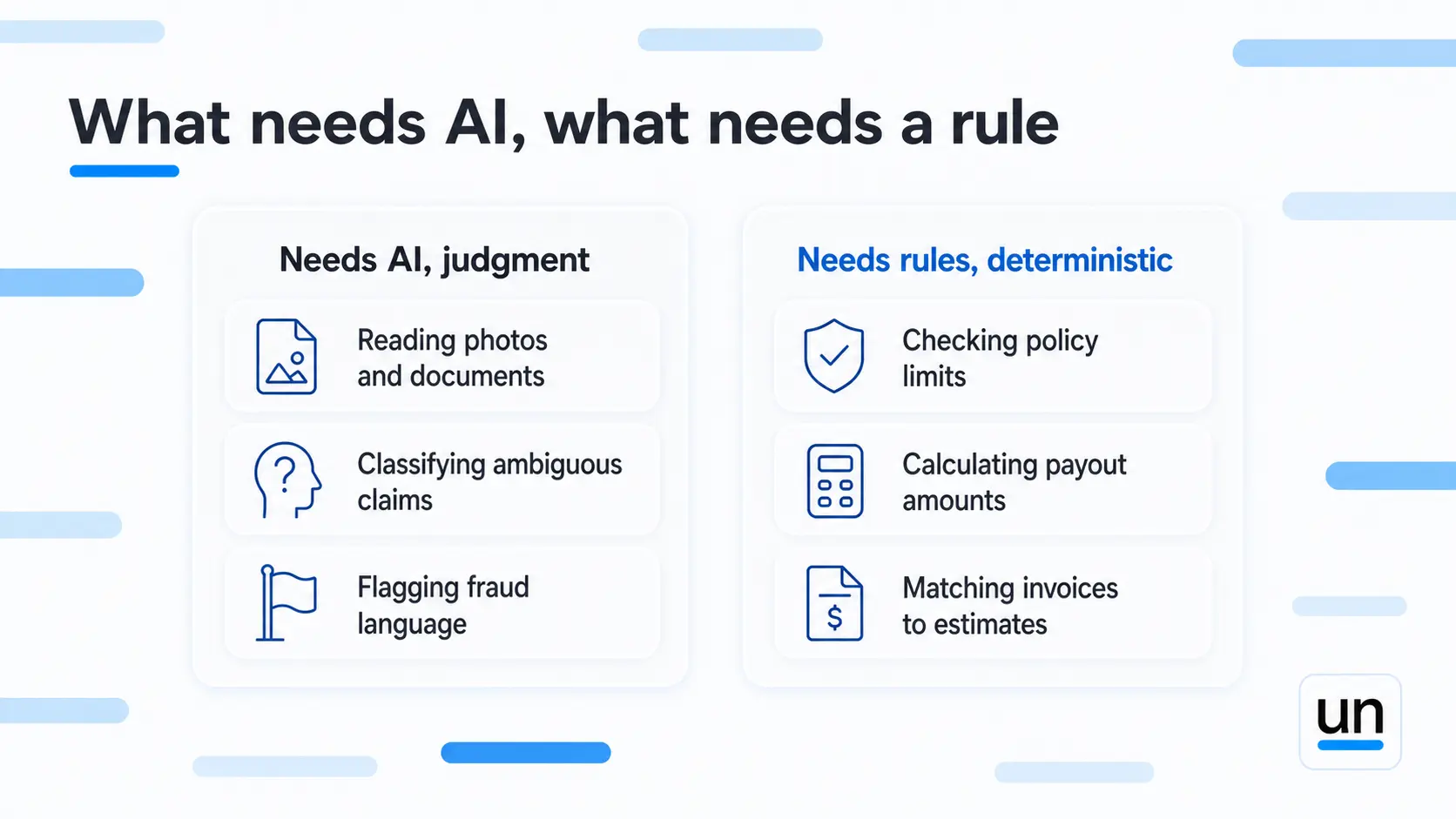
Most claims steps, once you ask that honestly, land on the rule side. This is what separates real insurance claims automation from a chatbot bolted onto a claims form.
| Steps that need AI (judgment) | Steps that need deterministic logic (rules) |
|---|---|
| Reading photos and documents to extract loss details | Checking policy limits and coverage against the claim |
| Classifying an ambiguous or unstructured loss description | Calculating deductibles and payout amounts |
| Summarizing adjuster notes or claimant correspondence | Matching invoices to approved repair estimates |
| Flagging claims with fraud-relevant language or inconsistencies | Approving claims that fall under a set threshold |
| Drafting a claimant-facing update in plain language | Routing exceptions to the right adjuster tier |
This is the same principle behind bringing AI workflows into production without burning tokens: once a decision is repeatable, encode it as a rule and stop paying a model to make it fresh every time. The model still matters. It just doesn't need to carry the whole claim.
6. What This Looks Like Inside a Claims Workflow?
A well-built insurance claims automation setup generally moves through the same shape, regardless of line of business:
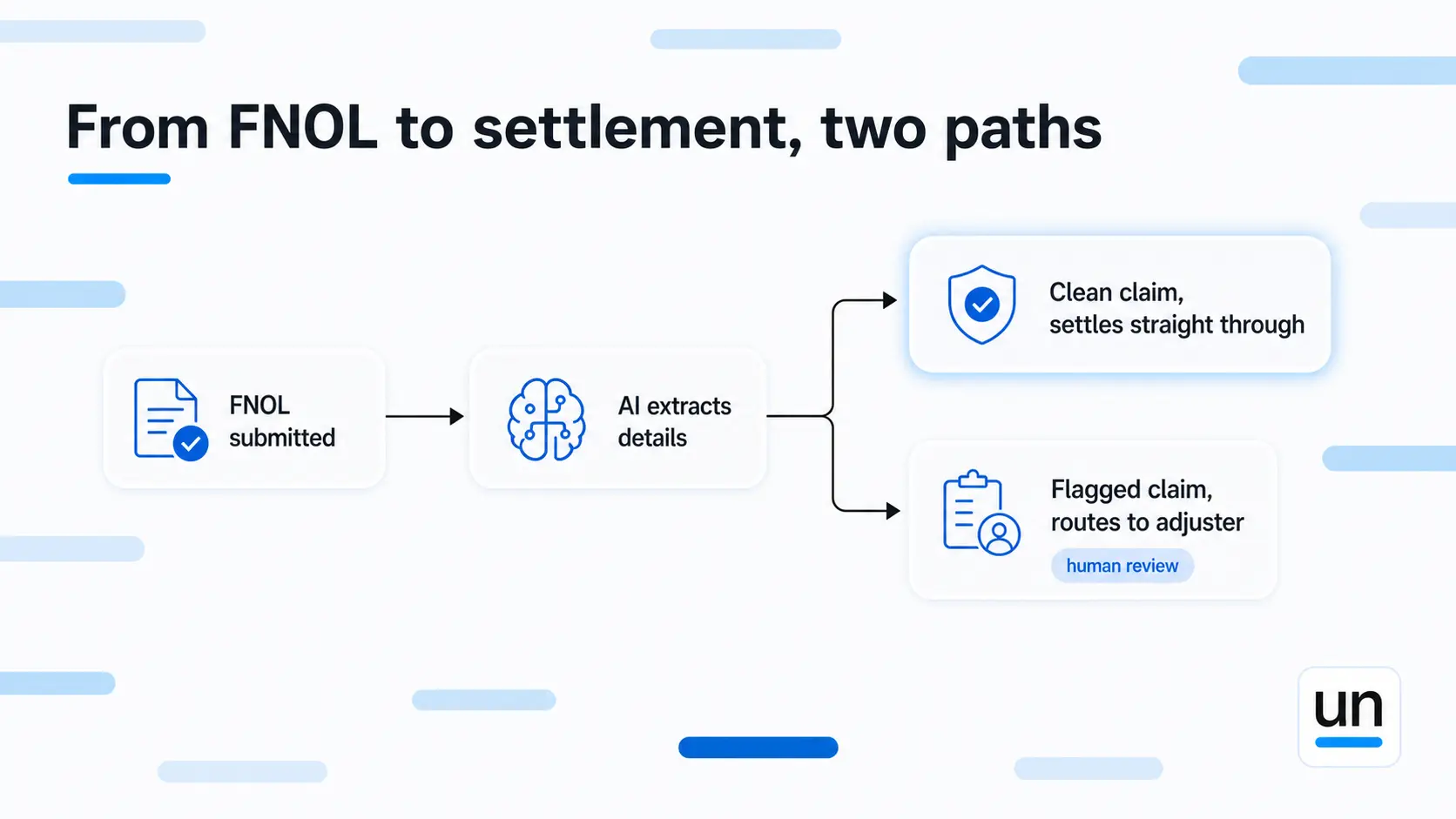
- FNOL submitted through a portal, app, or call transcript
- AI extracts structured fields from documents, photos, and free-text descriptions
- Deterministic rules verify coverage, policy limits, and deductible against the policy record
- Clean, low-value claims settle straight-through with no human step
- Flagged or high-value claims get an AI-drafted summary routed to the right adjuster tier
- Adjuster reviews and approves; the system logs every step, every input, and every decision
See this exact workflow, ready to run
Get the FNOL-to-settlement template, prebuilt with AI extraction, rule-based coverage checks, and adjuster review steps.
7. How Does Unmeshed Automate Insurance Claims?
This is exactly the kind of workflow Unmeshed is built for: AI, deterministic rules, APIs, and human approval, all in one place, instead of scattered across a model prompt, a spreadsheet, and someone's inbox.
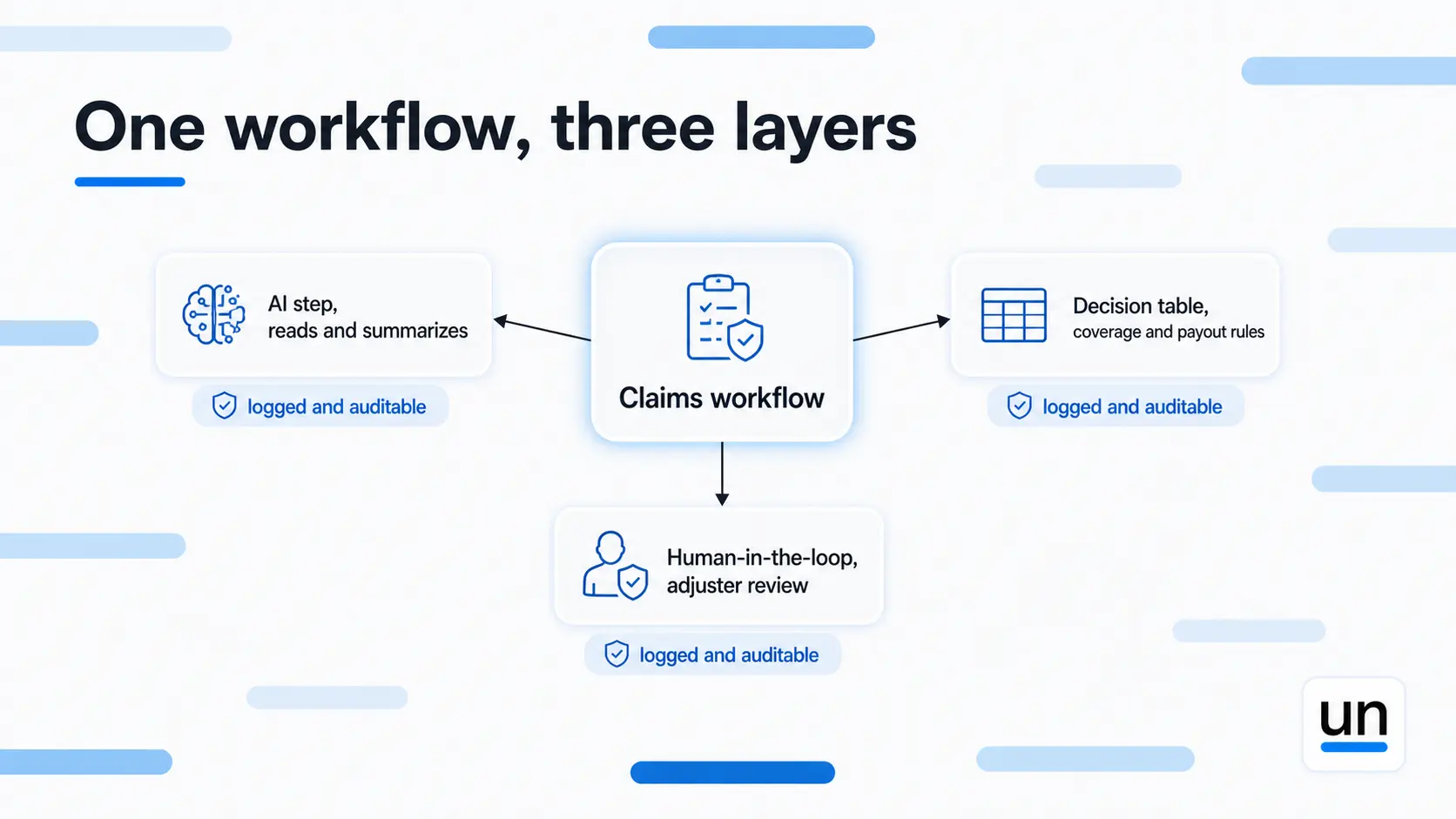
Orchestrate AI and rules in one claims workflow
In Unmeshed, an AI step for reading a photo or summarizing an adjuster's notes sits right next to a coverage check, a payout calculation, and an API call to the policy system. Nothing has to live in a separate script or a different tool just because it isn't a model call.
Turn repeat claims decisions into rules
When the same coverage check or payout calculation keeps showing up, it belongs in a decision table, not a fresh model call every time. Unmeshed's decision tables let claims and ops teams encode that logic once, run it consistently at scale, and update it without touching code.
Keep adjusters in the loop where it matters
Standard, low-value claims can move through automatically. Anything above a threshold, or anything the model flags as ambiguous, routes to a human adjuster with an AI-drafted summary instead of a blank file. Unmeshed's human-in-the-loop steps make that routing a normal part of the workflow, not a manual workaround.
Give regulators an audit trail, not a black box
Every step Unmeshed runs, AI or otherwise, is logged: what ran, what data it used, and what it decided. For claims teams answering to NAIC or NYDFS, that log is the difference between explaining a decision and guessing at one.
That logging sits on top of Unmeshed's own enterprise security, not a bolt-on audit tool.
See it on your own claims workflow. Try Unmeshed free, or talk to us about mapping FNOL through settlement.
8. The Same Model, Already Proven in Insurance
Unmeshed has applied this exact model: AI on the steps that need judgment, deterministic code on everything repeatable, inside insurance underwriting, and the numbers are worth putting in front of anyone deciding whether to invest in claims automation software next.
Across a live underwriting deployment:
- Only 9 of 45 underwriting capabilities actually needed a model; the other 36 ran as deterministic code, rules, and API calls, fully reproducible at zero marginal AI cost
- AI cost per submission dropped from $0.41 to $0.08, roughly an 80% reduction
- In one workflow-level comparison, cost per submission dropped from $0.32 to $0.013, a 96% reduction, without losing accuracy on the steps AI was actually handling
| Case | Result |
|---|---|
| Hiscox | Cut underwriting time from 72 hours to 180 seconds, a 99% reduction with no drop in decision quality |
| N2G Worldwide | 40% more underwriter capacity with 60% shorter cycle times, same team |
| McKinsey, 2025 | AI leaders in insurance produced 6.1x the total shareholder return of laggards over five years |
The mechanics carry over directly to claims. The same orchestration layer that routes an underwriting submission to AI or to code based on what the step actually needs does the same thing for a claims file:
- Coverage checks and payout math run as auditable code
- Document understanding and summarization run as AI
- A human adjuster stays in the loop for anything that crosses a threshold
9. What Insurers Can Realistically Expect
Put together, insurers running a properly governed insurance claims automation program are seeing:
- Claims cycle times fall by 30 to 75%, depending on claim complexity
- Straight-through processing rates of 70 to 90% on low-complexity claims
- Overall processing cost reductions of up to 70%
None of that requires replacing adjusters. It requires being deliberate about which 20% of claims steps actually need one, and letting code handle the other 80% reliably, with a full record of why each decision was made.
Move claims off spreadsheets and inboxes. Unmeshed orchestrates AI, deterministic rules, and human approval in one auditable workflow, built for the parts of claims processing that actually need to change. Try Unmeshed or talk to us about mapping your current claims workflow.
Frequently Asked Questions
Sources
Ready to automate claims?
Cut your claims processing costs
We'll map your current claims workflow, show you exactly where the cost is, and have Unmeshed running in weeks, not months