n8n is fair code, not open source in the sense the Open Source Initiative defines. You can self-host the Community Edition for free, but its cloud has no free tier past a 14-day trial, and reselling or hosting it for your own customers needs a commercial license.
That license gap, plus a node editor that gets harder to debug once a workflow has real branching, is why so many teams start looking for n8n alternatives the moment a proof of concept turns into something they actually have to run.
This is a plain look at ten workflow automation tools worth knowing in 2026, what n8n does well, and where each alternative picks up the slack.
Worth a read: Why Use Unmeshed Instead of CRON or In-House Workflow Engines
1. Why Are Teams Looking for an n8n Alternative
Three reasons come up again and again once a team outgrows the free plan, and they explain most of what separates the n8n alternatives on this list from each other.
- The license: n8n's Sustainable Use License permits internal use and self-hosting, but restricts reselling n8n or offering it as a hosted service to your own customers.
- No free cloud tier: n8n Cloud offers a 14-day trial, then starts at $24 a month. Self-hosting is free, but that means running, patching, and scaling your own server.
- The debugging curve: A node editor that expects comfort with data structures and code gets harder to reason about once retries, branching, and hidden workflows start piling up inside a single canvas.
2. How We Evaluated These Tools
We checked the same five things across every tool on this list, since n8n competitors solve very different problems depending on which of these actually matters to you.
- Execution model and pricing: Per execution, per task, per operation, or per credit, these meter very differently.
- Self-hosting and license: Genuinely open source with no commercial ceiling, or cloud only.
- Integration depth: Prebuilt connectors versus writing a script against an API.
- Reliability at scale: Retries, branching, and long-running steps, not just a happy-path demo.
- Who it's actually built for: Non-technical operators, or engineers who want real code.
3. n8n Alternatives at a Glance
Ten n8n alternatives side by side, on pricing, hosting, and what each one is actually best at.
| Tool | Best For | Pricing | Open Source |
|---|---|---|---|
| Unmeshed | Workflows with retries, branching, and human approval built in | Free forever; Premium $20/mo | No |
| Zapier | Widest app coverage and the fastest setup | Free 100 tasks/mo; Professional from ~$20 to $30/mo | No |
| Make | Visual automation with strong flow control | Free 1,000 credits/mo; Core $12/mo | No |
| Pipedream | Developers who want code without hosting | Free 100 credits/day; paid from ~$29/mo | No |
| Activepieces | The open source n8n swap most teams try first | Free self-host; cloud free for 10 flows, then $5/flow | Yes (MIT) |
| Workato | Enterprise automation across many departments | Custom, contact sales | No |
| Tray.ai | Technical teams needing complex, code-based flows | Custom, contact sales | No |
| Temporal | Engineers who want durable execution in real code | Free self-host; Cloud usage-based | Yes |
| Power Automate | Teams already deep in the Microsoft ecosystem | From ~$15/user/mo | No |
| Windmill | Open source with real code and a fast engine | Free self-host; Enterprise from ~$120/mo | Yes (AGPLv3) |
4. n8n Alternatives Reviewed One by One
Ten n8n alternatives, starting with the one that treats retries, branching, and approvals as first-class problems instead of afterthoughts.
A. Unmeshed
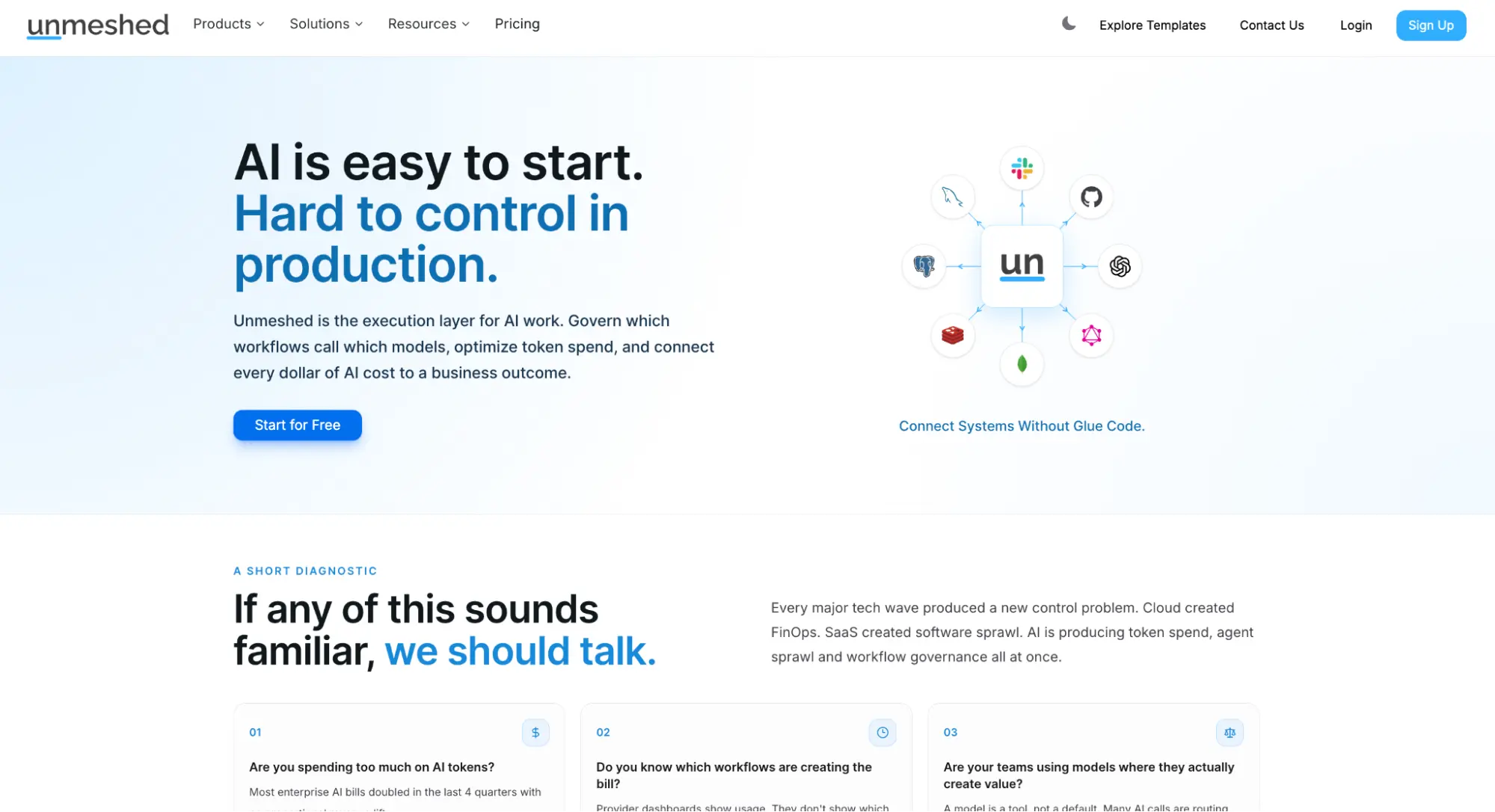
Unmeshed is a workflow orchestration platform built around the parts of automation that a visual node editor tends to paper over: retries, branching, parallel execution, and a point where a human actually has to approve something before the workflow moves on.
Unmeshed's own pricing page runs a direct comparison against Zapier Professional and n8n Starter. On the numbers published there, Unmeshed Premium runs several times the monthly workflow volume of n8n Starter or Zapier Professional, at a comparable or lower price, with 50 concurrent executions against n8n's 5, and 10,000 AI agent calls included against an add-on on Zapier.
Deterministic code, Python, JavaScript, and Go steps, a built-in decision engine, and AI agent steps all run inside the same workflow graph, so workflow automation tools don't end up split between a visual canvas and a pile of custom scripts bolted on the side.
Features
- Retries, branching, parallel execution, and human-in-the-loop approval steps as native step types
- A built-in decision engine and rules-based branching, not wired together with extra nodes
- AI agent steps that run in the same graph as your deterministic code
- File watching and event-driven triggers without polling loops
- Step-level observability and replay on every workflow run
Pros
- Free forever with 1,000 workflow runs a month, no 14-day countdown like n8n Cloud, which drops to no free tier at all once the trial ends
- Premium runs several times the monthly workflow volume n8n Starter or Zapier Professional give you, at a comparable or lower monthly price
- Retries, branching, and human-in-the-loop approval steps are native step types in the workflow definition, not something wired together with extra nodes or a separate app
- AI agent calls run in the same graph as your deterministic code, so a script step, a decision table, and an LLM call all show up in one execution view
- Self-hosting is available on Enterprise if data residency matters, without needing to run and patch the server yourself the way n8n's Community Edition requires
Pricing
Free forever covers 1,000 workflow runs and 1,000 AI agent calls a month. Premium is $20 a month. Enterprise is custom, with unlimited runs, seats, and agent calls, and self-hosting available.
B. Zapier
Zapier connects more than 8,000 apps, more than any tool on this list, and a non-technical person can ship a working automation in minutes. If the thing holding you back on n8n is integration coverage or setup time, Zapier sits at the opposite end of the spectrum.
Features
- The widest app catalogue of any tool on this list, at over 8,000 apps
- Copilot drafts Zaps from a plain description
- Zapier Agents and Zapier MCP expose the catalogue to AI clients like Claude and ChatGPT
- A very large template library for common automations
Cons
- Per-task pricing climbs fast, and each MCP tool call costs two tasks, so AI agent volume burns through the meter quickly
- The free plan is capped at 100 tasks a month and two-step Zaps
- No self-hosting option at any tier
Pricing
Free covers 100 tasks a month. Professional runs roughly $20 to $30 a month depending on billing term, for a few hundred tasks, with Team and Enterprise pricing above that.
C. Make
Make, formerly Integromat and now part of Celonis, is the closest visual analog to n8n for teams that would rather not own the infrastructure. You drag modules onto a canvas across more than 3,000 apps, and there is nothing to host or patch.
Features
- More than 3,000 apps with a visual drag-and-drop builder
- Flow Control for conditional logic across any connected app
- Make AI Agents, a Maia assistant, and native OpenAI, Anthropic, and Google connections
- An MCP server so AI clients can call Make scenarios as tools
Cons
- Credit counting is hard to forecast as scenarios grow, and AI-heavy modules burn through more credits than a plain step
- Cloud only, with no self-hosting option
- Complex scenarios with nested routers get harder to debug
Pricing
Free covers 1,000 credits a month. Core is $12 a month, Pro is $21 a month, and Teams is $38 a month, each for 10,000 credits, with custom Enterprise pricing above that.
D. Pipedream
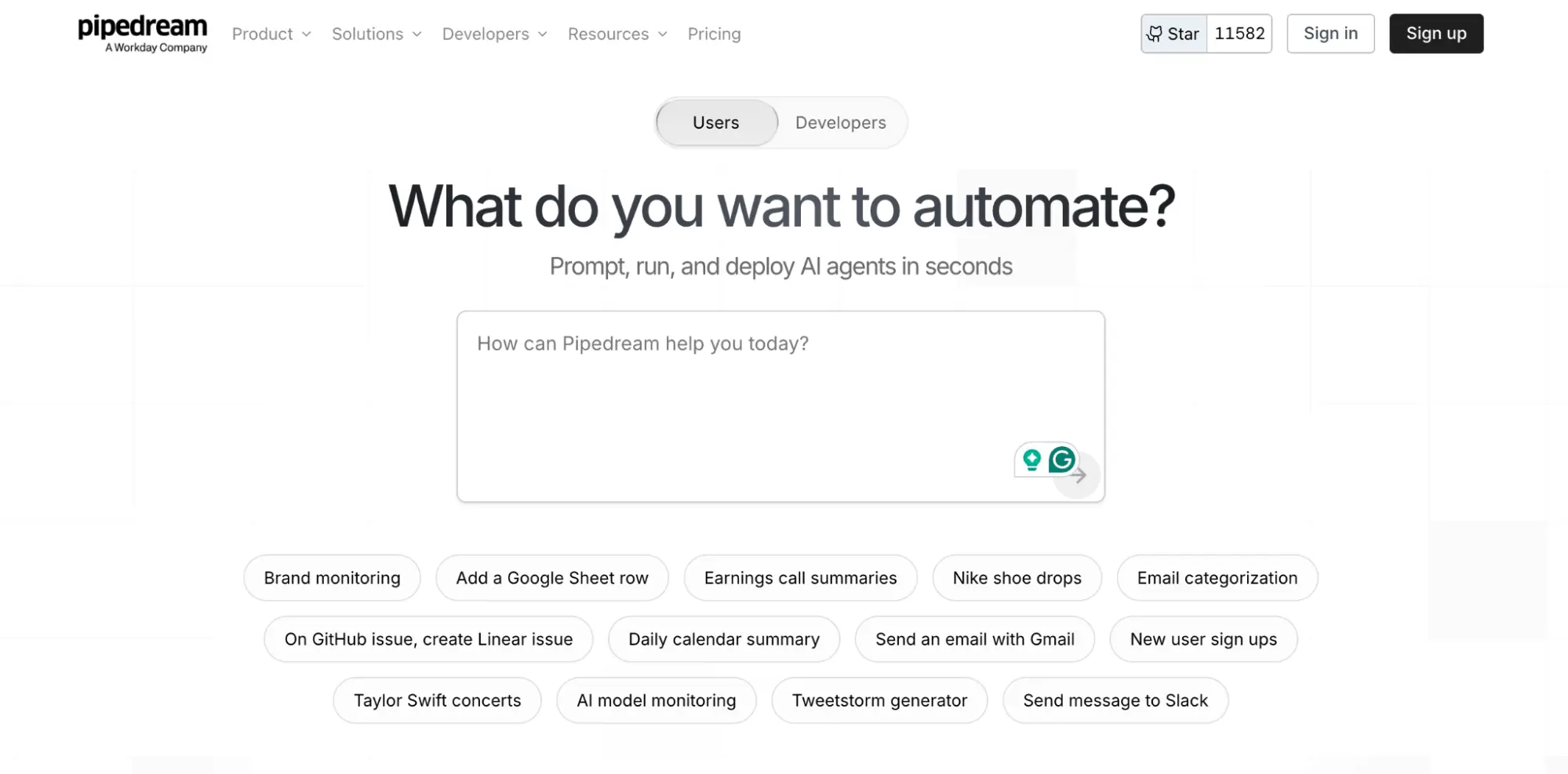
Pipedream sits close to n8n for developers, with one difference that matters at AI volume: it bills by compute, not by execution or step. Any step can be a Node.js, Python, Go, or Bash snippet next to roughly 3,000 prebuilt connectors.
Features
- Code steps in Node.js, Python, Go, or Bash next to about 3,000 connectors
- Compute-based credit pricing, so a longer workflow doesn't cost more per step
- One of the most mature hosted MCP servers in production, exposing thousands of tools
- Pipedream Connect lets you embed the same integration layer into your own product
Cons
- No self-hosting, so data residency-sensitive workloads need to look elsewhere
- More developer-oriented than the no-code builders on this list
- Credit usage needs watching on long-running steps
Pricing
Free includes 100 credits a day with 3 active workflows. Paid plans start around $29 a month, with higher tiers above that.
E. Activepieces
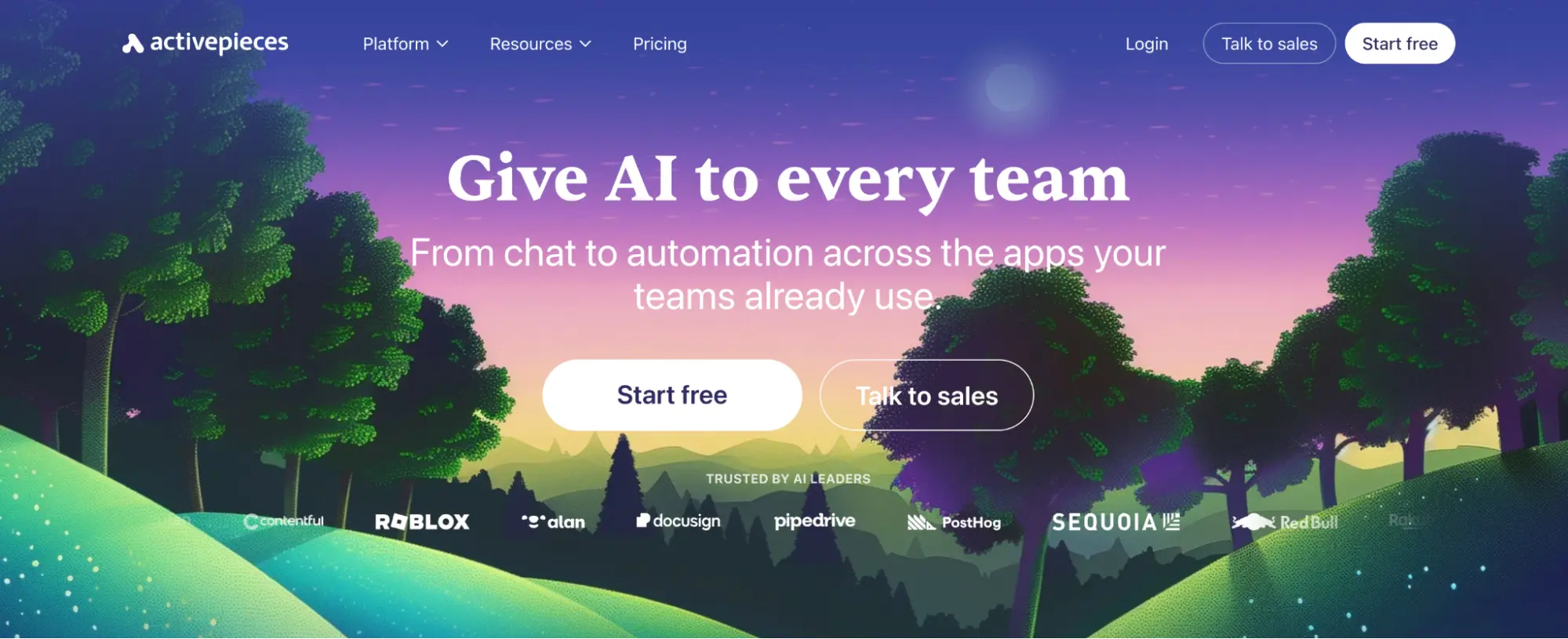
Activepieces is the tool that comes up most often when someone asks for an open source n8n alternative by name. The Community Edition is MIT licensed, so you can self-host it free with unlimited flows and runs.
Features
- 700+ integrations, called pieces, each also exposed as an MCP server
- AI agents run on every plan, including the free one
- An AI Copilot drafts flows from a plain description
- Human-in-the-loop steps that pause a flow for approval
Cons
- Cloud execution runs in sandboxed isolation, which is slower than n8n's own execution
- Individual integrations can be shallower than n8n's most mature nodes
- Documentation for building custom pieces can be thin
Pricing
Self-hosted Community Edition is free under MIT. Cloud Standard is free for 10 active flows with unlimited runs, then $5 per active flow monthly. Ultimate and Enterprise are custom.
F. Workato
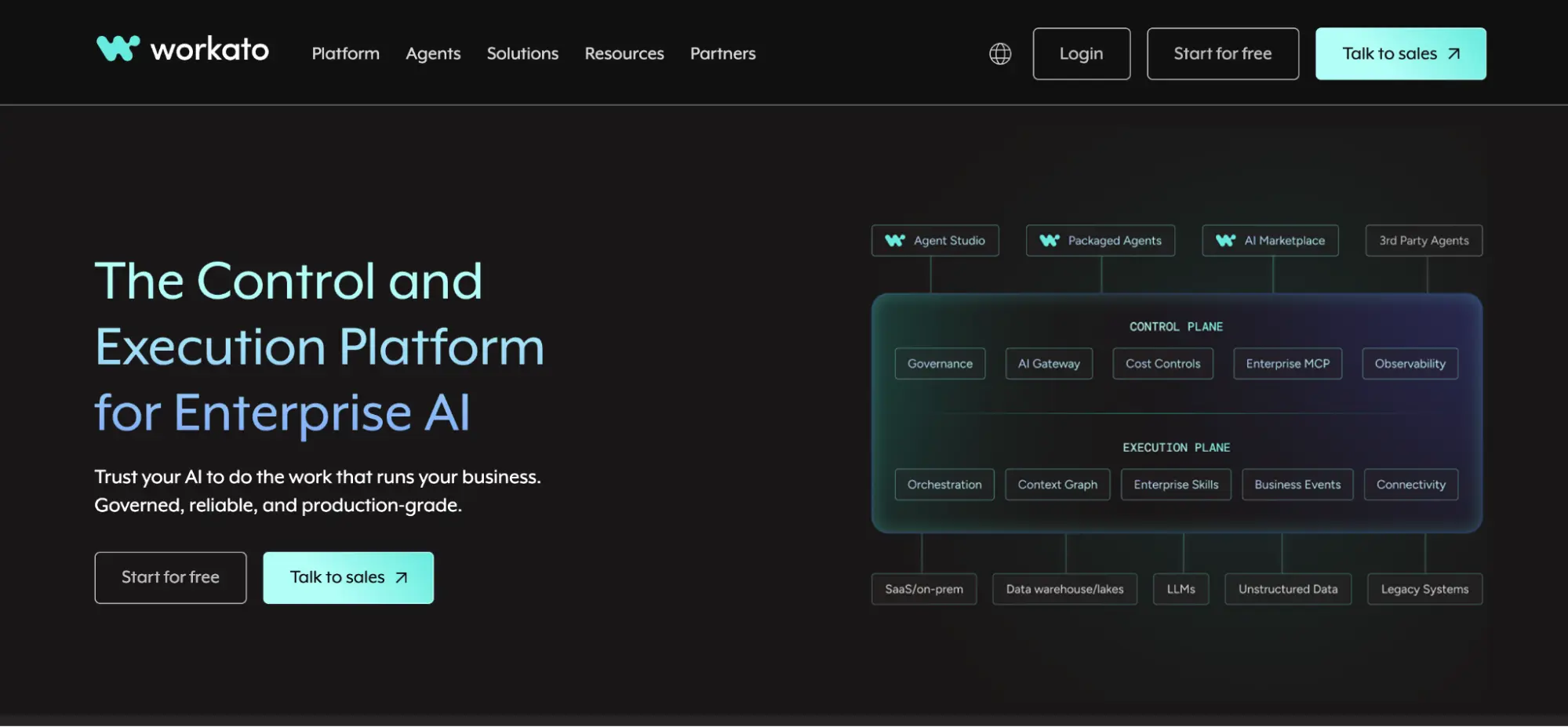
Workato is an enterprise automation platform built for companies already running legacy systems across marketing, sales, HR, support, and security. It's used by names like Booking.com, HubSpot, and Monday.com.
Features
- Unlimited connections, workflows, and collaborators included on every edition
- Serves multiple departments on one platform, not just engineering
- Deep integrations with established enterprise systems
Cons
- No published pricing. You need a sales call just to see numbers
- Built for large, established companies, overkill for a small team
- A steeper onboarding process than the self-serve tools on this list
Pricing
Custom enterprise pricing, platform plus usage. Contact sales for details.
G. Tray.ai
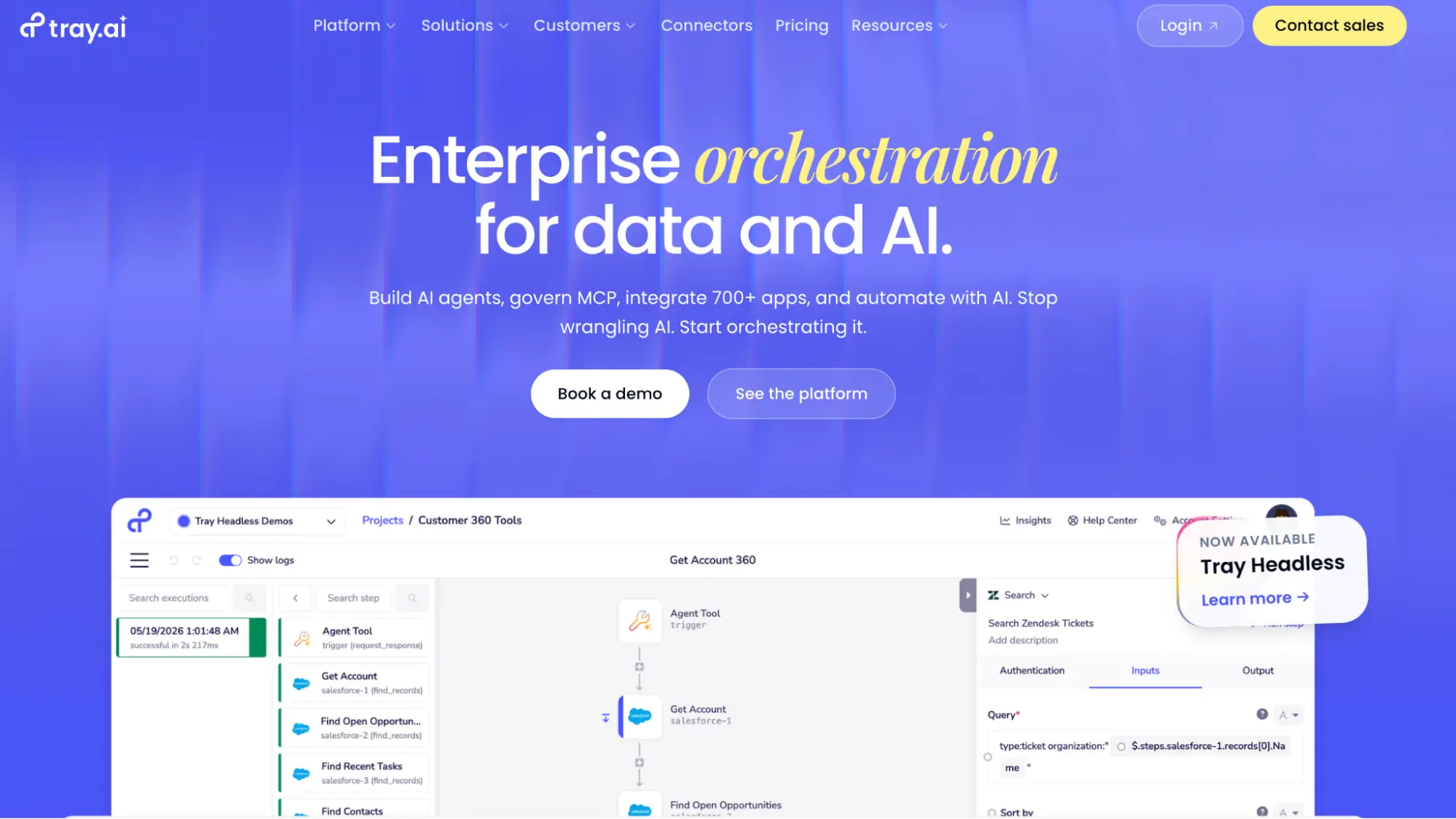
Tray.ai is a low-code builder for technical teams, with Python support for genuinely complex automations. It carries a steeper learning curve than n8n, closer to writing real integration code than dragging nodes onto a canvas.
Features
- Low-code builder with Python support for complex logic
- Used by large technical organizations including IBM, Cisco, and NetApp
- An interactive demo available without a full account
Cons
- No free tier at all, and no transparent published pricing
- A steeper learning curve than the no-code builders on this list
- No self-hosting option
Pricing
Custom enterprise pricing across Pro, Team, and Enterprise packages. Contact sales for details.
H. Temporal
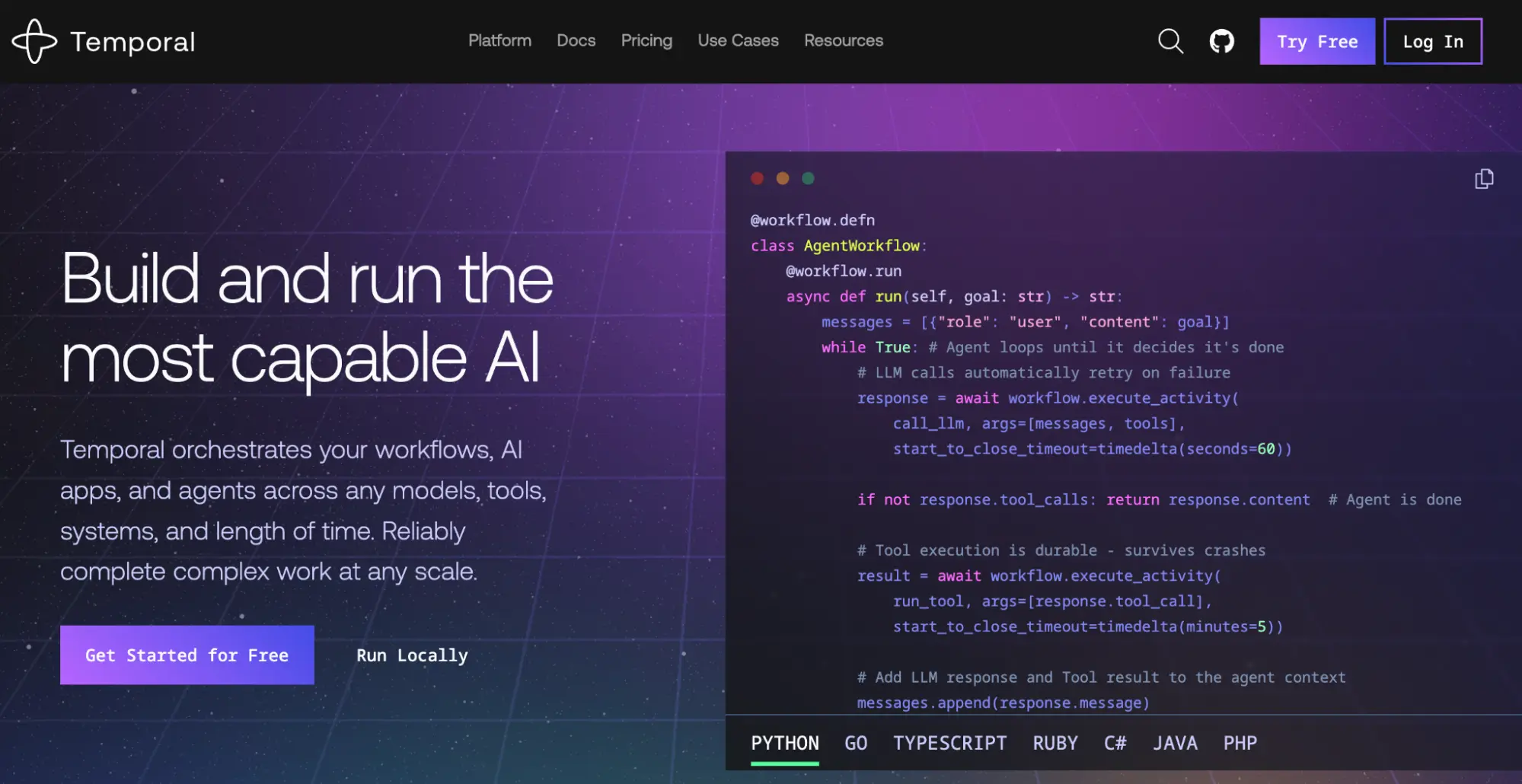
Temporal is a code-first durable execution engine, not a visual builder at all. You write the workflow in Go, Java, Python, TypeScript, or .NET, and Temporal handles retries and state persistence as part of the programming model itself.
Features
- SDKs in Go, Java, Python, TypeScript, and .NET
- Automatic retries and durable state built into the execution model, not configured after the fact
- Open source core you can self-host
Cons
- No visual builder at all, so it doesn't fit teams without engineers writing the workflow code
- Self-hosting means operating the Temporal Server and its database yourself
- Temporal Cloud pricing is usage-based on actions and storage, and needs real modeling before you commit
Pricing
Open source and free to self-host. Temporal Cloud is usage-based, priced per action and storage; request a quote for your volume.
I. Power Automate
Power Automate is Microsoft's automation platform, built for teams already living inside Microsoft 365, Dynamics, and Azure. Integration with that ecosystem is deeper than any other tool on this list.
Features
- Deep native integration with Microsoft 365, Dynamics, and Azure
- AI Builder credits for document processing and prediction models
- Per-user and per-flow licensing options depending on how automation is deployed
Cons
- Licensing stacks up fast once premium connectors and per-flow plans enter the picture
- Integration depth outside the Microsoft ecosystem is noticeably thinner
- The licensing model takes real effort to model correctly before you commit
Pricing
Premium plans start around $15 per user monthly, with a separate per-flow plan and AI Builder credits priced on top.
J. Windmill
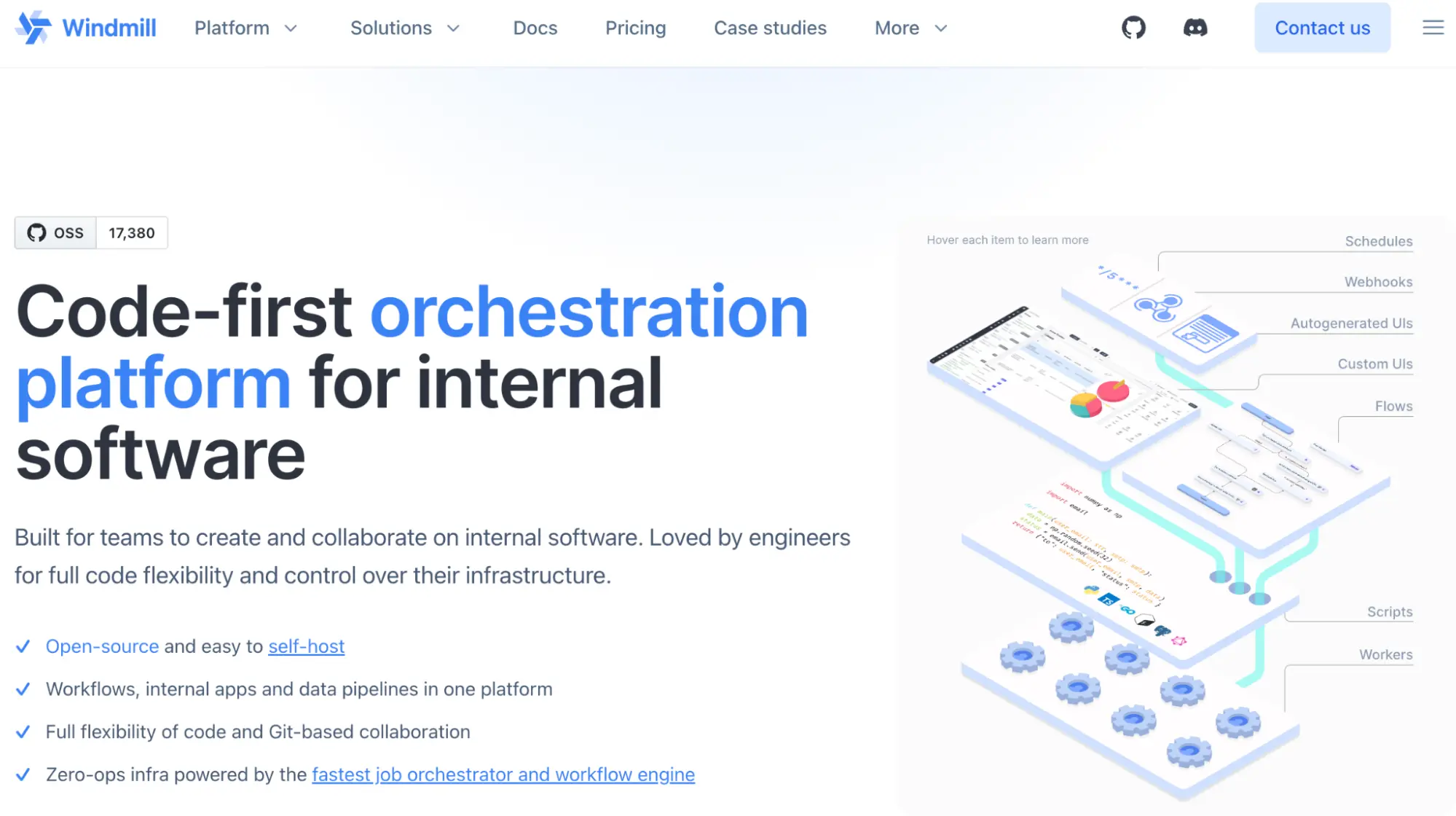
Windmill is open source under AGPLv3 and free to self-host with unlimited executions. You write steps in Python, TypeScript, Go, Bash, or SQL, and its Rust engine makes it one of the faster workflow runners on this list.
Features
- Real code in Python, TypeScript, Go, Bash, or SQL, with auto-generated UIs and APIs
- AI Agent steps and an MCP server and client for connecting external tools
- A fast Rust-based execution engine
Cons
- Far fewer prebuilt connectors than n8n, so many integrations mean writing a short script against an API
- Developer-first, so non-coders face a steeper start
- Enterprise pricing is compute-unit based and takes real modeling to estimate accurately
Pricing
Free and open source, self-hosted with unlimited executions. Enterprise starts around $120 a month, priced by seats and compute units.
5. Which One Actually Fits Your Situation
Picking between n8n alternatives starts with what's actually blocking you on n8n itself, not a generic feature checklist.
If your workflows need retries, branching, and a human approval step built in from day one, not wired together with extra nodes, Unmeshed is built for exactly that shape of problem, and it's worth comparing directly against whatever n8n vs alternatives shortlist you've already put together.
If the issue is the fair code license specifically, Activepieces, Windmill, and Temporal are genuinely open source options you can self-host without a commercial ceiling.
If you'd rather not run your own server at all, Make and Zapier are the easier hosted canvases, and Pipedream gives you that same hosted convenience with real code instead of a node editor.
If your team already lives inside Microsoft, Power Automate is the path of least resistance. And if you're choosing among enterprise n8n alternatives for a large organization with legacy systems and multiple departments to serve, Workato and Tray.ai are built for exactly that scale, though both require a sales conversation before you see a number.
Frequently Asked Questions
Sources
Still hitting n8n's execution ceiling?
Your workflows shouldn't need a bigger server to grow
Unmeshed gives you 3 to 4 times the headroom of n8n at the same price, with retries, branching, and approvals built into every workflow