TLDR
- Most "LangGraph alternatives" content right now still recommends AutoGen. Microsoft put it in maintenance mode in October 2025.
- The real current pick is Microsoft Agent Framework, GA since April 2026, merging AutoGen and Semantic Kernel into one SDK.
- Five other picks, each solving a different specific reason people leave LangGraph: CrewAI (verbosity), OpenAI Agents SDK (OpenAI-native), Mastra (TypeScript), Temporal (durability), Unmeshed (governance layer).
- Temporal and Unmeshed aren't agent frameworks at all; they wrap whatever framework you pick rather than compete with it.
- Pick based on your actual constraint, not whichever name shows up most in search results.
Search "LangGraph alternatives" right now, and most of what comes back still puts AutoGen near the top of the list. That's outdated advice.
Microsoft moved AutoGen into maintenance mode on October 2, 2025. No new features, no enhancements, just bug fixes and security patches going forward.
The actual successor, Microsoft Agent Framework, reached general availability in April 2026. It merges AutoGen's orchestration patterns with Semantic Kernel's enterprise tooling into one SDK.
Even guides published after that date have skipped it, usually because it was still too new to trust. Five months later, it isn't.
So this list starts by fixing that, then walks the other five LangGraph alternatives by the actual reason people leave LangGraph in the first place.
1. Why Teams Look Past LangGraph
LangGraph earned its adoption. Explicit state, real branching, and built-in checkpointing are exactly what a graph-shaped agent workflow needs. It's one of several agent orchestration frameworks built around that idea, but it isn't the only shape that works.
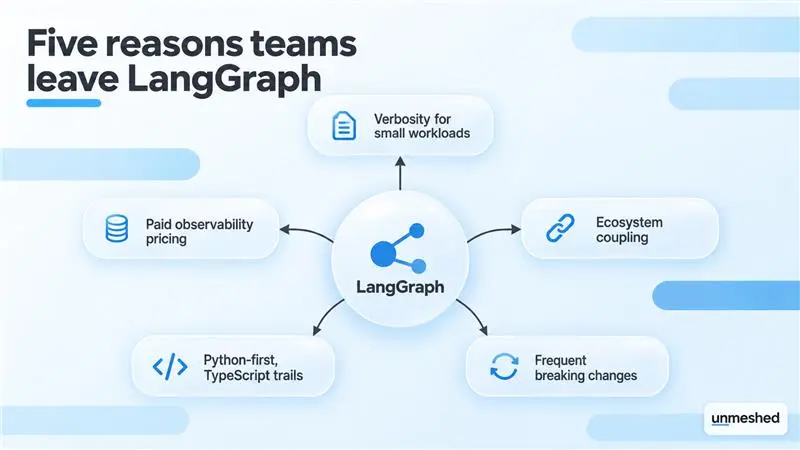
The reasons teams look at LangGraph competitors are specific, not vague dissatisfaction:
- Verbosity for small workloads: A two-step agent needs real graph declaration, nodes, edges, a compiler. Past a certain simplicity threshold, the graph is paperwork.
- LangSmith as the paid observability path: Pricing starts at $39 per seat on the Plus tier and climbs fast with trace volume. Self-hosted alternatives exist but are less polished.
- Ecosystem coupling: LangGraph ships from the same team as LangChain and shares primitives, so importing both compounds the exact upgrade tax teams left LangChain to escape.
- Python-first: The JavaScript port trails Python by months on features and documentation, leaving TypeScript teams in a sidecar pattern.
- Frequent breaking changes: The interrupt API has shifted more than once, and checkpoint formats have broken programs across minor versions.
None of this makes LangGraph the wrong choice for a genuinely graph-shaped workflow. It means a real range of LangGraph alternatives exists, depending on what actually bites for you.
2. What Should You Look for in a LangGraph Alternative?
Before comparing tools, it helps to know what you're actually optimizing for. Not every LangGraph alternative solves the same problem, so match the tool to the constraint that's actually yours.
- Language: Python-first, or does your team need real TypeScript support without a sidecar process?
- Durability: Does the agent need to survive a crash and resume mid-task, or is it short-lived and stateless between runs?
- Cost shape: A free open-source core with usage-based cloud pricing, or a flat enterprise license?
- Governance: Do you need audit logging, approvals, and access control built in, or is that being solved somewhere else in your stack?
Answer these four honestly, and the right pick from this list gets a lot more obvious.
3. The 6 Best LangGraph Alternatives
This is the LangGraph alternatives shortlist that actually holds up in late 2026, not the one still repeating 2025 assumptions about who's actively maintained.
Here's the LangGraph vs alternatives breakdown, each one picked for a different specific reason to leave, not ranked by popularity:
| Framework | What It Fixes | License / Pricing |
|---|---|---|
| CrewAI | Verbosity, role-based crews instead of graph declarations | Free (50 executions/mo); Enterprise custom |
| Microsoft Agent Framework | Replaces maintenance-mode AutoGen with the current supported path | Open source, MIT |
| OpenAI Agents SDK | OpenAI-native production runtime, minimal ceremony | Open source; usage-priced via OpenAI |
| Mastra | TypeScript-first agents, no Python sidecar | Apache 2.0 core; Enterprise add-ons |
| Temporal | Durability for long-running, crash-surviving agents | Self-hosted free; Cloud from $50/million actions |
| Unmeshed | Orchestration, durability, and governance around any framework | Free forever; Premium $20/mo |
1. CrewAI
CrewAI shows up on nearly every langgraph alternatives list for good reason. Its model is roles and tasks, not nodes and edges. Agent, Task, Crew, and Process cover most fixed-sequence pipelines in a third of the code a state graph needs.
- Readable role-based syntax: researcher, writer, reviewer, mapped directly to the code
- Used by 65% of the Fortune 500, per CrewAI's own pricing page
- Free tier covers 50 workflow executions a month; Enterprise adds SSO, RBAC, and dedicated VPC or on-prem deployment
Real tradeoff: workflows that are genuinely graph-shaped, with real branching and persisted state, fight the roles-and-tasks abstraction instead of fitting it.
2. Microsoft Agent Framework
Most langgraph alternatives roundups either skip this pick entirely or still lead with AutoGen. This is the corrected pick on this list. AutoGen moved to maintenance mode on October 2, 2025, confirmed directly on Microsoft's own AutoGen repository. No new features; community-managed going forward.
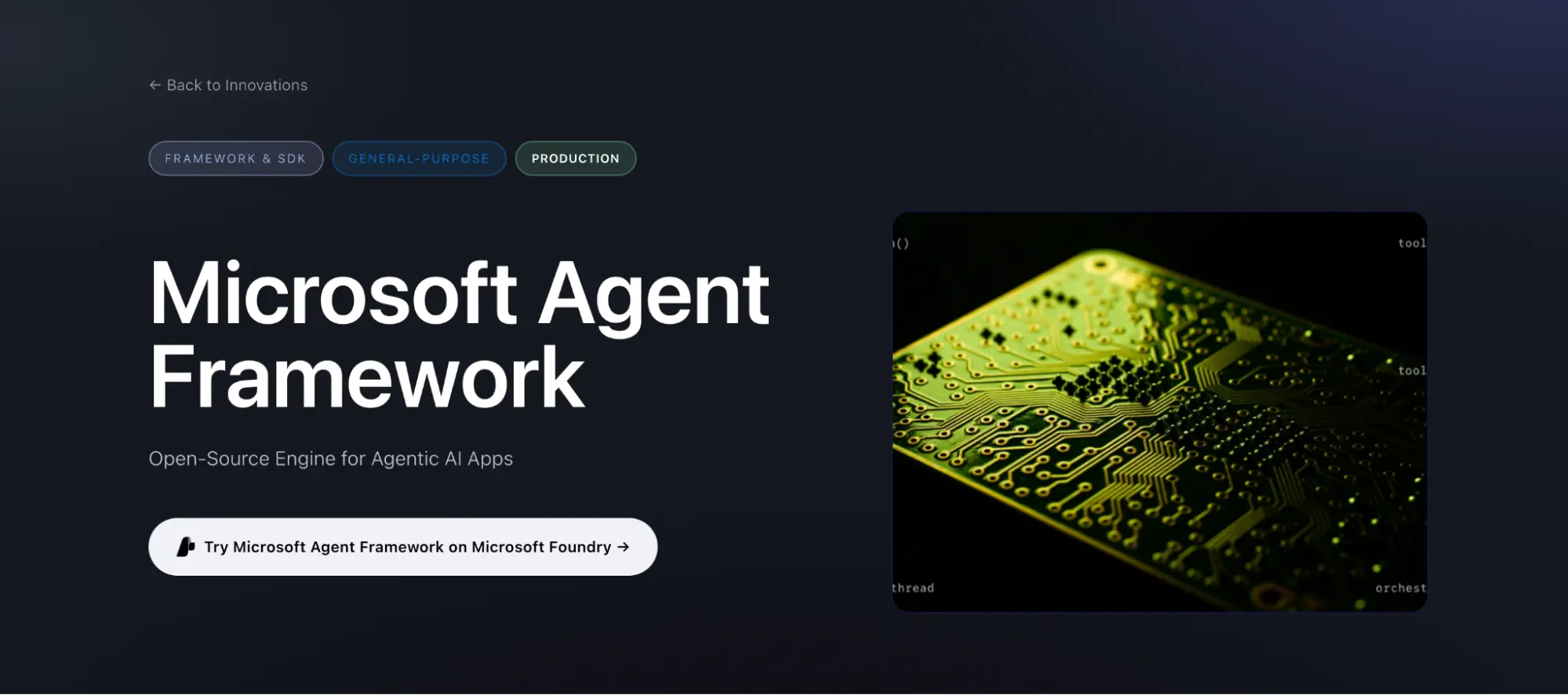
Microsoft Agent Framework reached general availability on April 3, 2026, merging AutoGen's orchestration patterns with Semantic Kernel's enterprise tooling into one open-source SDK.
- Graph-based workflows: sequential, concurrent, handoff, and group collaboration patterns
- Checkpointing, streaming, human-in-the-loop, and time-travel debugging built in
- Built-in OpenTelemetry observability, no separate paid add-on required
- MIT-licensed, with direct migration guides from both AutoGen and Semantic Kernel in the repo
Real tradeoff: a shorter production track record than LangGraph itself, even though it inherits Semantic Kernel's enterprise maturity underneath.
3. OpenAI Agents SDK
A common pick among LangGraph alternatives for teams already all-in on OpenAI models. It's the production-ready successor to OpenAI's earlier Swarm experiment. Three primitives: Agents, Handoffs, and Guardrails, with built-in tracing out of the box.
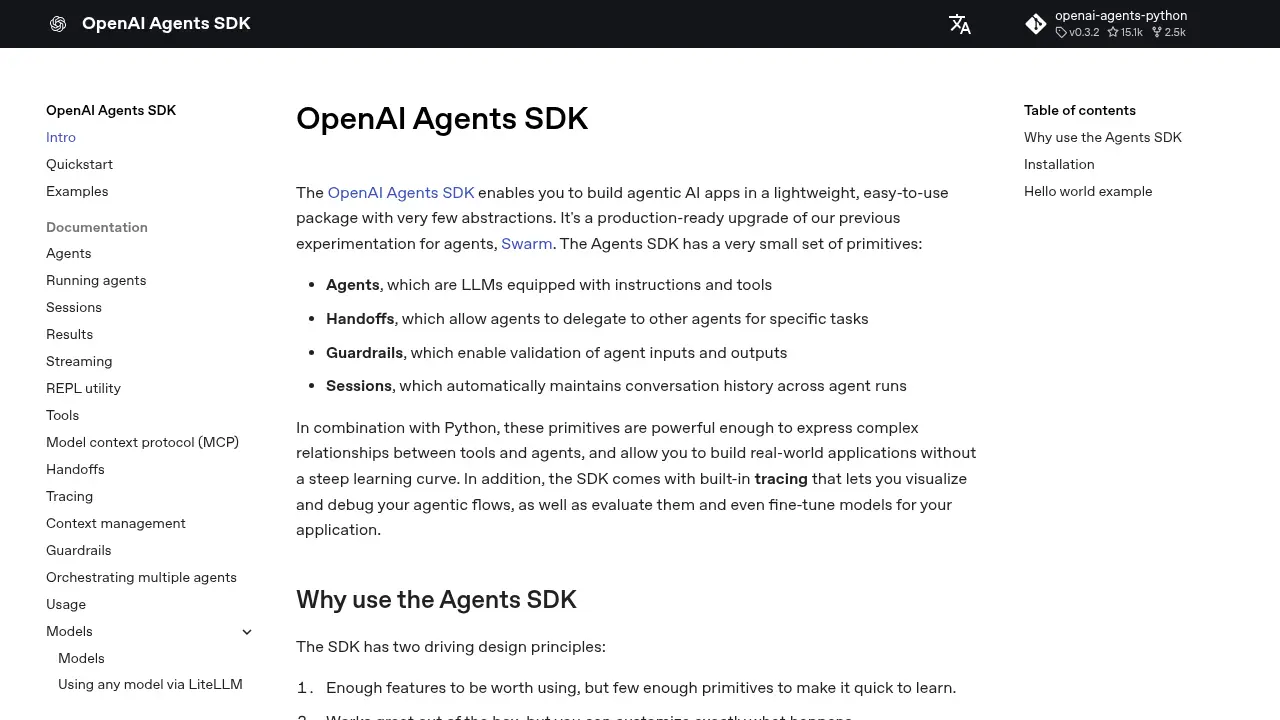
- First-class in both Python and TypeScript, no second-class port
- A
handoff()call transfers control between agents, simpler than a graph for specialist routing - Open source SDK; cost comes from OpenAI usage, not a separate framework fee
Real tradeoff: OpenAI-aligned by design. Non-OpenAI providers work through adapter layers with a thinner surface than the native path.
4. Mastra
Among TypeScript-first langgraph alternatives, Mastra is the most complete. It isn't a port of a Python framework. Agents, workflows, memory, and observability ship as part of the same package.
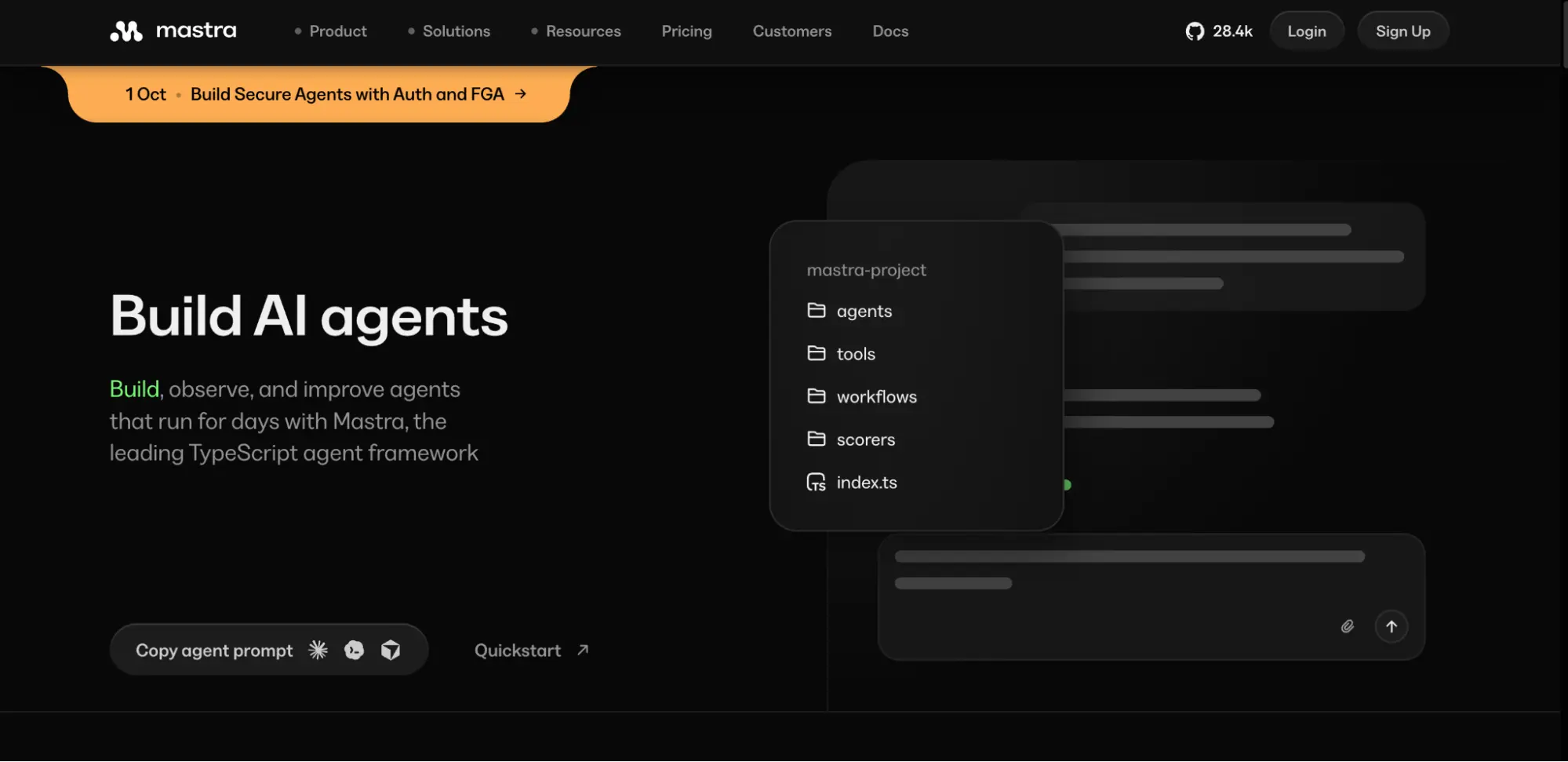
- Deployers built in for Vercel, Netlify, Cloudflare, or a standalone Hono server
- Real named customers on Mastra's own site: Salesforce runs a 100k-developer internal harness on it, MongoDB built an internal agent platform called Sage for 20+ engineering teams, and Range runs it for a $17B AUM investment advisory product
- Core framework is Apache 2.0; Enterprise features sit under a separate source-available license
Real tradeoff: a younger ecosystem than LangGraph or CrewAI, and no benefit at all for Python-heavy teams.
5. Temporal
Temporal rarely shows up on LangGraph alternatives lists because it isn't an agent framework at all. It's a durable execution engine that wraps any agent code, including LangGraph itself, and records full event history so a workflow can crash and resume exactly where it left off.
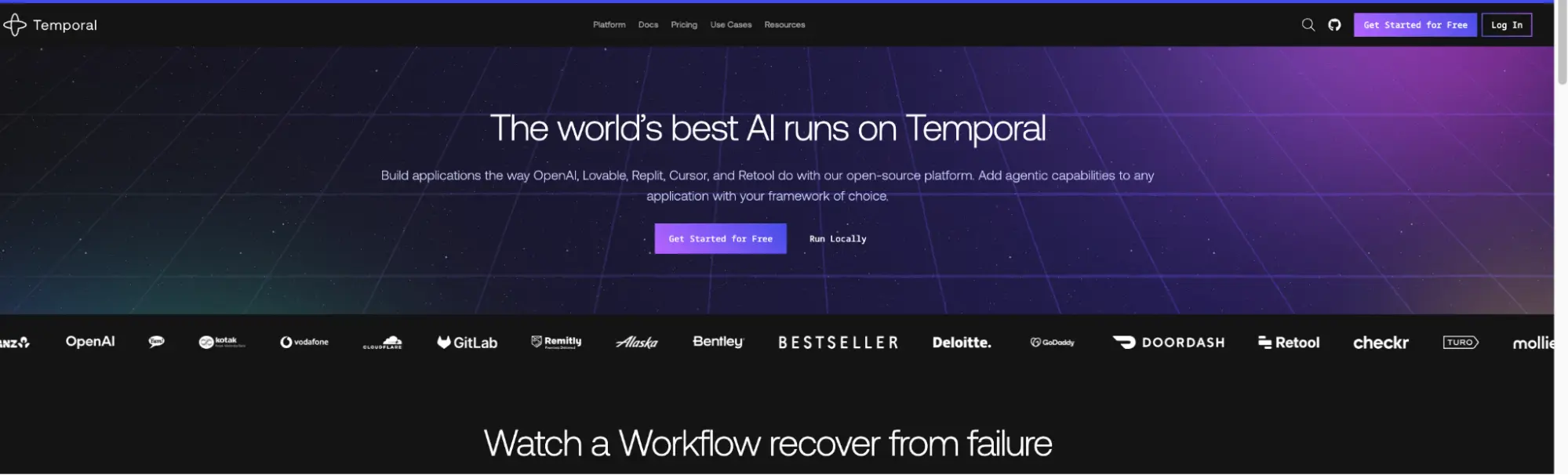
- Explicitly supports running the OpenAI Agents SDK and Google ADK as durable Activities, per Temporal's own pricing page
- Self-hosted is free and MIT-licensed; Temporal Cloud starts at $50 per million actions, with volume discounts down to $25 per million
- Backed by real momentum: a $12.55B Series E, with Temporal's own newsroom citing AI-driven demand for durable execution as the driver
Real tradeoff: adds a second runtime and operational surface. Duration alone doesn't justify it; the workflow needs a genuine durability requirement, like surviving crashes or running for days.
6. Unmeshed
Not a reasoning framework, and it doesn't compete with LangGraph, CrewAI, or Microsoft Agent Framework on agent logic. That's not the comparison to make. It sits underneath any of the five frameworks above, not instead of them.
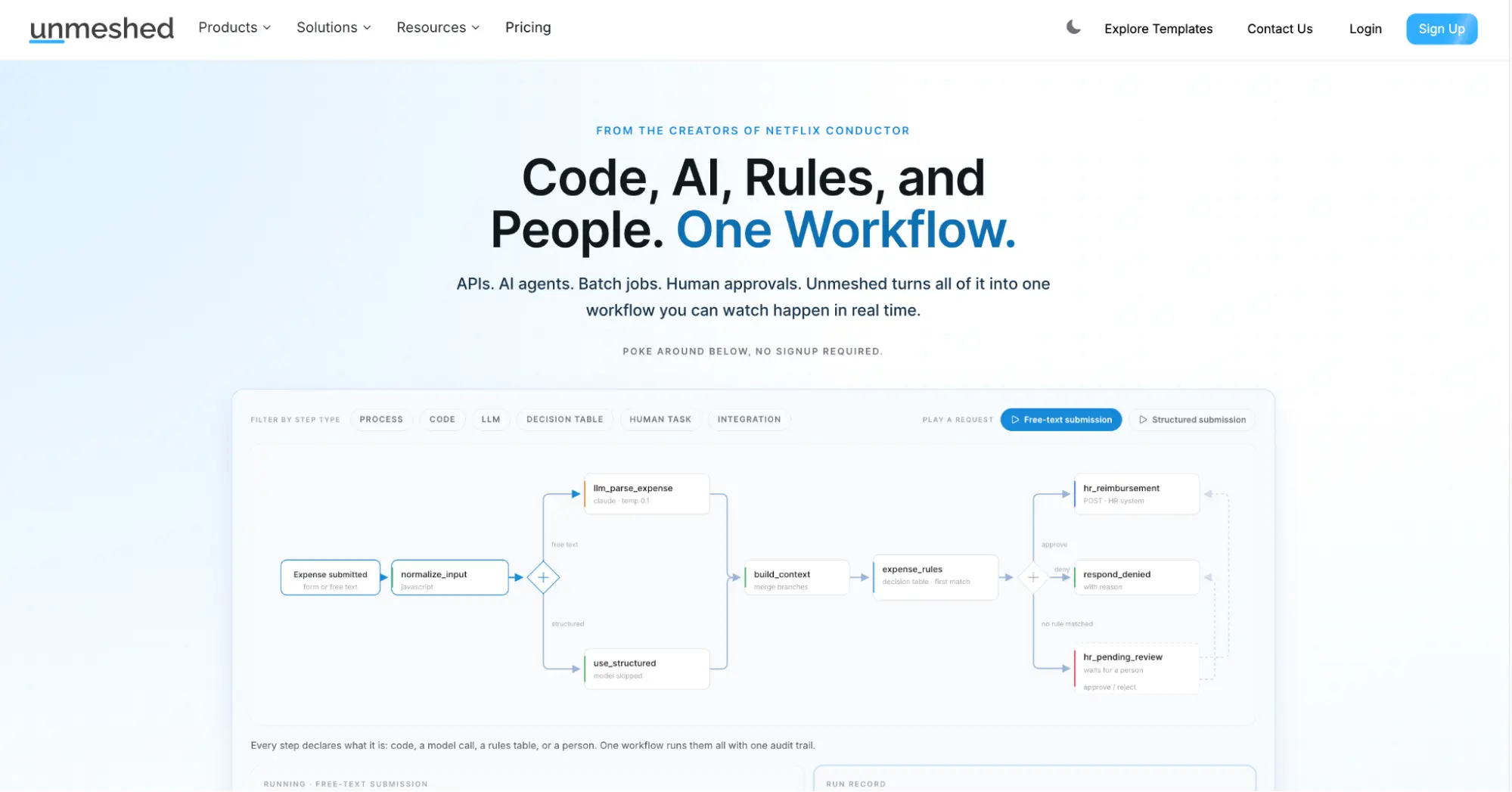
The gap it fills
- CrewAI, Microsoft Agent Framework, and the OpenAI Agents SDK all handle how an agent reasons, nothing more
- Mastra adds workflows and memory, but still no durable execution, approvals, or audit trail by default
- Temporal solves durability, but it's a separate runtime you have to learn and operate on top of whichever framework you already picked
What Unmeshed solves, on the free plan
- Durable execution, so a failed step resumes instead of restarting the whole run
- Human-in-the-loop approvals and a decision engine for branching logic, no separate approval tool bolted on
- Audit logging on every step as part of built-in AI agent governance, so there's a real, queryable answer to what an agent actually did and when
The practical difference
- The other five change how you write the agent; Unmeshed changes whether that agent survives contact with production
- No second vendor and no second learning curve just to get durability
- Free forever, Premium at $20 a month, for a team weighing LangGraph alternatives, that's the actual cost comparison
If the framework choice is settled and the actual gap is durability, approvals, or governance, that's a different layer entirely, covered in more depth in what is AI agent infrastructure.
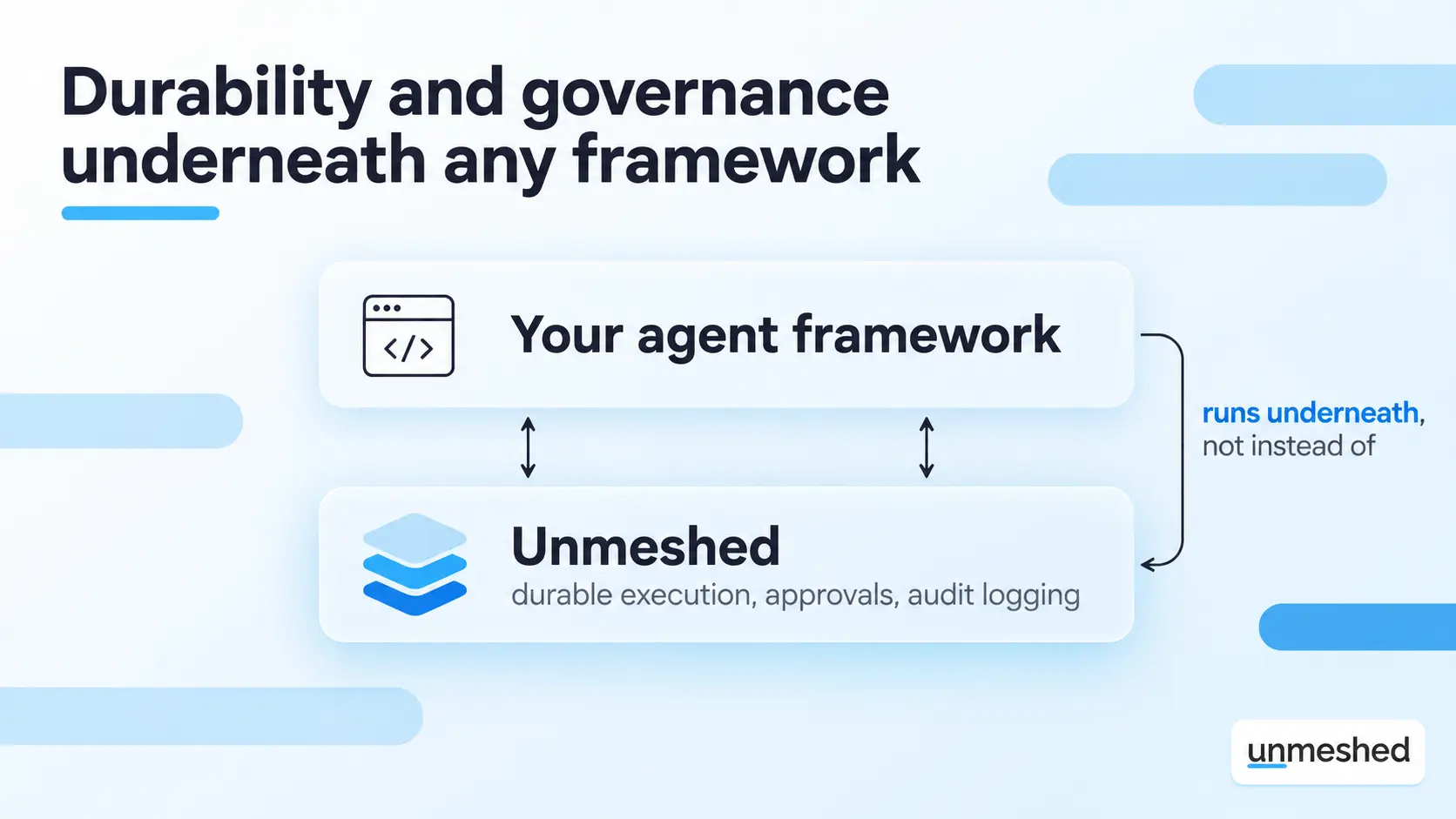
Your Framework Picks the Agent. Something Else Runs It.
Whichever of these six you land on, see what happens when durability, approvals, and audit logging run underneath it instead of getting bolted on later.
See The Layer Underneath4. How Do LangGraph Alternatives Handle Long-Running Agents?
Most don't, and that's the gap worth knowing about before you pick one. LangGraph's own persistence is real but lightweight, and the same is true for CrewAI, the OpenAI Agents SDK, Microsoft Agent Framework, and Mastra: none of them are built to survive a process crash mid-run or resume an agent that's been paused for hours or days.
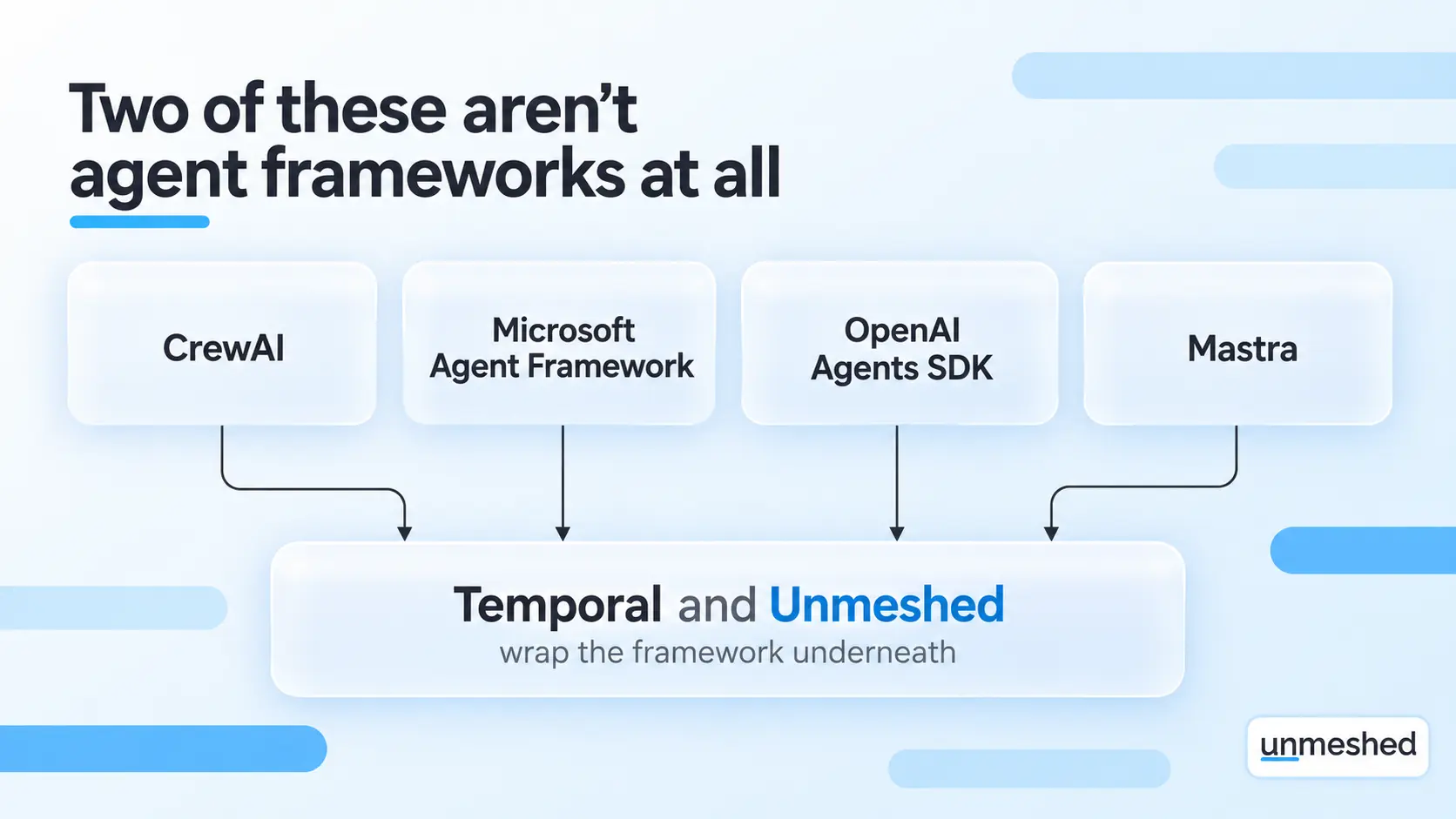
Two of the six LangGraph alternatives on this list actually solve that:
- Temporal records full event history and replays deterministically, so a workflow resumes exactly where it left off after a crash. It wraps existing agent code, including the OpenAI Agents SDK and Google ADK, but that means running and operating a second system alongside whichever framework you picked.
- Unmeshed builds durable execution directly into the same orchestration layer that also handles human-in-the-loop approvals, decisioning, and audit logging. A failed step resumes automatically, on the free plan, with no separate durability engine to license, deploy, or operate.
If your agents run for minutes and finish cleanly, this isn't your problem. If they run for hours, wait on human input, or need to survive a bad deploy, it's the first thing to check before picking a framework.
5. Are There Open Source LangGraph Alternatives?
Yes, most of them. Licensing varies more than people expect, though, so it's worth checking before you build on top of one.
- CrewAI: free tier (50 executions/month), Enterprise is custom and closed
- Microsoft Agent Framework: fully open source, MIT licensed
- OpenAI Agents SDK: open source SDK, though cost comes from OpenAI usage, not the framework itself
- Mastra: core framework is Apache 2.0, Enterprise features sit under a separate source-available license
- Temporal: self-hosted core is free and MIT-licensed; Temporal Cloud is usage-priced
- Unmeshed: free forever on the base plan; Premium is a flat $20/month
If open source with no vendor lock-in is the priority, Microsoft Agent Framework and Temporal's self-hosted option are the cleanest picks on this list, both fully MIT with no feature gate behind a paid tier.
6. Which One Actually Fits
Skip the ranked list. This isn't a popularity-contest kind of AI agent framework comparison; it's matched to the specific reason you're actually looking:
| Your Situation | Pick |
|---|---|
| Fixed-sequence pipeline of specialists, want less code than a graph | CrewAI |
| Building on Microsoft Foundry or Azure, want the current supported path | Microsoft Agent Framework |
| Mostly OpenAI models, want tracing and guardrails out of the box | OpenAI Agents SDK |
| TypeScript team, deploying to Vercel or Cloudflare | Mastra |
| Agents need to survive crashes and run for days | Temporal |
| Framework is fine; the pain is durability, approvals, or audit underneath it | Unmeshed |
Final Thoughts
The single most common mistake in LangGraph alternative advice right now is recommending AutoGen without mentioning it's in maintenance mode.
Past that correction, the rest of these LangGraph alternatives are genuinely differentiated, not just renamed versions of each other. The choice comes down to which specific limitation is yours: verbosity, cost, language, durability, or the governance layer underneath the framework entirely.
Pick based on the actual reason you're looking, not the most popular name in the search results.
Frequently Asked Questions
Sources
- 1.Microsoft AutoGen GitHub repository - maintenance-mode status
- 2.Microsoft Agent Framework GitHub repository - license, GA status, feature set
- 3.CrewAI pricing - Fortune 500 stat, plan details
- 4.Mastra - license, customer names
- 5.Temporal pricing - Cloud pricing, durable-agent support
- 6.OpenAI Agents SDK documentation - primitives, features
Still choosing a framework?
Pick the framework. We'll handle what happens after.
Talk to us about pairing any of these six with durable execution and governed, auditable agent steps.