TLDR
- AI orchestration means four different jobs sharing one name: pipeline, model and LLM, multi-agent, and AI workflow coordination.
- The definition is one sentence about coordinating models, agents, pipelines, and business logic with context and a record.
- Gartner expects 40% of enterprise apps to include task-specific agents by the end of 2026, and one third of agentic implementations to combine different skills by 2027. That makes coordination unavoidable.
- Every type follows the same loop. The last two steps, recovering from failure and logging, are the ones teams skip until production.
- Unmeshed covers AI workflow coordination only. It doesn't cover training pipelines, model routing, or agent reasoning.
AI orchestration is one of those terms everyone uses, and few people define it the same way. Search it, and you'll find pages about training pipelines, LLM routing, agent teams, and business workflows. All four call themselves AI orchestration.
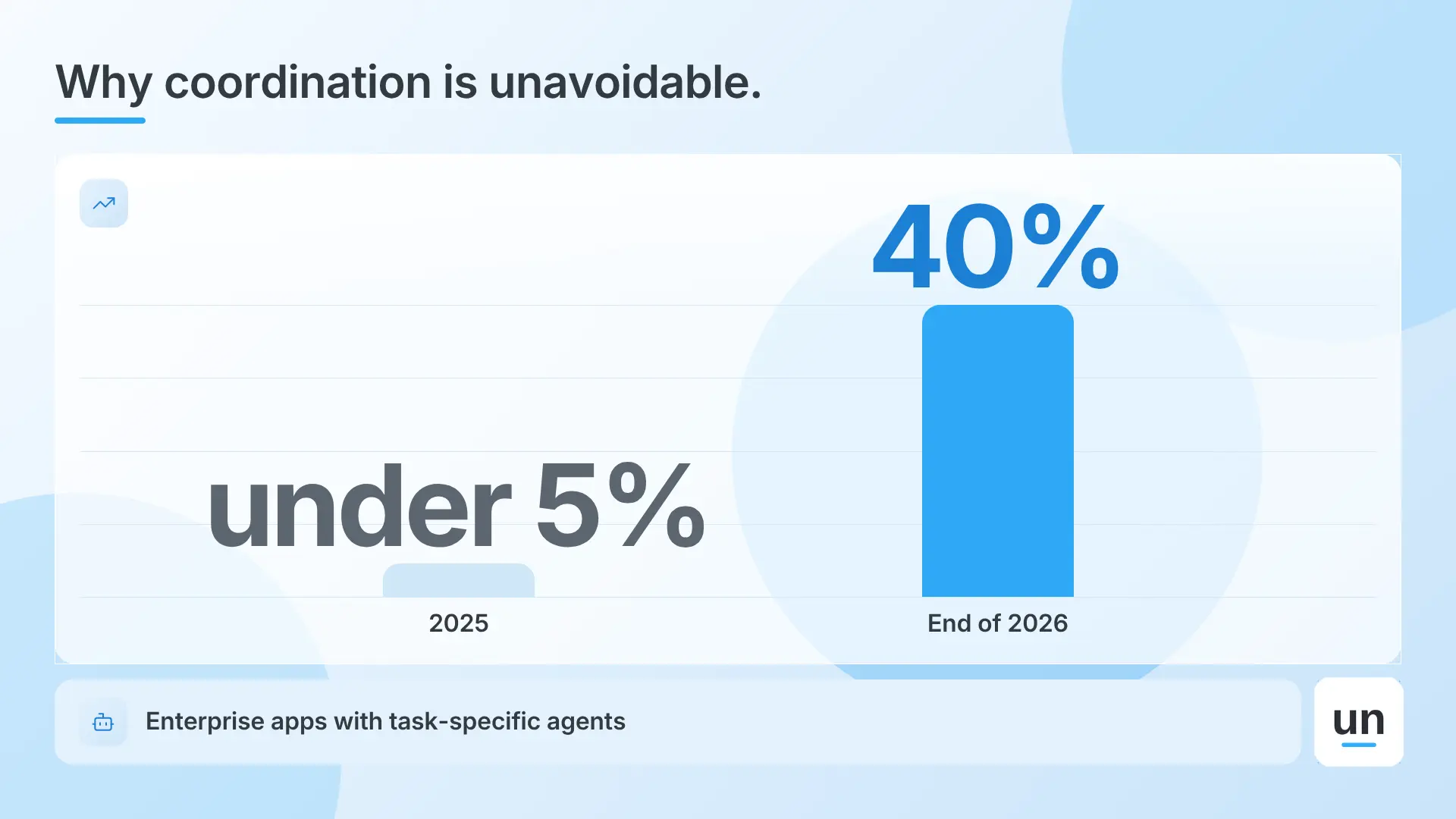
That gap matters more this year than it did last year. Gartner expects 40% of enterprise applications to include task-specific AI agents by the end of 2026, up from less than 5% in 2025. More agents mean more things to coordinate.
So this guide defines AI orchestration once, then separates the four jobs hiding under the name. You'll see how each one works, what an AI orchestration platform needs to include, and how to pick the one that matches your problem.
We'll also say plainly where Unmeshed fits. It covers one of the four well, and it doesn't pretend to cover the rest.
1. What Is AI Orchestration?
AI orchestration is the coordination of models, agents, data pipelines, and business logic so that AI steps run in the right order, with the right context, and with a record of what happened.
That definition is broad on purpose, because the term is. Four different groups of engineers use it for four different jobs, and the next sections pull them apart.
It helps to say what orchestration is not. A model is not orchestration. A single prompt chain isn't either. And an agent framework handles how one agent reasons, which is only one piece of the coordination problem.
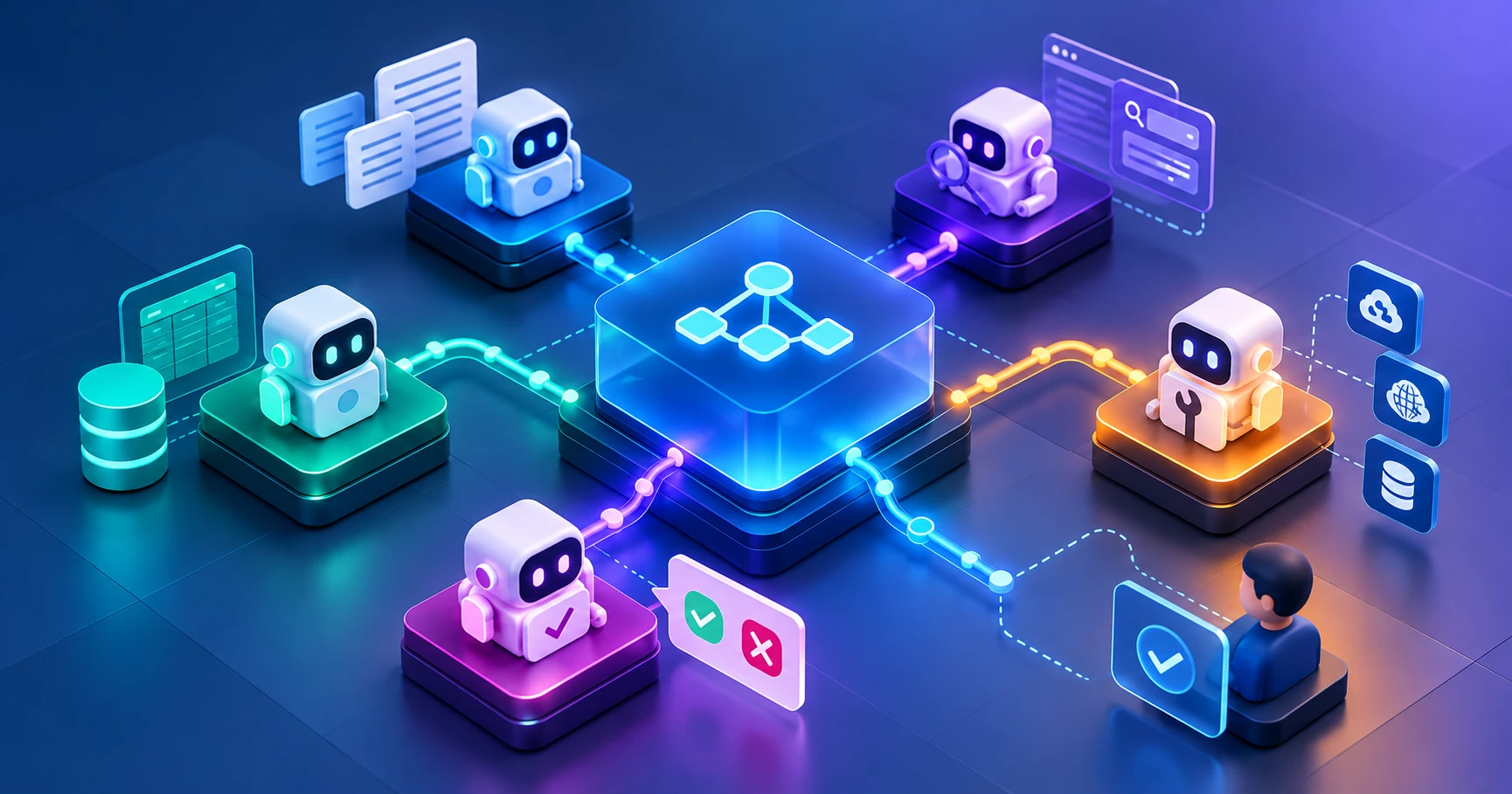
Orchestration decides the things around the model call:
- What gets called, and in what order
- What context each step receives
- What happens when a step fails halfway
- Who has to approve what before the run continues
- What gets recorded so you can explain the result later
2. Why Does AI Orchestration Matter Now?
AI orchestration matters because organizations are moving beyond standalone AI chatbots to multi-agent systems that need to coordinate complex, end-to-end business workflows.
In August 2025, Gartner predicted that 40% of enterprise applications will include task-specific AI agents by the end of 2026. In the same release, it expects one third of agentic AI implementations to combine agents with different skills by 2027.
That second number is the real driver. Once agents have different skills, someone has to decide which one acts, what it sees, and what happens when it's wrong.
Without that layer, teams run into the same problems in the same order:
- Agent sprawl: Every team ships its own agent with its own retry logic and its own idea of state.
- Duplicate spend: Two agents call the same model for the same answer, and nobody sees it.
- No shared state: A step fails, and the run starts over from zero.
- No approval path: A risky action goes through because nothing paused it.
- No audit trail: Someone asks why the system did that, and nobody can say.
3. What Are the Four Types of AI Orchestration?
AI orchestration coordinates multiple AI models, data pipelines, and autonomous agents so they can work together as a unified system.
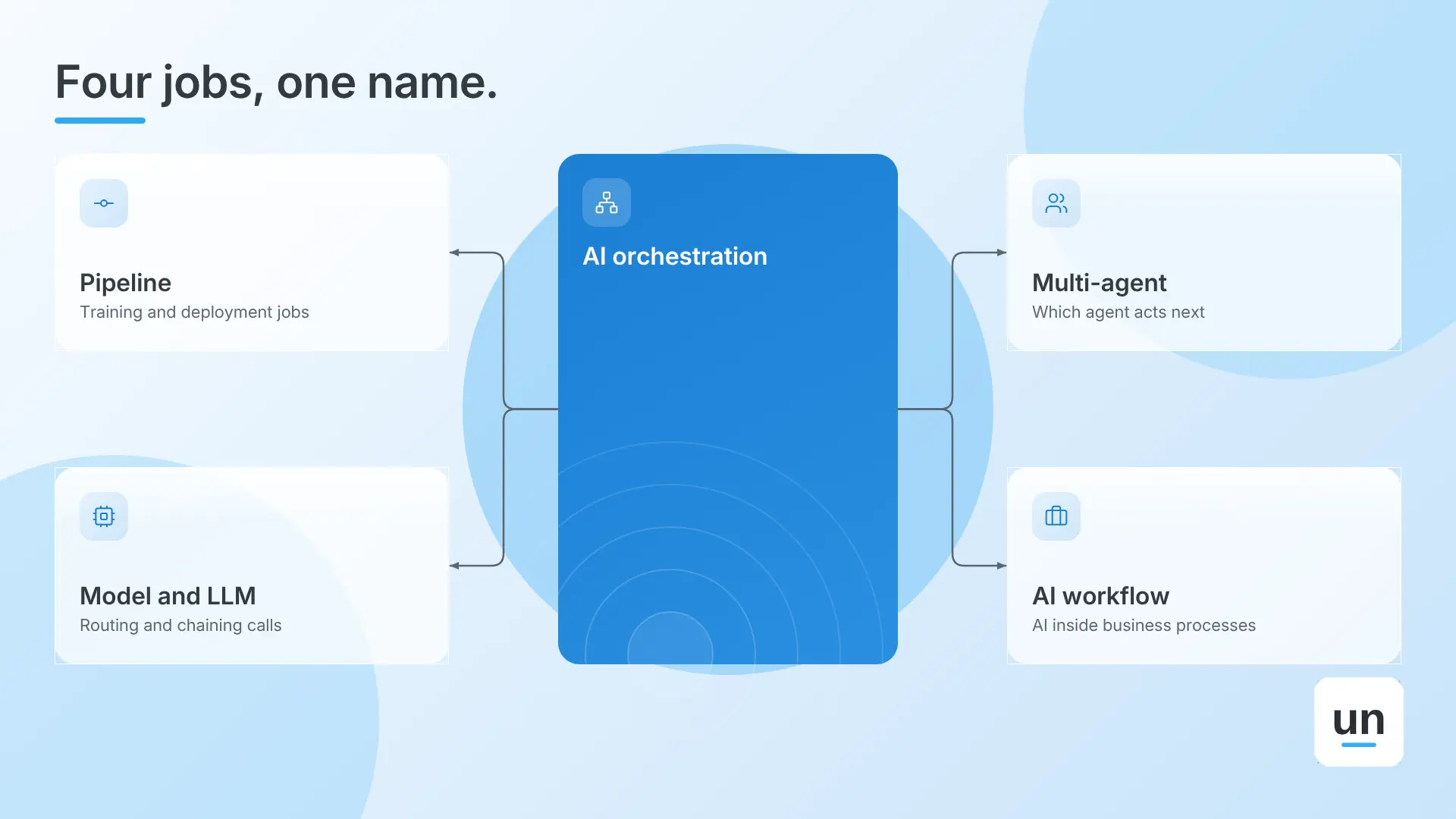
In enterprise and multi-agent architectures, AI orchestration typically follows four primary patterns:
| Type | What Gets Coordinated | Typical Tools |
|---|---|---|
| AI pipeline orchestration | Training, evaluation, and deployment jobs | Airflow, Kubeflow, Dagster, Prefect |
| Model and LLM orchestration | Calls, routing, and chaining across models | LLM gateways, chaining libraries |
| Multi-agent orchestration | Which agent acts next, with what context | Microsoft Agent Framework, CrewAI, LangGraph |
| AI workflow coordination | AI steps inside business processes, next to APIs, rules, and people | Workflow engines such as Unmeshed |
4. How Does AI Pipeline Orchestration Work?
AI pipeline orchestration coordinates data flows, tools, machine learning models, and APIs to run together as a single automated workflow.
Apache Airflow describes itself as an open-source platform for developing, scheduling, and monitoring workflows, including machine learning and model training. Kubeflow Pipelines is built for ML workflows that run as containers on Kubernetes, where each component execution maps to one container.
This type needs:
- Scheduling, backfills, and reruns of only the failed tasks
- Tracking for artifacts and metadata between steps
- Compute and container management at training scale
You probably mean this one if your team trains or tunes models and the work is batch, scheduled, and owned by data scientists.
5. What Is Model and LLM Orchestration?
Model and LLM orchestration is the control layer that manages and routes interactions between large language models, external data sources, APIs, and tools.
This type coordinates calls across models. It routes a request to a cheaper model, falls back when a provider goes down, chains prompts together, and caches repeat answers.
Most teams handle it in an LLM gateway, a single layer that every model call passes through.
This type needs:
- Routing and fallback rules across providers
- Cost and rate limit controls
- Logging of every prompt and response
You probably mean this one if your main worry is which model gets which request, and what it costs.
6. How Does Multi-Agent Orchestration Work?
Multi-agent orchestration coordinates multiple specialized AI agents so they can work together as a single, goal-driven system.
It decides which agent acts next and what it sees when it does. Microsoft Agent Framework, for example, supports sequential, concurrent, handoff, and group collaboration patterns in one SDK.
If you're weighing options, our guide to agent frameworks compares six of them.
This type needs:
- Clear handoff rules between agents
- Shared context that doesn't get lost between steps
- Limits on loops and spend, so one agent can't run away
You probably mean this one if you're building a team of agents that split a task between them.
7. What Is AI Workflow Coordination?
AI workflow coordination, also called AI workflow orchestration, connects AI models, data sources, software tools, and human reviews into a structured, repeatable end-to-end workflow.
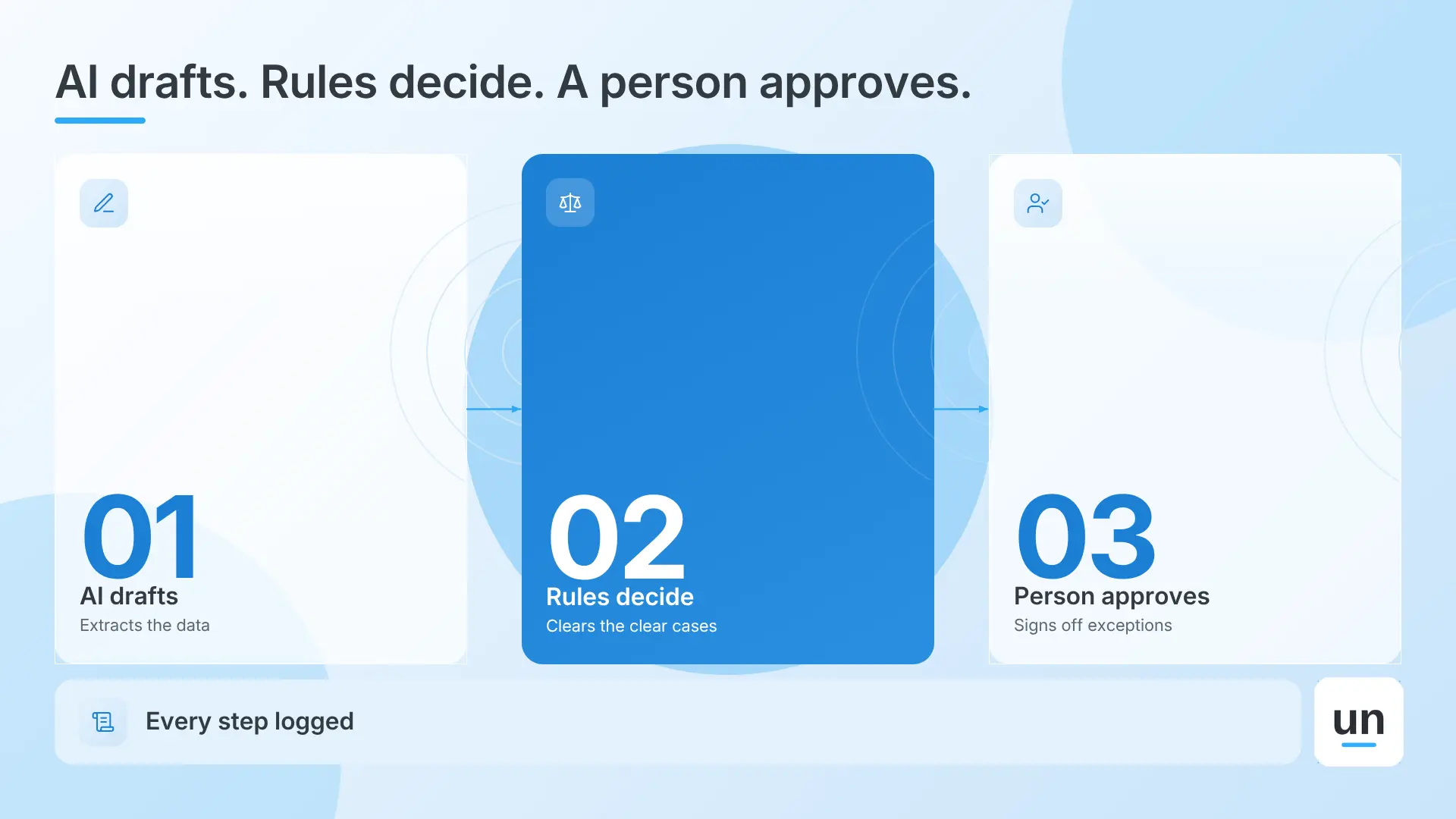
It puts AI steps inside a business process, next to APIs, rules, and people. An AI step extracts data from a document, a rules step decides the clear cases, a person approves the exceptions, and the whole run is logged.
The model is one step among many, and rarely the hardest one. The hard part is everything around it.
This type needs:
- Durable state, so a run survives crashes and long waits
- Human approval steps that pause and resume cleanly
- A rules layer for decisions that shouldn't be left to a model
- An audit trail for every input, output, and decision
You probably mean this one if AI is one step in a process your business already runs.
8. How Does Orchestrating AI Systems Work Step by Step?
AI orchestration coordinates AI models, tools, data, and agents to turn an individual AI capability into an end-to-end automated workflow.
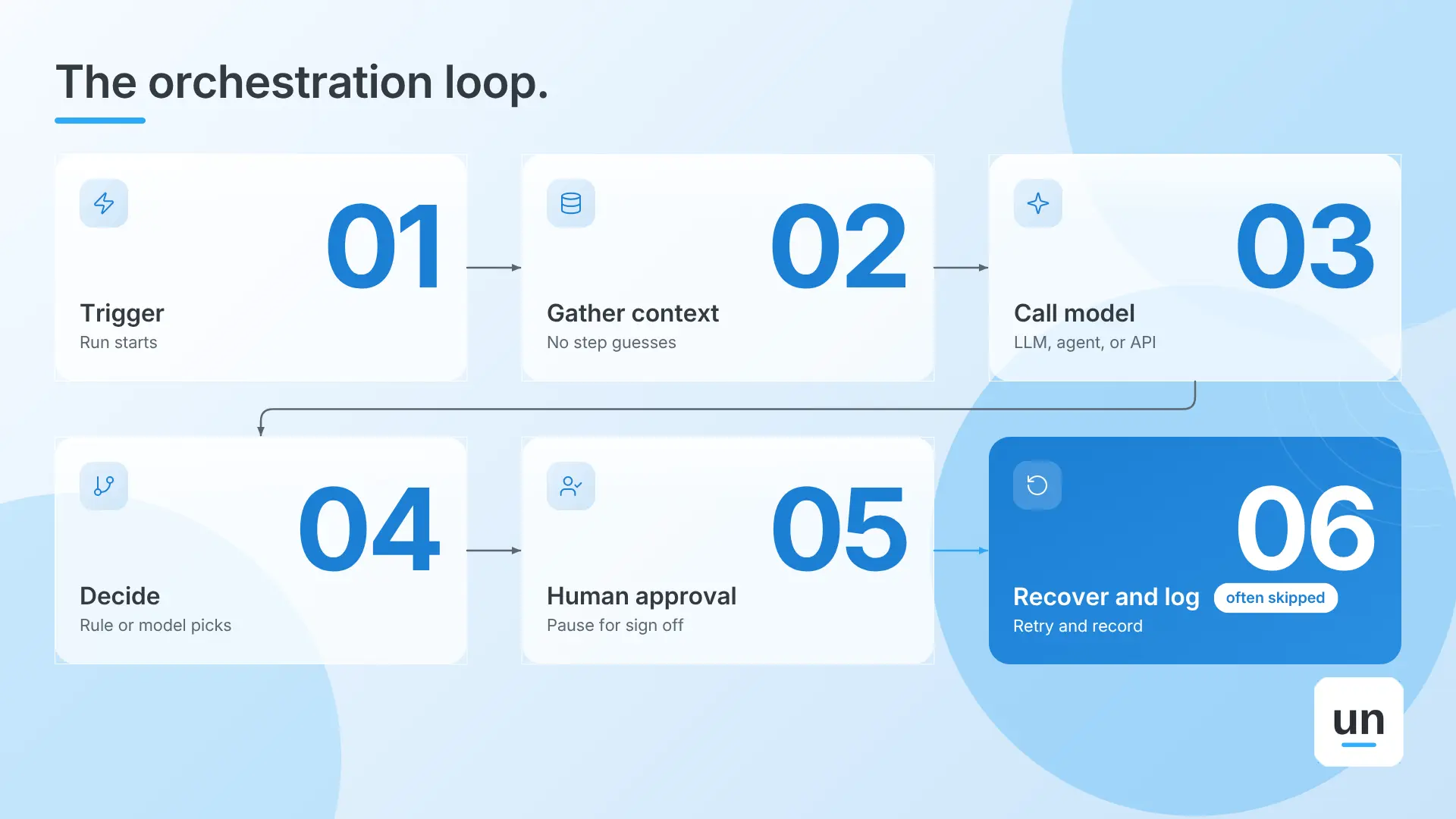
Whatever the type, orchestrating AI systems follows the same basic loop. The tools change, but the steps don't.
- Trigger: A webhook, a schedule, a queue message, or a person starts the run.
- Gather context: The workflow pulls the data each step needs, so no step guesses.
- Call the model or tool: An LLM, an agent, or an API does the work.
- Decide what happens next: A rule or a model output picks the next step.
- Route to a person when needed: Low confidence or high stakes pauses the run for approval.
- Recover from failure: Retries, timeouts, and saved state let the run resume instead of restart. This is what durable execution means in practice.
- Log everything: Every input, output, and decision stays searchable.
The last two steps are the ones teams skip in a prototype and regret in production.
9. What Are the Core Components of an AI Orchestration Platform?
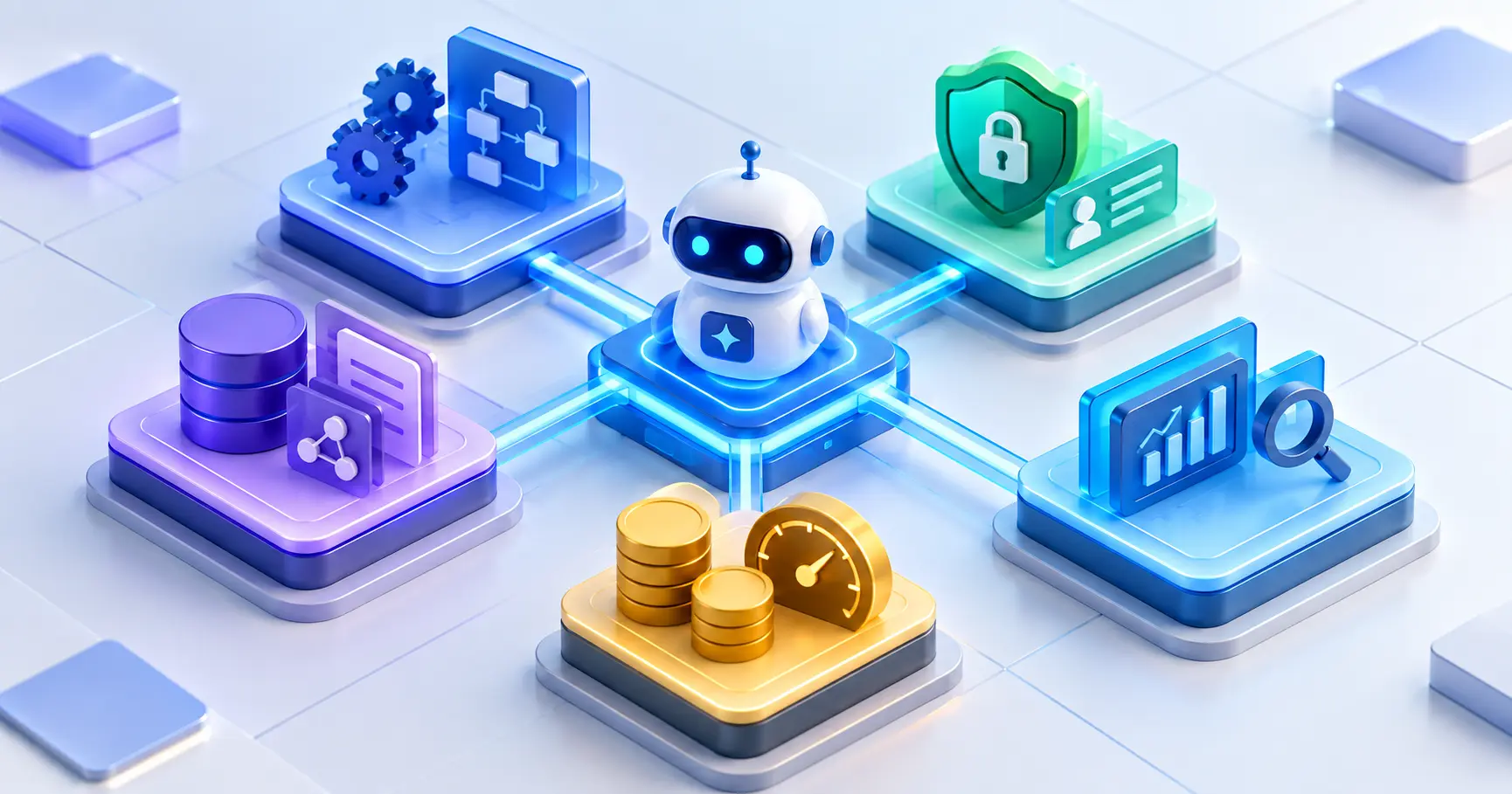
AI orchestration platforms provide seven core capabilities for running reliable AI workflows: workflow execution, model and tool connectivity, state and memory, rules and decisioning, human approval, observability, and governance. Each capability addresses a specific requirement for running AI systems in production.
A good platform covers seven things. The table shows what each one does and what goes wrong when it's missing.
| Component | What It Does | What Breaks Without It |
|---|---|---|
| Workflow engine | Runs steps in order, with branching and parallel work | Logic ends up scattered across scripts |
| Model and tool connectors | Calls LLMs, APIs, databases, and SaaS tools | Every integration becomes custom glue code |
| State and memory | Keeps context across steps and across crashes | A failure restarts the whole run |
| Rules and decisioning | Handles decisions that must be exact and repeatable | A model makes calls it shouldn't |
| Human approval | Pauses a run for sign-off, then resumes it | Risky actions go through unchecked |
| Observability | Records every run, step, and payload | Failures can't be debugged |
| Governance | Enforces access, policy, and audit rules | Nobody can prove what the system did |
Together, these form the orchestration layer of your agent infrastructure.
Two of the seven get skipped most often. Observability tells you what happened, and LLM observability covers that in depth. Agent evals tell you whether the result was any good.
Governance ties both to policy, which is the argument behind governed AI.
10. How Is AI Orchestration Different From Workflow Orchestration and Agent Frameworks?
AI orchestration is the control layer that manages AI models, workflows, tools, and enterprise policies across an AI system. Workflow orchestration manages deterministic, step-by-step processes, while agent frameworks manage the reasoning and state of individual AI agents.
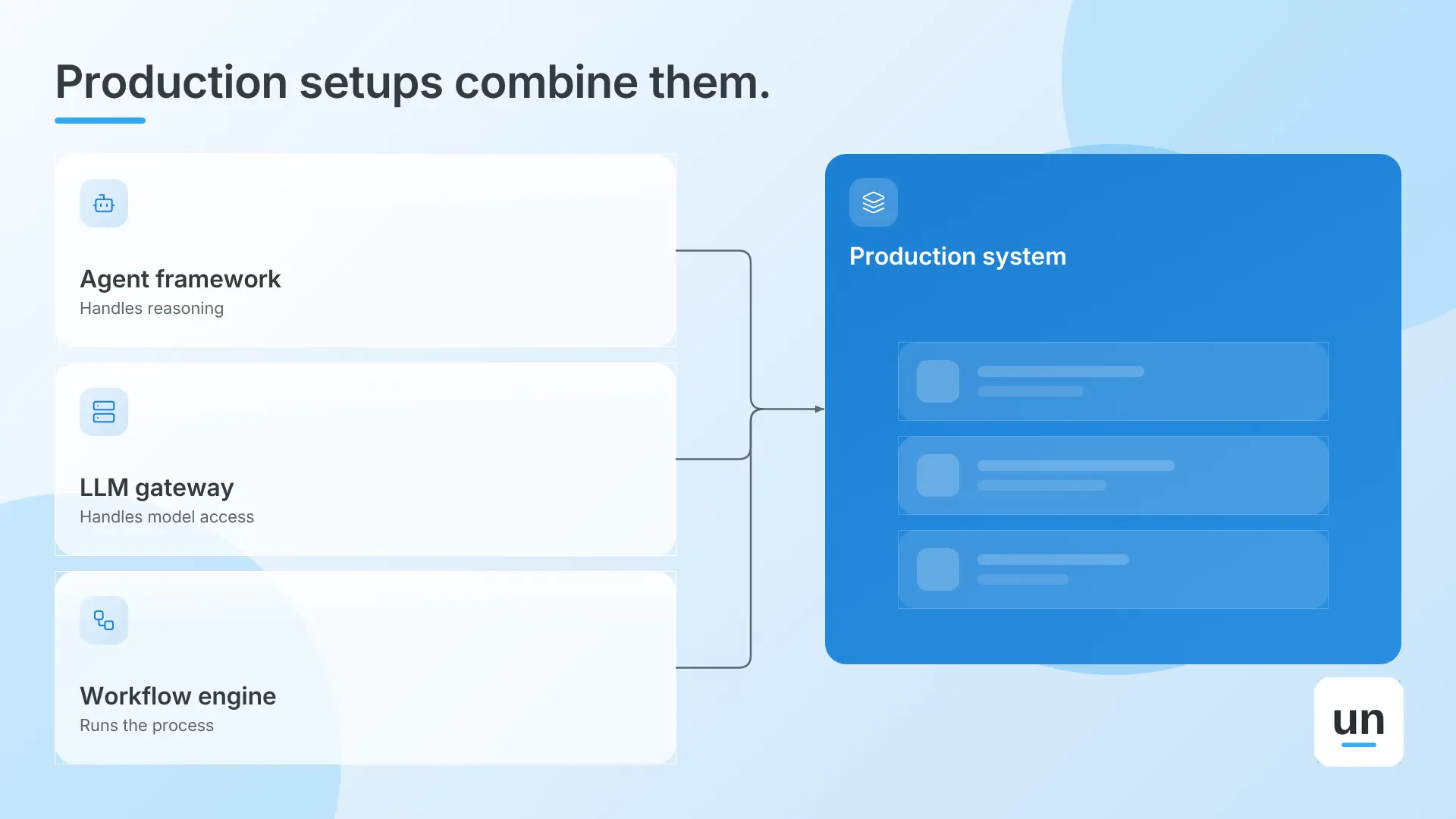
The terms overlap, and that's where most mix-ups start. Each approach has a main job and a point where it stops.
| Approach | Main Job | Where It Stops |
|---|---|---|
| AI orchestration | Coordinates models, agents, pipelines, and processes as a whole | It's an umbrella, so it needs a concrete tool underneath |
| Workflow orchestration | Runs durable, scheduled, multi-step processes | Knows nothing about models unless you connect them |
| API orchestration | Chains and fans out calls across services | Covers the calls, not the reasoning or approvals |
| Agent frameworks | Handles agent reasoning and handoffs | Usually lacks built-in durability, approvals, and audit |
In practice, production setups combine them. A workflow engine runs the process, an agent framework handles the reasoning, and a gateway handles model access.
For a closer look at the engine layer, see our roundup of workflow orchestration tools. For the service layer, start with API orchestration.
11. When Do You Need an Orchestration Layer, and When Don't You?
An orchestration layer is needed when multiple autonomous systems, APIs, or AI agents must work together to complete an end-to-end process. It is usually unnecessary for a single, isolated task or tool.
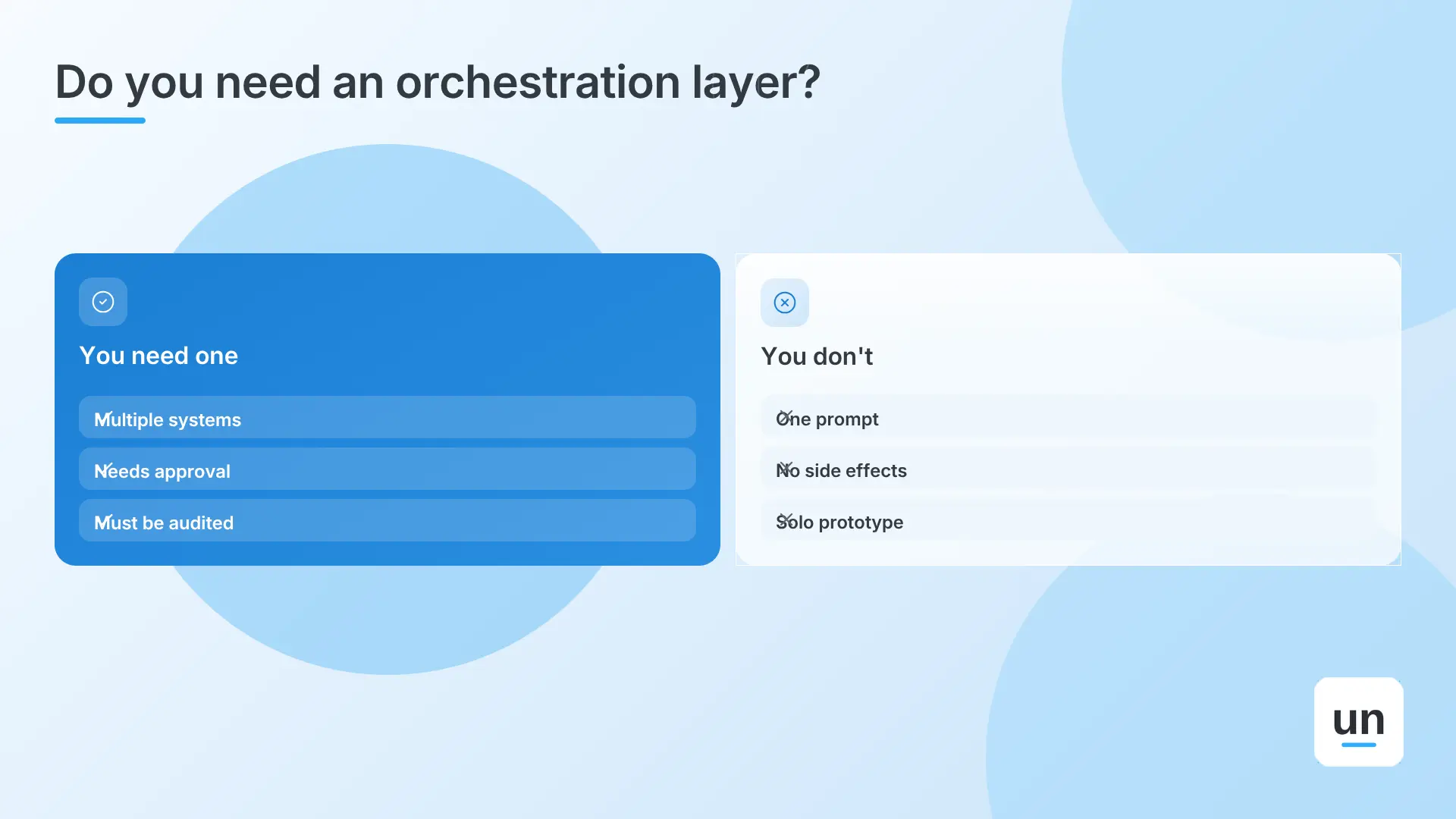
You need one when
- A single run touches more than one model, agent, or system
- A step can fail partway and cost real money to repeat
- A person has to approve something before the run continues
- You need to prove later what the system did and why
- A run lasts longer than one request, such as hours or days
You don't need one when
- It's one prompt, one model, and one response
- Nothing the model does has side effects
- There's no approval or audit requirement
- It's a prototype only you will use
If you're in the second list, skip the layer. Adding it too early costs more than it saves.
12. How Do You Choose an AI Orchestration Platform?
Choosing an AI orchestration platform depends on your team's technical skills, workflow complexity, integration requirements, and governance needs.
Start by naming which of the four types you actually have. That one decision removes most of the options.
- Training and deploying models: Pick a pipeline tool.
- Routing across models: Pick a gateway.
- Teams of agents: Pick an agent framework.
- AI inside business processes: Pick a workflow engine that handles state, approvals, and audit.
Then compare candidates on the criteria below.
| Criterion | What To Ask |
|---|---|
| Durability | Does a run survive a crash or a redeploy, and resume where it stopped? |
| Languages | Can your team write steps in the language it already uses? |
| Governance | Are approvals, access control, and audit logs built in or bolted on? |
| Integrations | Does it connect to the APIs, databases, and models you run today? |
| Cost shape | Does pricing grow with actions or runs, or stay predictable? |
| Observability | Can you inspect and replay any run without extra tooling? |
13. How Does Unmeshed Handle AI Orchestration?
Unmeshed covers AI workflow coordination, the fourth type. It does not cover the other three, and you should know that before you compare tools.
What it covers
- Workflows with durable execution, so state survives crashes and redeploys
- Agentic AI steps that run on the same engine as your other steps
- Human-in-the-loop approvals that pause a run and resume it automatically
- A built-in decision engine for rules that must be exact
- Hosted functions in Python, JS/TS, or Go, plus integrations with over 100 apps
What it doesn't do
- It doesn't run ML training or serving pipelines
- It isn't an LLM gateway for routing across model providers
- It isn't an agent reasoning framework, so it sits underneath one instead of replacing it
The practical difference
Most teams assemble this layer from three tools: a workflow engine, an approval tool, and a logging stack. Unmeshed puts durable state, approvals, rules, and a full run history in one system, built by the creators of Netflix Conductor.
That also makes governance easier. Every step is inspectable, and the same engine backs AI agent governance and its enterprise security controls.
AI Drafts. Rules Decide. A Person Approves.
One workflow, no stitching three tools together. See an AI step, a rules check, and a human sign off run as a single flow.
Wire It UpIn a Nutshell
The phrase covers four jobs, and buying for the wrong one is the most common mistake. Name your type first, then pick the tool that matches it.
If you're building pipelines or routing models, a pipeline tool or a gateway fits. If you're building agent teams, start with a framework. If AI is one step in a process your business already runs, you need durable state, approvals, and an audit trail around it, and that's the layer a workflow engine provides.
Most real systems end up using more than one of the four. That's fine, as long as you know which job each tool does.
Frequently Asked Questions
Sources
Still sorting out which AI orchestration you actually need?
Describe your workflow. We'll tell you where it fits.
Bring the messy version. We'll map it to the right layer, even if the answer isn't us.