TLDR
- Most agentic AI projects don't fail because the model is bad; they fail because the infrastructure underneath isn't there.
- "Agent infrastructure" isn't one thing. It's five layers: runtime/orchestration, identity/governance, data/memory, observability/evals, cost/resource management.
- No vendor, including Unmeshed, covers all five. Anyone claiming otherwise is drawing the map around their own product.
- Unmeshed handles runtime/orchestration and identity/governance. Data/memory and model routing are gaps, stated plainly.
- Fix the layer that's actually breaking for you first. Don't shop for a platform that claims to own the whole stack.
Over 40% of agentic AI projects will be canceled by the end of 2027. That's not a hot take; it's Gartner's own research.
The reason isn't that the models got worse. Teams built agents that worked fine in a demo, then watched them fall apart the moment real traffic, real failures, and real audit requirements showed up.
The model was never the problem. The infrastructure underneath it didn't exist yet.
Search "AI agent infrastructure," and you'll land on five different answers depending on whose guide you read. Four layers in one framework, five in another, seven in a third.
Nobody selling a platform actually agrees on where their own product's edges are, and that tells you something. There's no established standard yet, just a handful of companies drawing the map to match what they already built.
So the useful question isn't which platform covers all of agent infrastructure. Nothing does, honestly.
The useful question is which specific layer is actually breaking for you right now, and what fixes that layer specifically. That's what this guide walks through.
1. What AI Agent Infrastructure Actually Means
AI agent infrastructure is the specialized layer of runtime, identity, data, observability, and cost-control systems that keeps autonomous agents running reliably once they leave the demo and hit production traffic.
That's a mouthful, so here's the shorter version. An agent framework, LangChain, CrewAI, Mastra, whatever you're using to define how the agent reasons and calls tools, decides what the agent does.
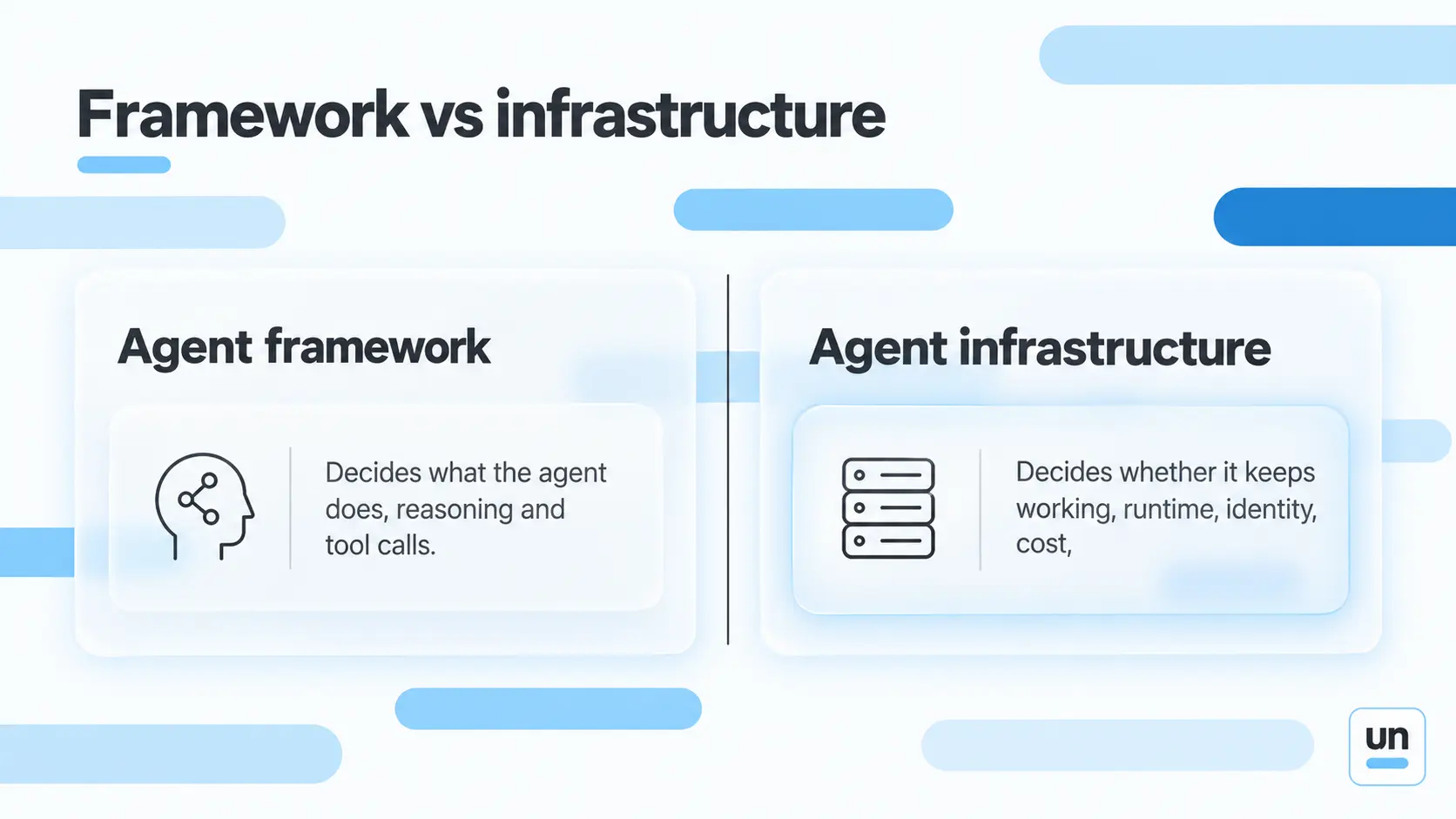
AI agent infrastructure decides whether it keeps doing that reliably at 2 am when a downstream API times out, whether anyone can tell what happened after the fact, and whether the bill for a bad loop shows up before it's too late to stop it.
You can swap frameworks without touching infrastructure, and swap infrastructure without touching the framework. They're genuinely separate problems, which is part of why teams underbuild one while over-investing in the other.
That distinction is worth holding onto for the rest of this guide, because most of the confusion around AI agent infrastructure comes from collapsing it back into the framework conversation.
It's also why "the complete agent infra platform" is such a common pitch, and such an inconsistent one from vendor to vendor. Every version of that pitch draws the boundary in a different place, depending on what the company selling it already happened to build.
2. The Five Layers of AI Agent Infrastructure
Pull up three different guides on this, and you'll get three different layer counts:
- Agentuity's guide settles on four: runtime, orchestration, observability, and cost control
- MindStudio's framework splits it into five: runtime orchestration, identity and authorization, data access and memory, payments and resource management, and observability and debugging
- Other guides add a sixth or seventh cut specifically for memory or security
None of that disagreement is really about the technology. It's about which product each company is selling, and where its edges happen to fall.
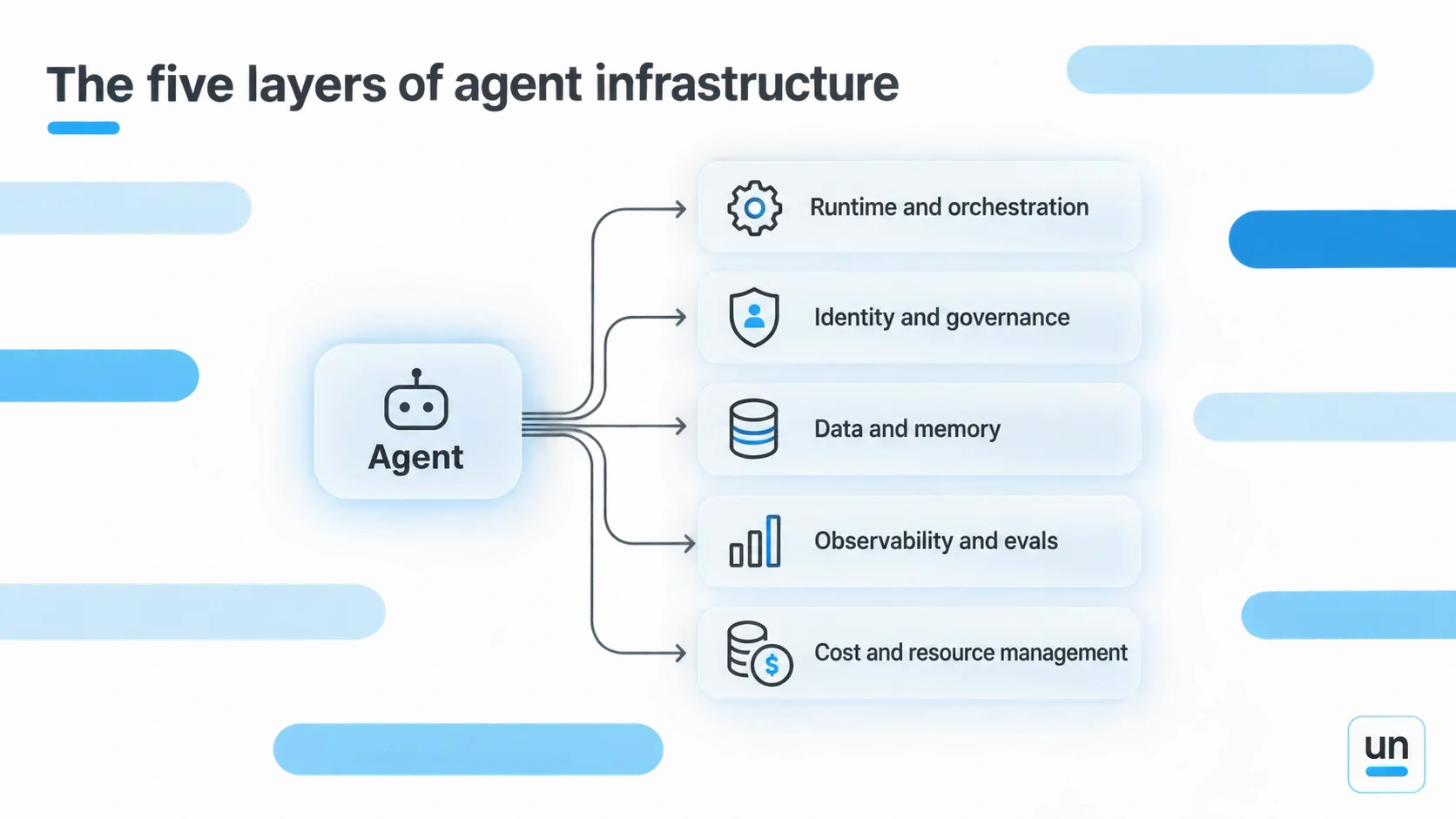
For this guide, five layers cover the ground that actually matters when you're scoping an agent infrastructure stack from scratch:
- Runtime and orchestration
- Identity and governance
- Data and memory
- Observability and evals
- Cost and resource management
Whichever count you land on, the point of mapping AI agent infrastructure this way is to stop treating it as one undifferentiated blob and start treating it as five separate buying, building, or fixing decisions.
| Layer | What Breaks Without It | Where To Look |
|---|---|---|
| Runtime & orchestration | Agents lose state mid-task and can't resume where they left off | Durable execution, API orchestration |
| Identity & governance | No audit trail, no record of what the agent actually touched | Governed AI |
| Data & memory | Agent starts cold every session, or acts confidently on stale context | Not a native layer for most orchestration platforms |
| Observability & evals | A failed run is undebuggable, quality drifts unnoticed | LLM observability, AI agent evals, LLM as a judge |
| Cost & resource management | Runaway spend, no idea which agent is driving the bill | LLM gateway, LLM cost optimization |
Runtime and Orchestration
This is the layer most teams hit first, because it's the one that breaks the loudest. An agent runtime manages:
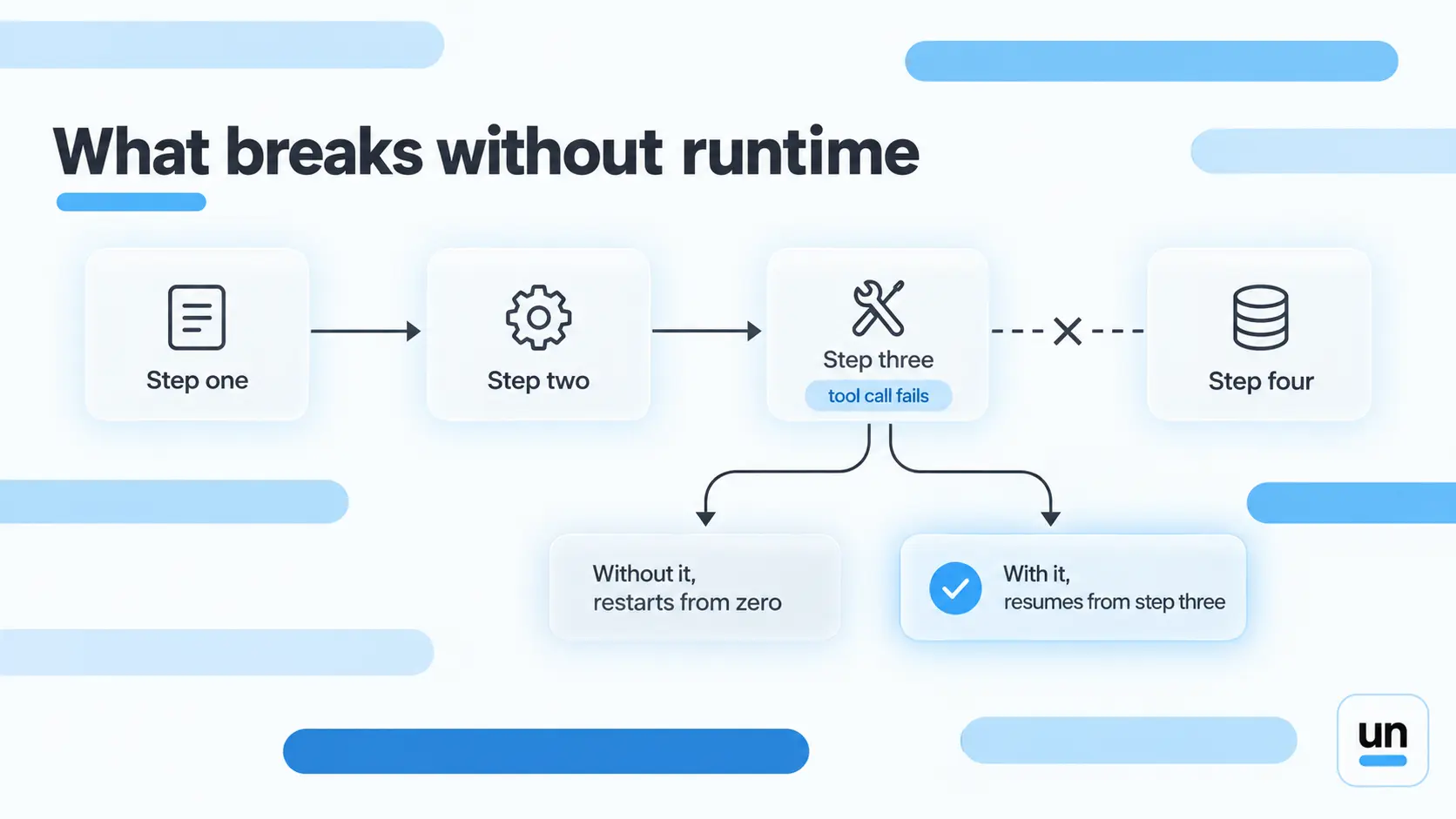
- Which step runs next
- How state carries across a multi-step task
- What happens when a tool call fails partway through
- How the agent resumes after pausing for a human approval or a slow webhook, instead of losing its place
An agent that can't survive a downstream API timeout without restarting from zero isn't production software yet. It's an expensive demo with good uptime.
Get this layer wrong, and every other part of your AI agent infrastructure inherits the instability, because nothing downstream can trust that a run actually finished the way it looks like it did.
We've written about what durable execution actually requires in what is durable execution, and how this differs from plain API orchestration once a workflow includes AI steps and not just service calls.
Identity and Governance
An agent is an identity now, not just a script. It holds credentials, calls tools on someone's behalf, and can rack up real consequences if nobody's watching what it does with that access.
This layer covers:
- What the agent is allowed to touch
- What a human is allowed to authorize through it
- Whether there's an audit trail that would actually hold up if someone asked for one
Skip it, and you get an agent with more standing access than any single person on the team, and no record of how it used it. We covered why this stopped being optional for enterprise teams in governed AI.
Data and Memory
Two different problems live under one label here.
Data access is how the agent retrieves the right information at the right moment, through a vector store, a structured tool call, or context loaded straight into the prompt.
Memory is whether the agent remembers anything between sessions instead of starting cold every single time.
This is the one layer of agent infrastructure most orchestration-first platforms, Unmeshed included, don't own natively. Memory and retrieval usually come from a dedicated vector database or memory service, paired with whatever runs the rest of the workflow, not bundled into it.
It's also the layer most frequently oversold in AI agent infrastructure marketing. A thin retrieval integration is easy to demo and hard to distinguish from real long-term memory until it's under real load. Worth naming plainly rather than stretching a feature to cover a gap that's genuinely there.
Observability and Evals
When a normal API call fails, you check a log line. When an agent fails after thirty tool calls and a dozen model calls, a log line tells you almost nothing.
This layer needs:
- Tracing across the entire run
- Token and cost tracking per session
- A way to tell whether the output was actually good, not just whether it ran without an error
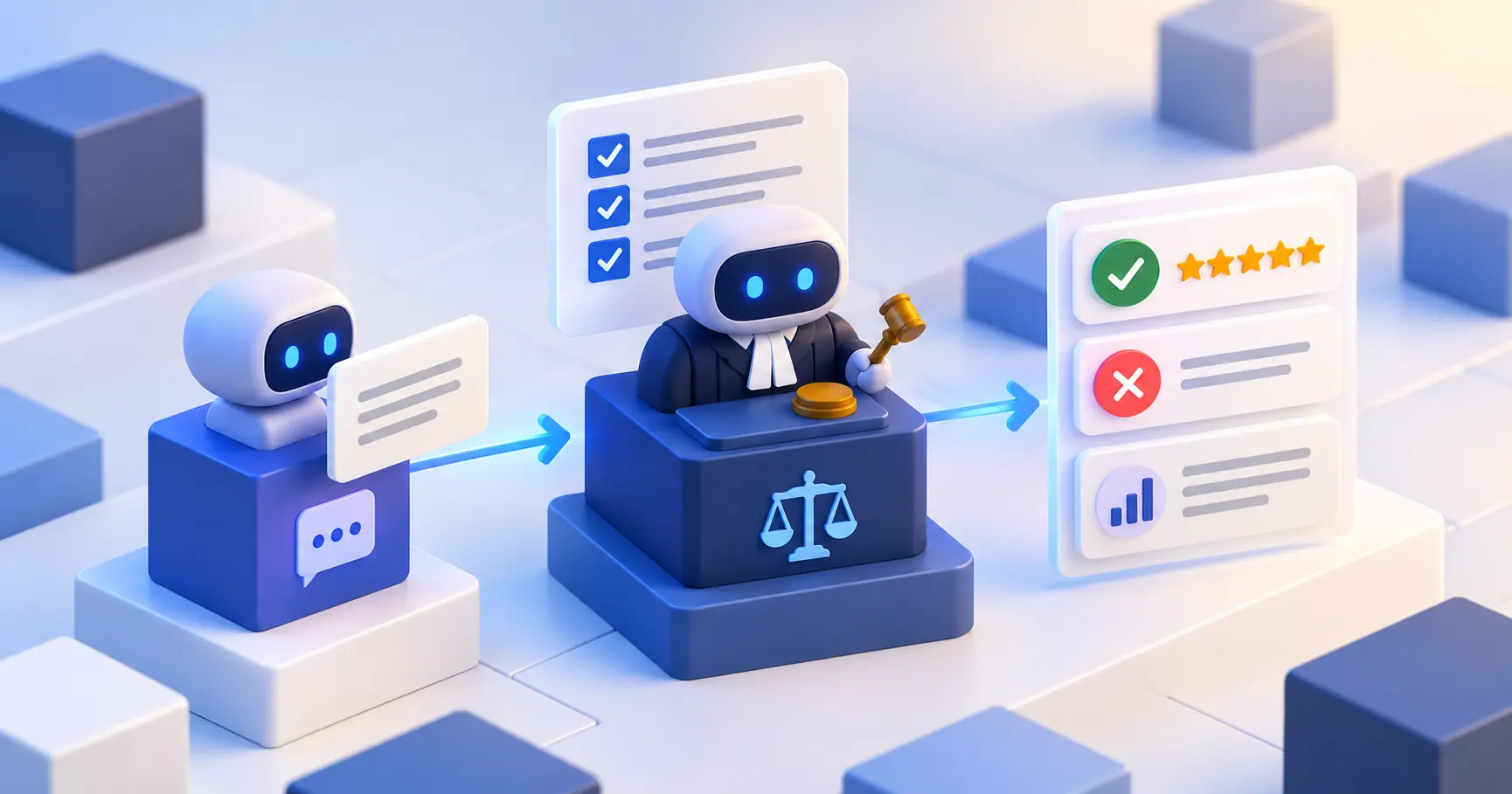
That last part is evals, different from observability even though the two get lumped together constantly. We drew that line explicitly in LLM monitoring vs observability and went deep on the eval side in what are AI agent evals, including how teams automate quality scoring with an LLM as a judge instead of a human reading every transcript.
Cost and Resource Management
A single LLM call costs fractions of a cent. An agent making a hundred calls across multiple providers, in a loop that doesn't know when to stop, costs real money, and the invoice usually arrives after the damage is done.
This layer covers:
- Token budgets per run
- Rate limiting against downstream services
- Cost attribution, so you know which agent, user, or workflow is actually driving the number
Multi-provider billing is its own headache here, which is exactly the problem an LLM gateway exists to solve. If runaway spend is the actual pain point, this is also where techniques like the ones in LLM cost optimization pay off fastest.
Left unmanaged, this is the layer of AI agent infrastructure that turns a promising pilot into a budget conversation nobody wanted to have.
3. Where Unmeshed Fits, and Where It Doesn't
No hedging on this one. Unmeshed covers two of the five layers directly:
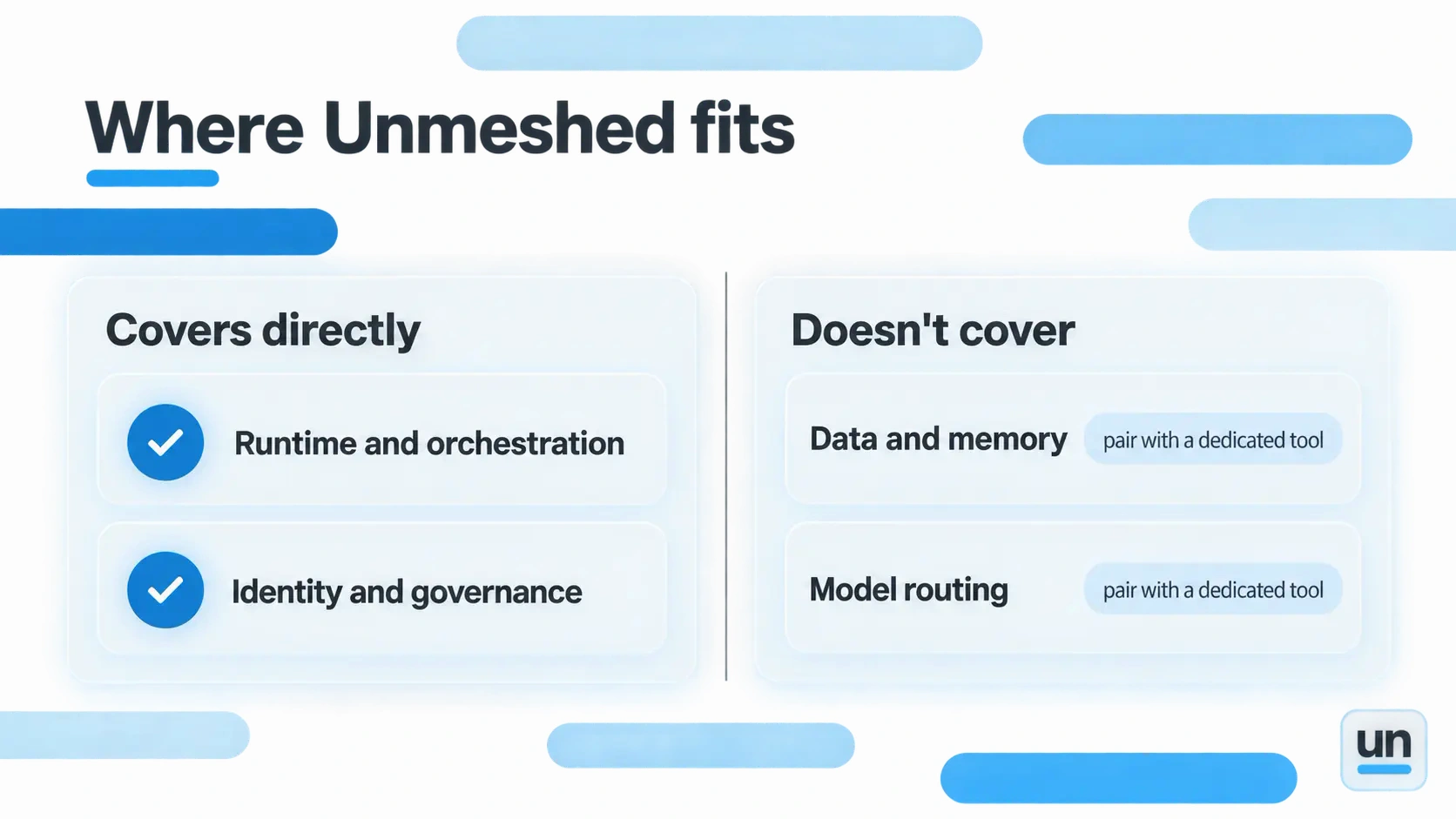
- Runtime and orchestration: Durable execution that survives a failed step and resumes instead of restarting, with workflow-level state kept automatically
- Identity and governance: Human-in-the-loop approvals, a decision engine for branching logic, and audit logging on every step, so "what did the agent actually do" has a real answer
It does not cover two of the five:
- Data and memory: No built-in vector store or long-term memory layer, and pretending otherwise would be the kind of overclaiming this guide is arguing against
- Model routing: It doesn't function as an LLM gateway for multi-provider routing; that's a separate, complementary piece
If your gap is specifically in one of those two layers, you're pairing a dedicated tool with whatever runs your orchestration. That's true whether the orchestration layer is Unmeshed or anything else.
Most AI agent tooling on the market is built to solve one of these layers well and imply, quietly, that it solves the rest. Being specific about which two is more useful than a feature list that stretches to cover the gaps.
Two of These Five Layers, Handled
Durable execution and governed, auditable agent steps are built in. See what that actually looks like before you build it yourself.
See It In Action4. Build, Buy, or Assemble
No single agent infra platform actually owns all five layers. The guides that claim to are drawing generous lines around their own product.
Most teams end up assembling from two or three specialized tools rather than buying one platform that does everything. That's not a failure of the market; it's just where the market actually is right now.
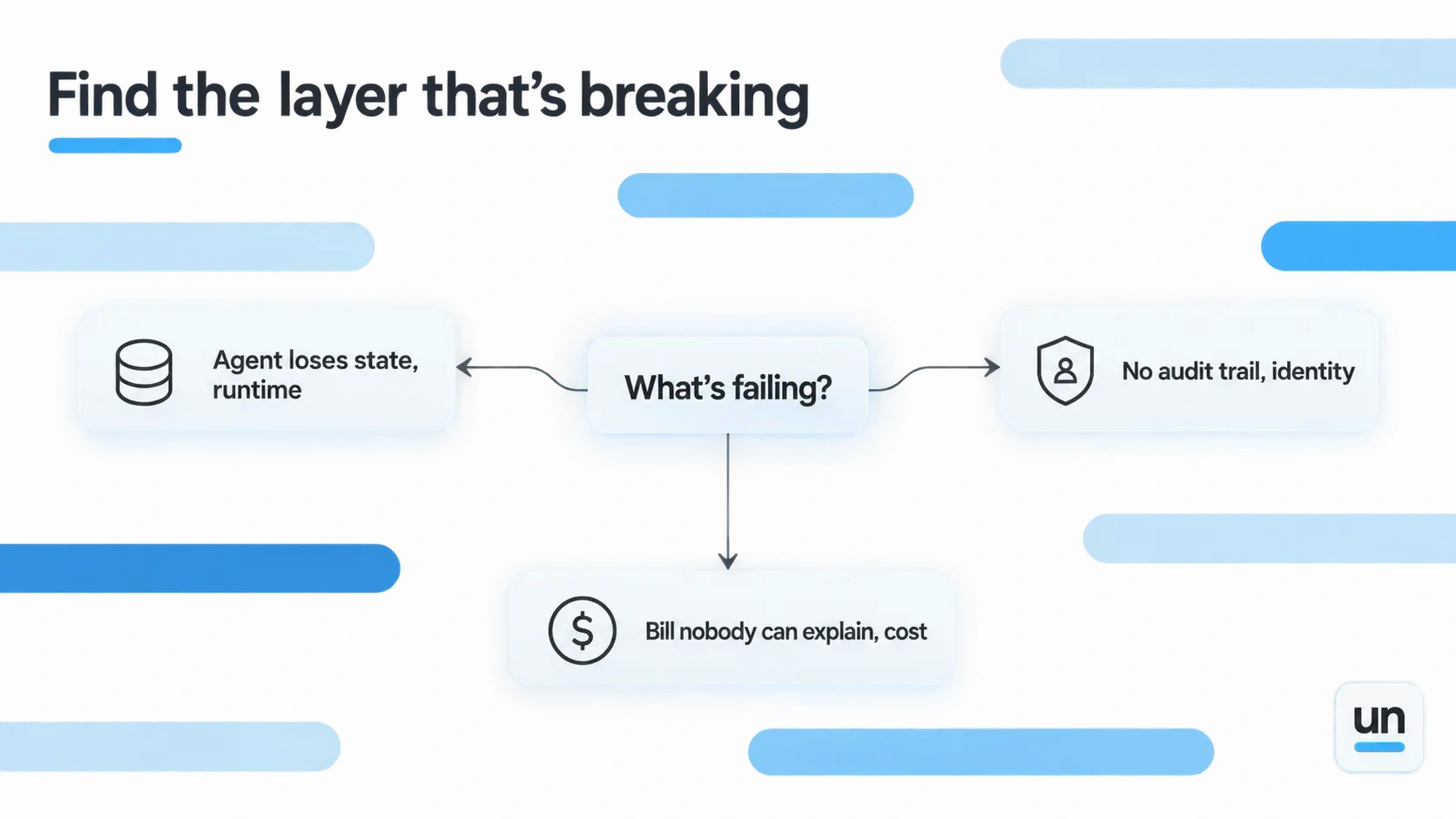
A practical way to decide where to start: figure out which layer is causing you pain today, not which one sounds most important in the abstract.
| What's Actually Happening | The Layer That's Missing |
|---|---|
| Agents keep losing state on failure | Runtime and orchestration |
| Nobody can answer what an agent did last Tuesday | Identity and governance |
| The agent gives confidently wrong answers from stale context | Data and memory |
| A production incident takes hours to diagnose | Observability and evals |
| Last month's bill had a number nobody can explain | Cost and resource management |
Solve the layer that's actually on fire first. The rest of the agent infrastructure stack can wait until it's the one causing the pain.
That's the practical reality of AI agent infrastructure today, whatever a sales deck implies about full coverage.
Conclusion
AI agent infrastructure isn't a single product category, whatever the pitch decks say.
It's five layers that different vendors draw differently. The honest starting point is knowing which one is actually failing you, not shopping for a platform that claims to own all of them.
Runtime and orchestration, identity and governance, data and memory, observability and evals, cost and resource management.
Name the layer that's breaking, fix that one, and build out from there instead of trying to solve all five on day one.
Still scoping your agent infrastructure stack? Talk to us about which layers you're missing, and whether Unmeshed covers the ones that matter most for your use case. Start The Conversation
Frequently Asked Questions
Sources
- 1.Gartner Predicts Over 40% of Agentic AI Projects Will Be Canceled by End of 2027 - Gartner newsroom, June 2025
- 2.AI Agent Infrastructure: The Complete Guide - Agentuity (original article title)
- 3.AI Agent Infrastructure: The 5 Control Layers That Decide If Your Agent Ships - MindStudio (original article title)
Still scoping your agent stack?
Figure out what you actually need to build
Talk to us about which layers you're missing, and whether Unmeshed covers the ones that matter most for your use case.