
TLDR
- Teams don't leave Airflow over DAGs. They leave because keeping the scheduler alive eats a good engineer's week.
- No single best alternative. The right pick depends on which specific cost is actually yours.
- Dagster and Prefect fix Airflow's Python/testing pain. Flyte and Mage are built specifically for ML pipelines.
- Kestra and Unmeshed go beyond pure data pipelines, handling APIs, approvals, and AI steps in the same run.
- Google Cloud Composer isn't really an alternative; it's managed Airflow, same constraints, less ops work.
Ask five data engineers why they're looking at Airflow alternatives, and four of them won't say a word about DAGs or batch versus streaming. They'll tell you about the Tuesday they lost to a scheduler bug instead of shipping the pipeline someone actually needed. Yeah, that's usually how it actually goes.
Most comparisons skip that part. They'll walk you through Airflow's batch-first design and its weak observability, both real, both true. What they leave out is the quieter cost, and honestly, it's the one that actually gets people looking for a way out. A good engineer spends the week keeping Airflow alive instead of doing the job they were hired for.
It can suck, plain and simple.
The eight tools in this guide fix that in different ways. A couple just take Airflow off your plate and manage it for you. A couple rebuild the model so testing and lineage aren't things you bolt on later. And a couple assumes your pipeline was never really just a pipeline; it calls an API, it waits on a person, it runs a model somewhere in the middle.
Pick based on which of those is actually costing you time, not on which tool has the loudest GitHub page. Pretty simple, once you frame it that way.
1. Why Teams Actually Leave Airflow
Airflow's core design is time-indexed. Every task is anchored to an execution date, which made complete sense when it was built for nightly batch jobs. It stops making sense the moment work needs to react to an event, hold for a human, or run somewhere close to real time.
That's one real constraint among several. Here's what actually shows up once teams start lining up Airflow alternatives and Apache Airflow competitors side by side:
- A schedule-first execution model: That fights event-driven or streaming work instead of handling it natively
- Real operational weight: A scheduler, a metadata database, and workers, all needing someone to patch, upgrade, and babysit
- Thin native observability: Tracing a failed DAG back to its root cause often means digging through logs by hand
- Hard-to-test pipelines: Writing real test cases against jobs that touch raw, messy data is genuinely difficult, and most teams just don't do it well
None of these are reasons to panic. They're reasons to get specific about which one is actually yours before picking a replacement. Run your own workflow scheduler comparison before you commit to anything, since the right fit depends entirely on which failure mode is actually costing you time.
2. Airflow Alternatives, Grouped by the Problem They Solve
This is how Airflow alternatives actually break down for most teams, less Airflow vs alternatives as one clean race and more four different problems with four different fixes:
- Want asset-level lineage and real testing? Dagster rebuilds the model around that.
- Want Python-native without the DAG-authoring tax? Prefect and Windmill both cut that overhead, in different ways.
- Want one control plane across more than just data pipelines? Kestra and Unmeshed both go wider than pure data pipeline orchestration.
- Want to keep Airflow but stop running it yourself? Google Cloud Composer does exactly that, nothing more, nothing less.
Flyte and Mage sit in their own lane too, built specifically around ML pipelines rather than general-purpose data work, which is worth knowing before you compare them head-to-head with the rest of this list.
3. The 8 Tools at a Glance
Before picking one, here's how these eight Airflow alternatives actually stack up on price and fit.
| Tool | Pricing | Best For |
|---|---|---|
| Dagster | Free (Apache-2.0); Solo $10/mo; Starter $100/mo; Pro/Enterprise custom | Asset lineage and testable pipelines |
| Prefect | Free tier; paid Cloud tiers scale by usage | Python-native workflows, less DAG overhead |
| Kestra | Free OSS; Cloud usage-based; Enterprise custom | One control plane across data, AI, and infra |
| Mage | Free OSS; from $0.29/compute hr or $100/mo | UI-first pipelines for data scientists |
| Flyte | Free and open source (Apache 2.0) | Kubernetes-native ML pipeline orchestration |
| Windmill | Free tier (1,000 exec/day); Team $10/user/mo | Fast, script-first internal tools and pipelines |
| Google Cloud Composer | Consumption-based, ~$0.35-$0.85/hr environment fee | Managed Airflow for GCP-committed teams |
| Unmeshed | Free forever; Premium $20/mo | Pipelines that also need APIs, approvals, or AI steps |
4. The 8 Apache Airflow Alternatives Tools, One by One
Here's how each of these eight Airflow alternatives actually holds up once you look past the landing page.
1. Dagster
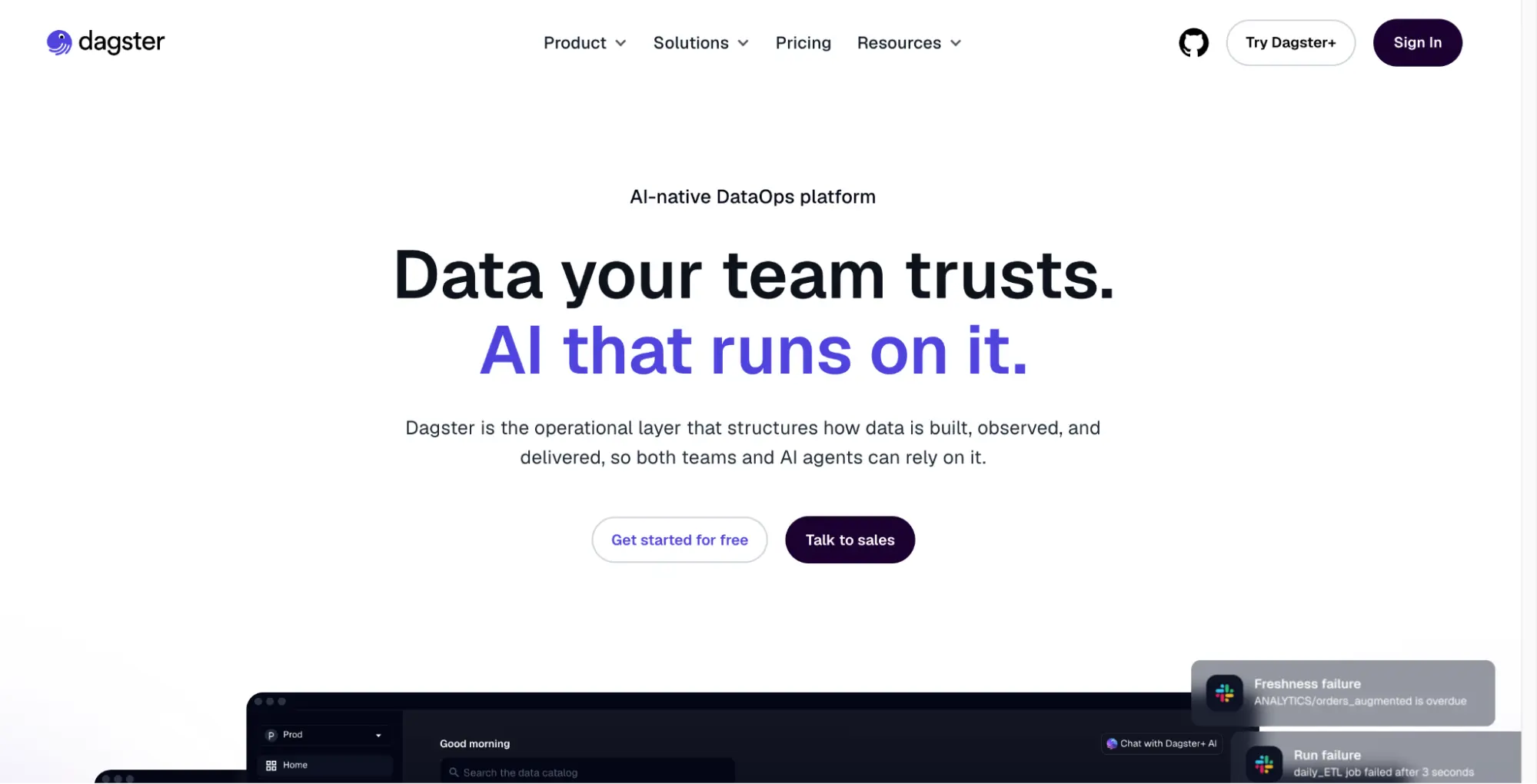
Dagster throws out Airflow's task-first thinking and models workflows as a graph of data assets instead: tables, files, ML models, anything your pipeline actually produces. That shift sounds academic until you're the one debugging a failure and can trace it straight to the asset that broke, instead of a task ID buried three DAGs deep.
- Software-defined assets with built-in lineage tracking
- A real testing story: unit tests against assets, not just integration tests against a whole DAG run
- Free and open source under Apache-2.0, with paid tiers starting at $10/month for a managed Solo plan
The tradeoff: asset-centric thinking has a real learning curve if your team has spent years reasoning in Airflow's task-first model. It's worth it for the lineage and testability, but budget time for the mental shift.
2. Prefect
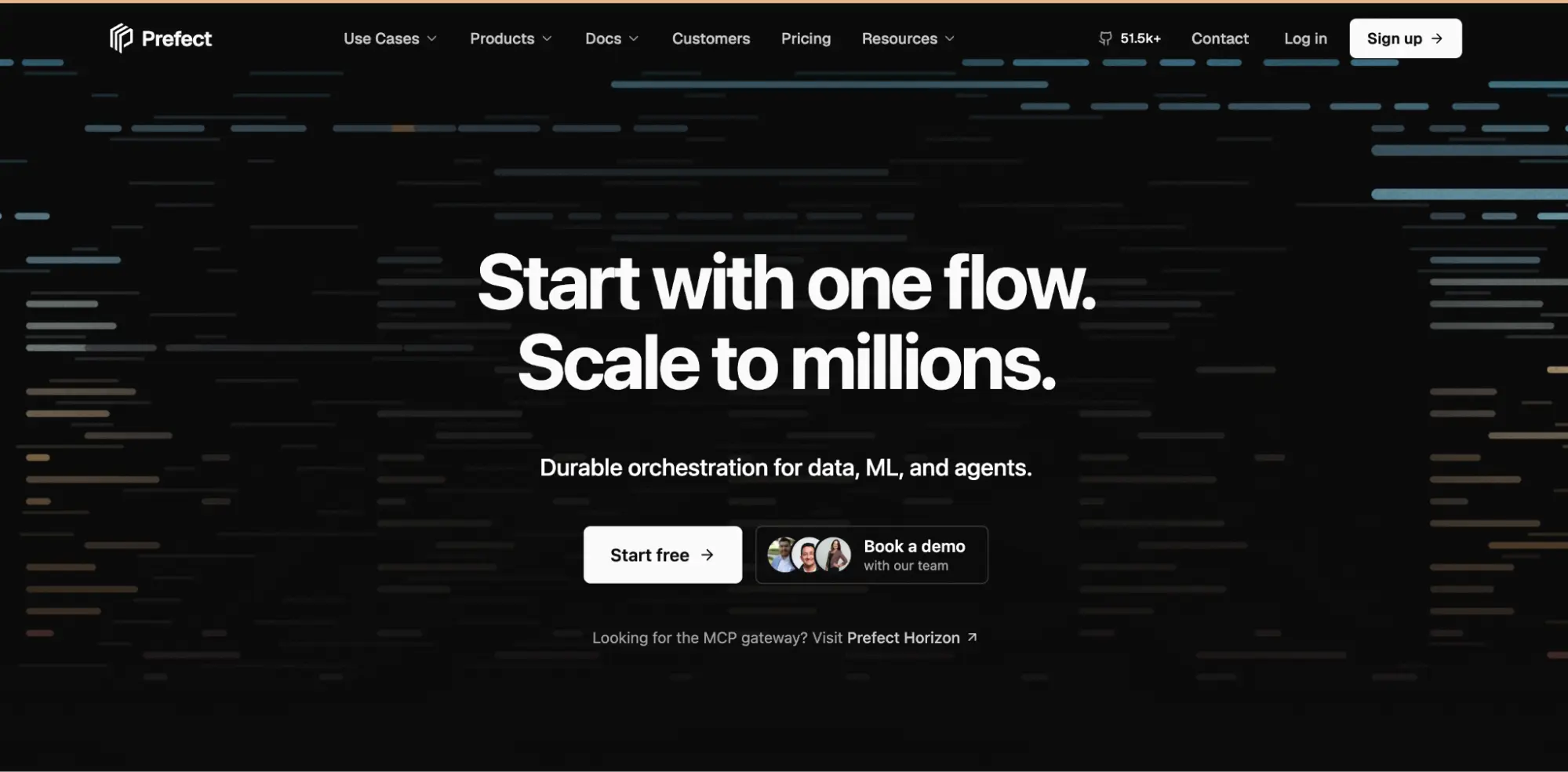
Prefect's pitch is simple. Write your pipeline as plain Python functions, and let Prefect handle the orchestration underneath, no separate DAG syntax to learn or maintain.
- Workflows defined as ordinary Python, decorated rather than declared
- Dynamic, runtime-defined flows instead of Airflow's static DAG structure
- A free tier for individuals and small teams, with paid Cloud tiers that scale by usage; confirm current rates directly since published per-seat figures vary
The tradeoff: Prefect's operator ecosystem is smaller than Airflow's decade of accumulated integrations. For common sources and destinations, that's rarely an issue. For niche systems, check before you commit.
3. Kestra
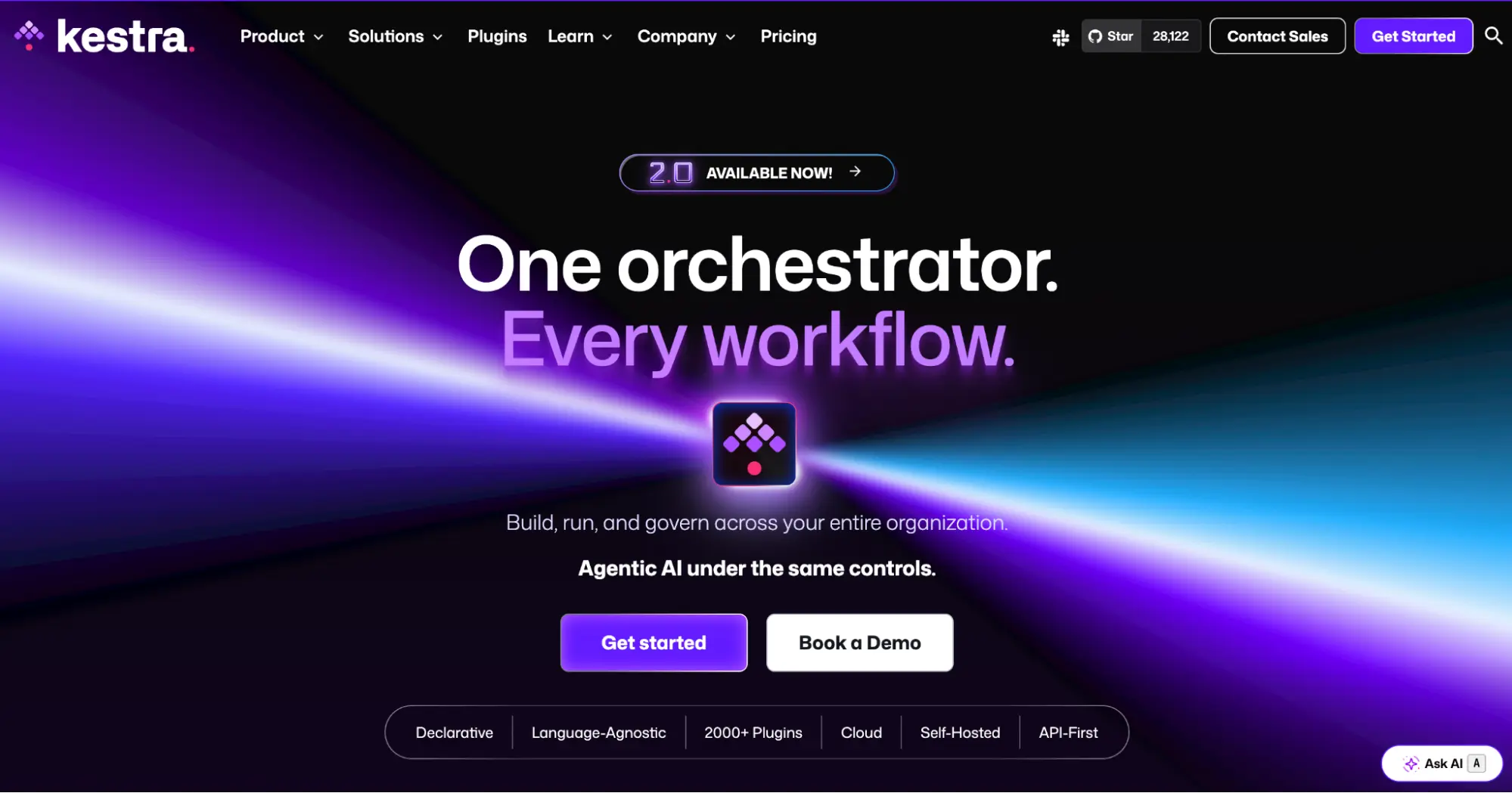
Kestra is the one growing fastest on this list, and the growth isn't just marketing. The company raised a $25 million Series A led by RTP Global in March 2026, and the announcement noted the platform now runs across 30,000-plus organizations, including Bloomberg, Toyota, and JPMorgan Chase, executing more than 2 billion workflows in 2025 alone.
What it actually does differently: Kestra treats data pipelines, AI workflows, and infrastructure automation as one declarative, YAML-based control plane instead of separate tools bolted together. One customer put it plainly in a testimonial on Kestra's own pricing page:
- Declarative, event-driven workflows across data, AI, and infrastructure in one plugin ecosystem
- Free open-source core, unlimited flows and executions
- Kestra Cloud is fully managed and usage-based, currently request-access only
The tradeoff: it's newer than Airflow, so the deep well of Stack Overflow answers and battle-tested tribal knowledge that Airflow has built up over a decade simply doesn't exist yet for Kestra. Still, among Airflow alternatives aiming to be one control plane rather than one more point solution, Kestra's growth is hard to ignore.
4. Mage
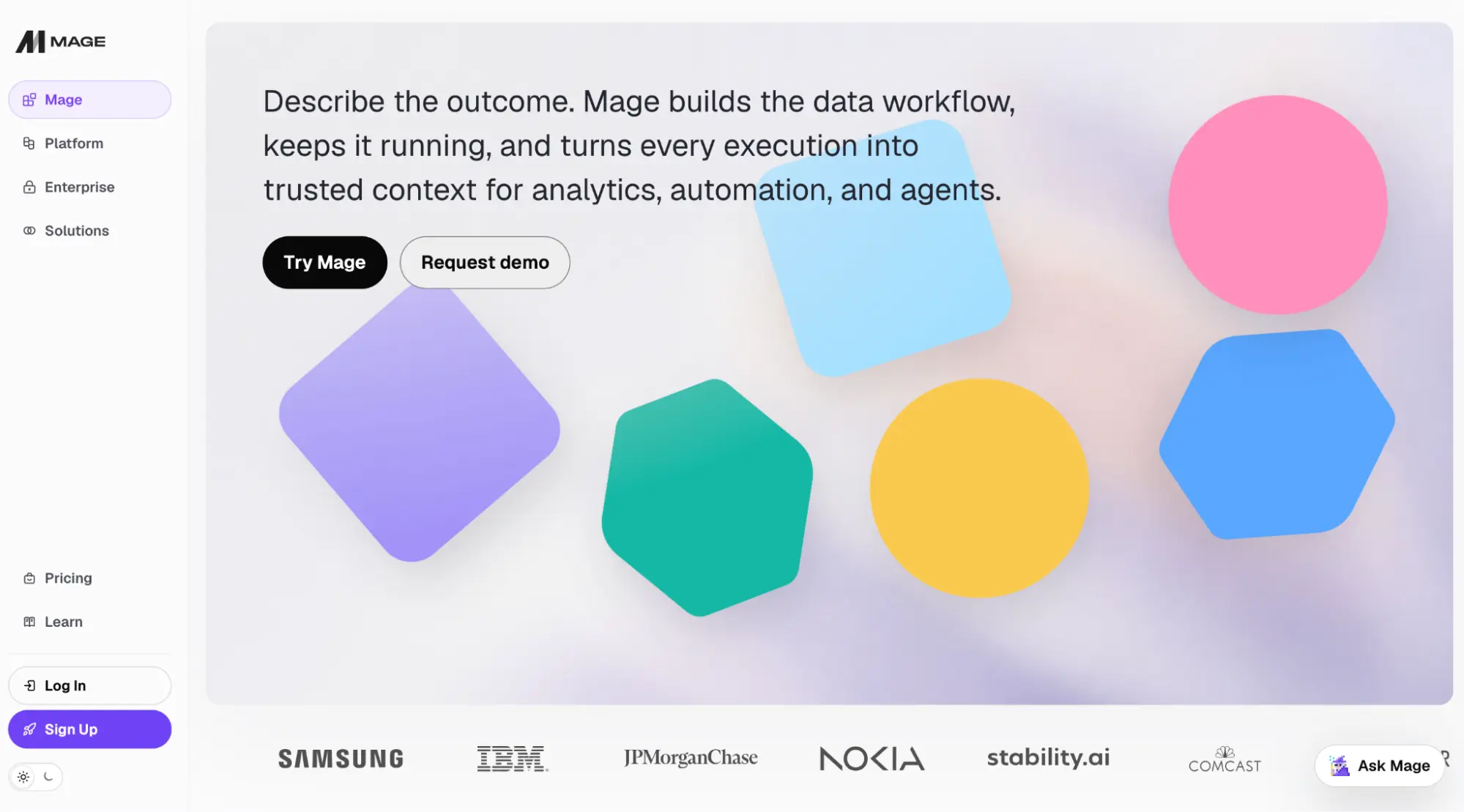
Mage leans hard into a clean, notebook-style UI, which is exactly why data science teams tend to reach for it over Airflow. Building and testing a pipeline step feels closer to working in a notebook than writing a DAG file from scratch.
- Real-time and batch pipelines in the same tool, with a visual pipeline editor
- Free open-source version, with hosted pricing from $0.29 per compute hour or a flat $100/month, scaling to $500/month for Team and $2,000/month for Plus
- Built to lower the bar for data scientists, not just platform engineers
The tradeoff: at very large scale, with deeply nested, complex DAG logic, Mage is less battle-tested than Airflow or Dagster. It's strongest for teams whose pipelines are more numerous than they are architecturally complex.
5. Flyte
Flyte came out of Lyft's own ML infrastructure needs and now runs as a Linux Foundation project, which matters if procurement ever asks who governs a tool you're about to depend on.
- Kubernetes-native, with versioned, reproducible ML pipelines as a first-class concept
- Strong typing between pipeline steps, catching data-shape errors before a job runs, not after it fails halfway through
- Fully open source under Apache 2.0, genuinely free to run
The tradeoff: you need a Kubernetes cluster and the operational maturity to run one. If your team doesn't already live on Kubernetes, that's a bigger lift than switching orchestrators.
6. Windmill
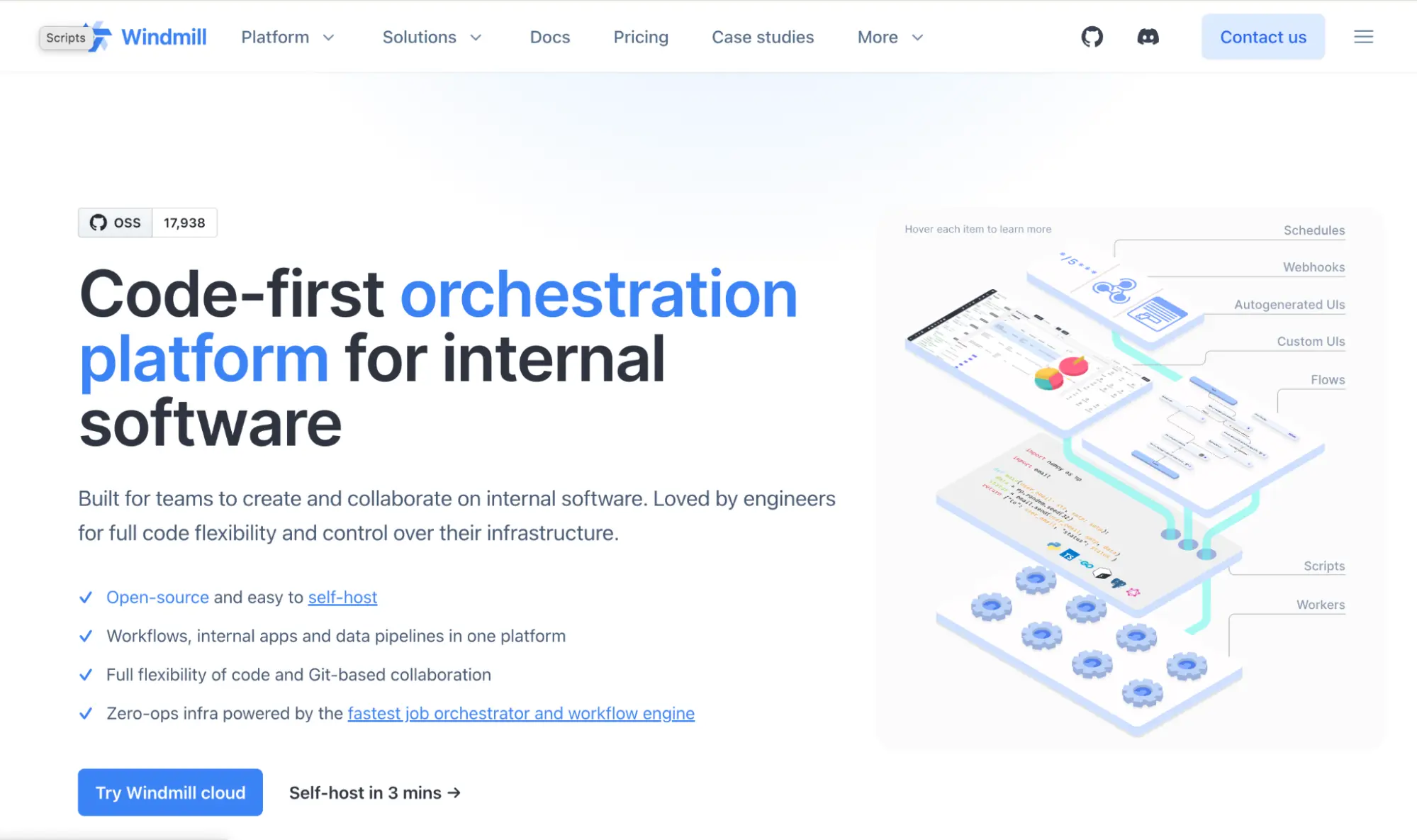
Windmill skips DAG ceremony almost entirely. Write a script in Python, TypeScript, or a handful of other languages, and Windmill turns it into a workflow step, fast, with a UI that leans toward internal tools as much as data pipelines.
- Script-first workflow steps, minimal boilerplate between writing code and running it as a pipeline step
- A free cloud tier covering 1,000 executions a day, Team pricing at $10 per user per month
- Self-hosted Community edition is free; Enterprise self-hosted splits pricing between developer and operator seats, a real cost lever for teams with more viewers than builders
The tradeoff: Windmill is built more for fast internal tools and scripts than for the kind of long-running, dependency-heavy batch DAGs that were Airflow's original reason for existing. Great fit for some teams, wrong tool for others.
7. Google Cloud Composer
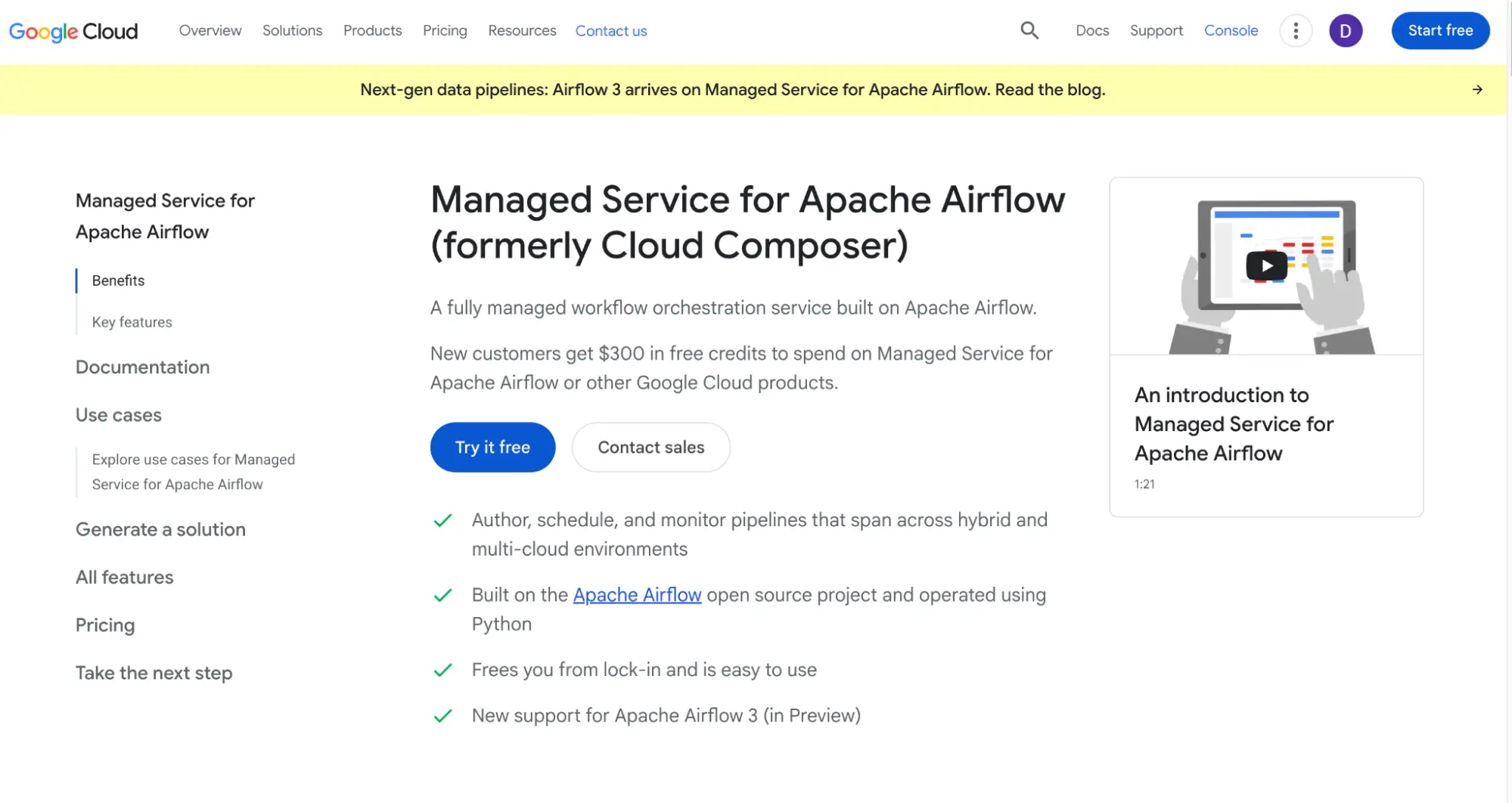
Composer is, plainly, managed Airflow. Same execution model, same DAG syntax, same operators, just running on Google's infrastructure instead of yours.
- Everything your team already knows about Airflow carries over directly, zero relearning
- Consumption-based pricing, with an environment fee of roughly $0.35 to $0.85 per hour depending on size, commonly landing around $300 to $350 a month for a small environment
- Google handles the scheduler, metadata database, and worker infrastructure
The tradeoff, and it's an important one: Composer removes the operational tax, but it doesn't touch Airflow's underlying design constraints. The time-indexed execution model, the thin observability, all of it comes along for the ride. Of every option on this list of Airflow alternatives, this is the only one that's honestly not an alternative at all; it's Airflow, minus the part that was actually hurting you.
8. Unmeshed
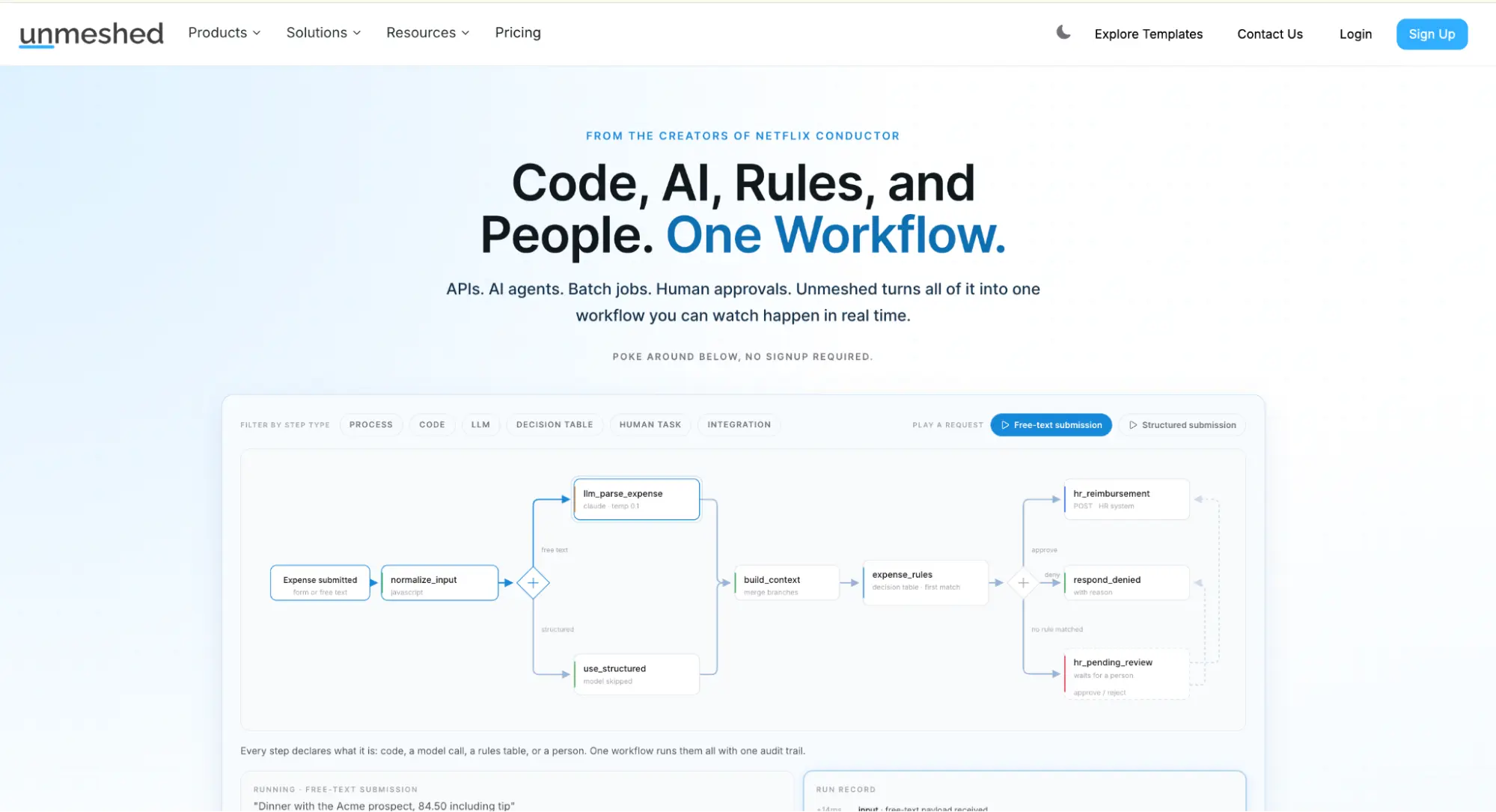
Unmeshed is not a drop-in Airflow replacement for a pure ETL shop, and it shouldn't be pitched as one. It matters here for a narrower, real reason: some data pipelines aren't just data pipelines. They call three APIs, wait on a person to approve something, or hand a step to an AI agent, and none of those fit naturally into Airflow's world.
- Batch job processing alongside API calls, rules, human approval, and Agentic AI steps in the same run, not four separate systems stitched together
- Free forever tier covering 1,000 workflow runs and 1,000 AI agent calls a month; Premium at $20/month
- Changes to workflow logic ship without a redeploy, which matters once something is actually running in production
The honest scope note: if your pipeline is genuinely just data in, transform, data out, this is more platform than you need. If it's data plus everything else, it's worth a real look, and we've written more broadly about how this compares across the wider workflow orchestration category for teams weighing it against Temporal, Camunda, and the rest.
5. Which Airflow Alternative Actually Fits
All eight Airflow alternatives above solve a real problem. Only one or two solve yours.
If the real cost is operational overhead and your pipelines are otherwise fine, Google Cloud Composer removes that tax without asking you to relearn anything.
If you want lineage and real tests without giving up Python, Dagster or Prefect are the two worth a proof of concept: Dagster for the asset model, Prefect for the lighter touch.
If your pipelines are really ML training jobs, Flyte's Kubernetes-native model and strong typing are built exactly for that, and Mage is the softer landing if your team leans more data science than platform engineering.
If you're building something closer to internal tools than classic batch DAGs, Windmill's script-first model fits better than any DAG-based tool on this list.
And if what you're actually running was never a pure data pipeline, if it calls APIs, waits on people, or runs AI steps, that's the case for Kestra or Unmeshed over anything built purely for data pipeline orchestration.
Final Thoughts
There's no single best pick among these Airflow alternatives, and any list that hands you one probably didn't ask what was actually costing you time in the first place.
The operational tax, the lack of lineage, the DAG-authoring overhead, the fact that your pipeline secretly needs a human in the loop- these are different problems with different fixes.
Match the tool to the actual problem and the decision gets a lot less complicated than the marketing pages make it look.
Still not sure which bucket you're in? Talk it through instead of guessing. Talk To Us
Frequently Asked Questions
Sources
Still weighing Airflow alternatives?
Find out if you actually need a data-only tool
Try Unmeshed free, or talk to us about what a migration off Airflow actually looks like.