

Concepts
Workers
Most Processes can be implemented by using Unmeshed's built-in Steps. These Steps run directly on the Unmeshed Engine and are designed for simplicity, performance and scalability. There are cases, however, when it may be more desirable to run workloads outside of Unmeshed. Some reasons could include:
- When Unmeshed does not have access to data due to organization policies
- When business logic already exists elsewhere but is not available via APIs
- When built-in Steps do not provide a viable solution
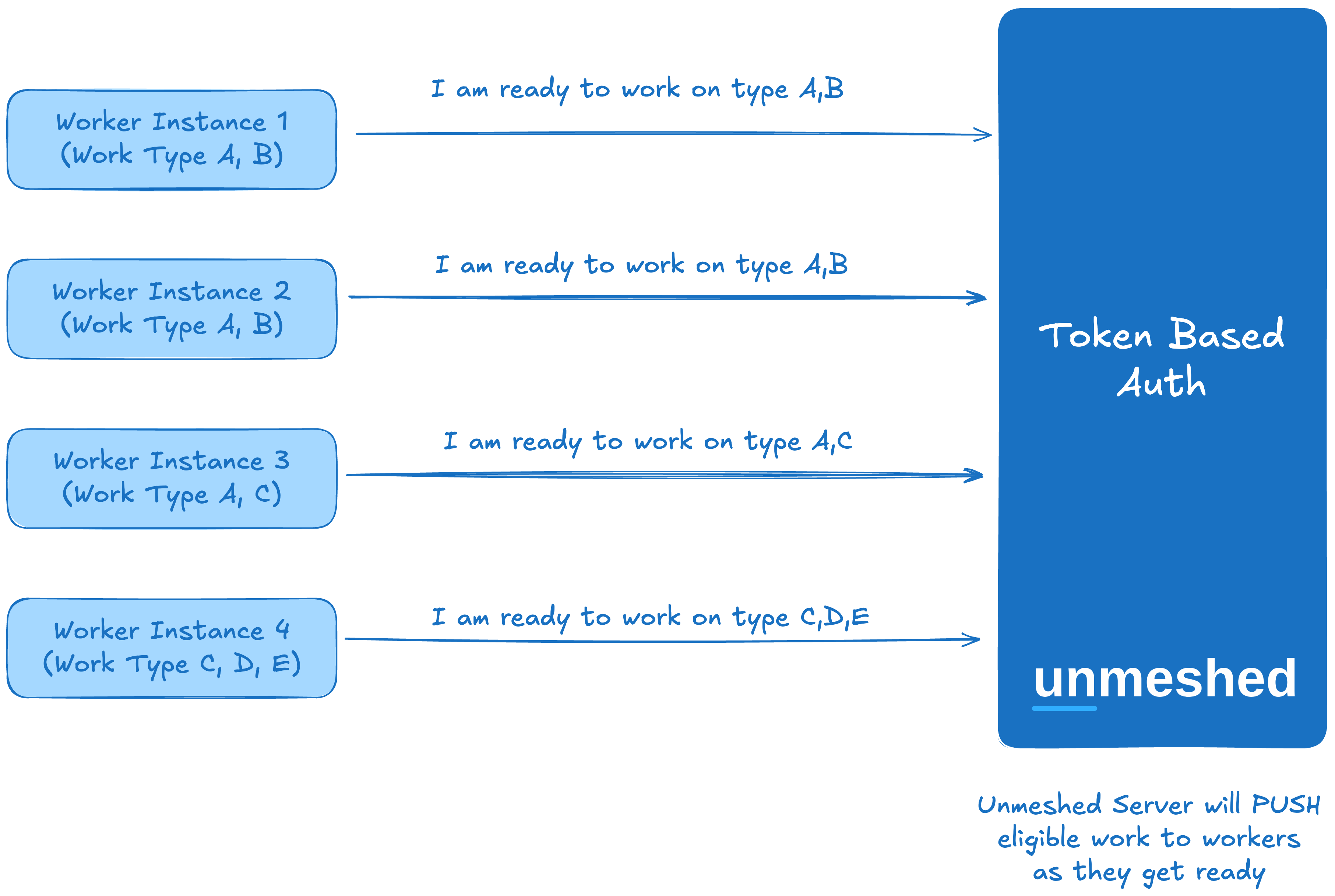
To support these cases, Unmeshed uses the concept of Workers. Workers are external clients that connect to the Unmeshed server and poll for work that needs to be executed. As soon as work is available, Unmeshed issues the work to the Worker by sending the parameters provided by the relevant Step, and manages execution of the Worker code in the same way it manages any other tasks. Put differently, even though the code isn't directly executed on Unmeshed, the platform still ensures a timely execution and reschedules the work should any issues arise.
Video Overview: Workers or Custom Code in Unmeshed
Github Codebase for Java SDK Example
Github Codebase for Java SDK Example
What language can I write my worker code in?
We have a simple API based integration model and you can write your workers in any language of your choice. You can use our SDKs to simplify this. First-party SDK guides are available for Java, JavaScript/TypeScript, Go, and Python. If you prefer another language, you can still integrate with the API-based model.
Our SDKs are lightweight and is strictly intended to manage token auth and efficient retrieval of work.
Restricting Worker Clients
Worker SDK clients can be limited to specific namespace:workerName entries through the API client user's Allowed
Workers Policy. This lets a client credential register, poll, and submit only for the workers it is allowed to execute.
See Restricting Client Credentials to Workers for the detailed setup guide.
Where can I find the SDKs?

Java SDK
Available
Open SDK documentation

JavaScript/TypeScript SDK
Available
Open SDK documentation

Go SDK
Available
Open SDK documentation

Python SDK
Available
Open SDK documentation
Can the workers scale?
In a single node cluster we have demonstrated running up to 5000 workers completing per second include simulated worker delays. Our servers can handle any scale you require. Once you cross the capacity of a single node, you can add on more nodes to achieve more scale.
Example
Here's an example of the Java based worker