TLDR
- Ten companies- Klarna, Zendesk, Spellbook, EvenUp, Qonto, Carvana, DXC, Atlassian, Supermetrics, and GitHub- show what AI agents do in daily work today.
- Every number is the company's own claim, and nobody audited it. Klarna's figures date from February 2024.
- The bike analogy sorts agents by how much they do alone, from suggesting, to acting after approval, to acting within limits.
- The agents that work keep a person at the point of consequence, so someone approves, signs, or turns things live.
- Unmeshed runs the steps around your agents, with approval steps, retries, durable runs, and a log of every step. We don't build the agent or the model.
AI agents for business get talked about a lot and shown very little. Most posts say agents will "transform" support or finance and then stop, which gives you nothing to act on.
So we did it differently. We picked ten companies that run agents in daily work and read what each one says about the job, the result, and who still checks the work. Every number below comes from the company itself. Nobody audited them, and we haven't run any of these agents ourselves. Klarna's figures date from its February 2024 launch post, so read them as a snapshot.
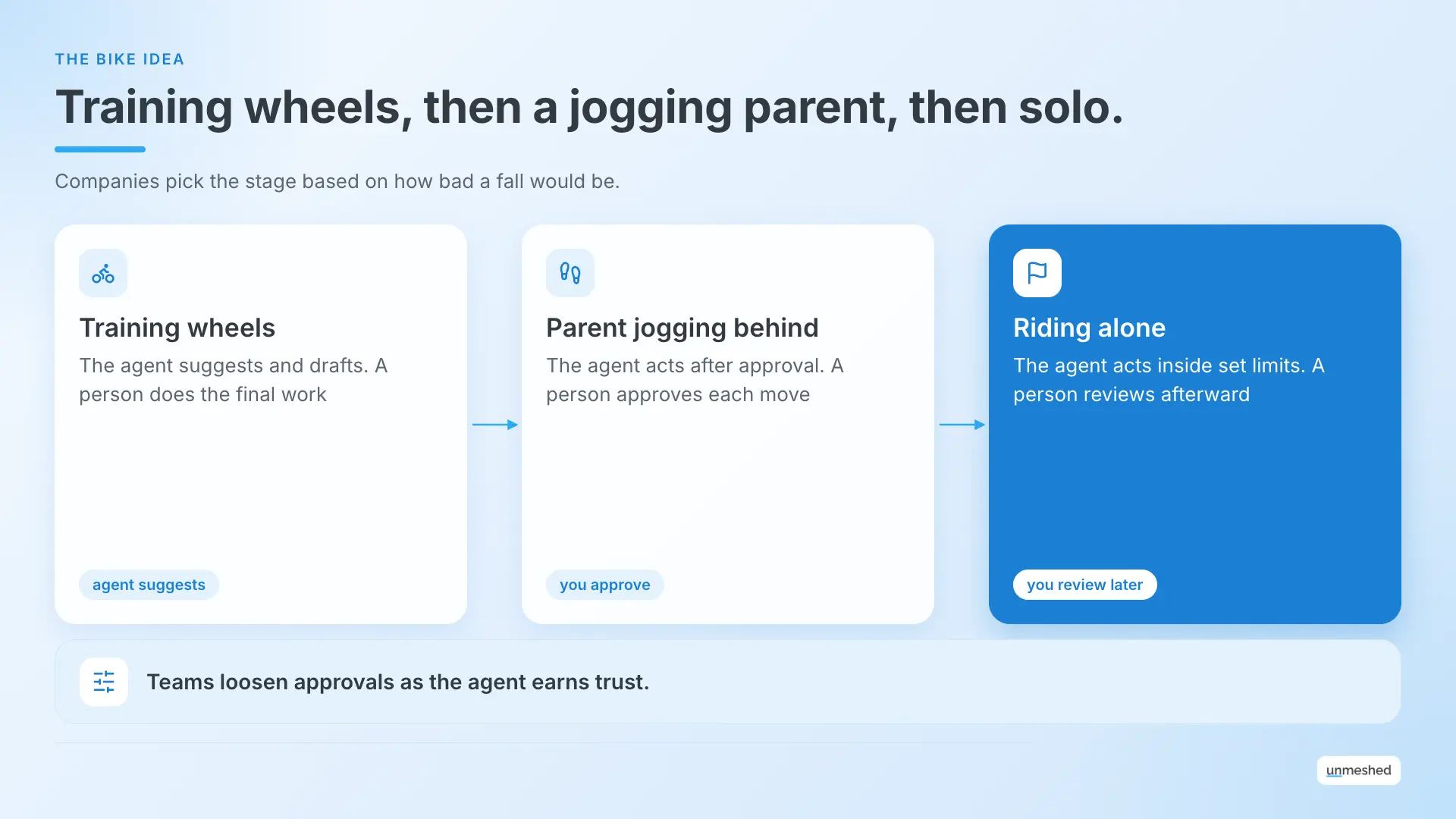
One idea runs through all ten. Think about learning to ride a bike. You start with training wheels, then a parent jogs behind you, then you ride alone. Companies treat AI agents for business the same way, and they pick the stage based on how bad a fall would be.
We build workflow software, so we'll say where Unmeshed fits near the end. Okay, let's get into it.
1. What Are AI Agents for Business?
AI agents for business are software that takes a goal, plans the steps, uses your tools, checks the result, and adjusts. A chatbot answers a question. An agent files the ticket, updates the record, or drafts the contract. A person still sets the limits and reviews the work.
GitHub puts it well in its docs on Copilot agents. An agent can search a repository, edit code, run tests, and revise its changes when a test fails. It decides the steps instead of only returning an answer.
Here's how the three terms people mix up compare.
| Term | What It Does | Who Picks the Steps |
|---|---|---|
| Chat | Answers questions and takes direction in a back-and-forth | You |
| Fixed automation | Runs the same steps when an event or schedule triggers it | Whoever built it |
| Agent | Works toward a goal, uses tools, and adapts to what happens | The agent, within the limits you set |
If you want the longer version of how agents get coordinated, we cover it in our post on agentic orchestration.
2. What Can AI Agents Do for Your Business?
AI agents for business can answer customers, review documents, draft work for a person to check, prepare financial tasks, investigate alerts, and manage campaigns. How much they do alone varies. Some only suggest, some act after approval, and some run alone within set limits.
That's the bike again. Training wheels means the agent suggests and a person does the work. The jogging parent means the agent acts and a person approves each move. Riding alone means the agent acts within limits and a person reviews afterward.
| Stage | What the Agent Does | Where the Person Is | Example Below |
|---|---|---|---|
| Training wheels | Suggests and drafts | Does the final work | Spellbook, EvenUp |
| Parent jogging behind | Acts after approval | Approves each action | Qonto, Supermetrics |
| Riding alone | Acts inside set limits | Reviews afterward | Klarna, Carvana |
Nobody stays at one stage forever. A team might start with approvals on everything and loosen them as the agent earns trust. That takes good plumbing underneath, which is what AI orchestration is for.
3. What Are 10 AI Agent Examples That Work Today?
Ten companies run AI agents for business in daily work today. They are Klarna, Zendesk, Spellbook, EvenUp, Qonto, Carvana, DXC, Atlassian, Supermetrics, and GitHub. Each one below says what the agent does, what the company reports, and where a person stays involved. All numbers come from the companies themselves.
This is the quick view before we go one by one. These AI agent examples cover support, legal, finance, engineering, insurance, and marketing.
| Company | Job | Person's Role | Company Reported |
|---|---|---|---|
| Klarna | Customer service chats | Handles what the agent can't | Two-thirds of chats in month one |
| Zendesk | Customer-built service agents | Picks which actions are allowed | 1 million executions in 7 weeks |
| Spellbook | Contract review | Lawyer decides the edits | About 530,000 reviews a month |
| EvenUp | Legal demand drafts | Attorney signs every draft | 8 to 15 hours down to minutes |
| Qonto | Payroll, transfers, invoices | Customer approves | Payroll 5X faster |
| Carvana | Production alerts | Engineer reviews the fix | 56 percent fewer alerts in one channel |
| DXC | Insurance claims | Experts own the checkpoints | Backlogs from days to minutes |
| Atlassian | Team workflow agents | Customers set what agents touch | 5 million plus agents a month |
| Supermetrics | Ad campaigns | Human turns campaigns live | 10-hour report in 20 minutes |
| GitHub | Code changes | Reviewer merges the pull request | Opens pull requests for review |
1. Klarna Handles Customer Service Chats
Klarna's AI assistant handled 2.3 million conversations in its first month, two-thirds of its customer service chats, which Klarna says equals the work of 700 full-time agents. It runs in 23 markets and over 35 languages. Klarna reports satisfaction on par with human agents, per its launch announcement.
Klarna also says repeat inquiries fell 25 percent and resolution time dropped from 11 minutes to under 2. The assistant runs on OpenAI, and these are February 2024 figures, so check for newer ones before you quote them.
2. Zendesk Lets Customers Build Their Own Service Agents
Zendesk built custom agents on Claude and reports 1 million agent executions in the first 7 weeks of early access, with up to 80 percent lower human handle times. Customers choose which actions each agent may take, so the limits sit with the company using it, per Zendesk's story.
One example is incident triage. The agent files a Jira issue and posts in Slack. That's a small job with a clear edge, which is why it works.
3. Spellbook Reviews Contracts
Spellbook says its agents handle about 530,000 contract reviews a month, cutting some reviews from about 10 hours to about one. Edits stay confined to the paragraphs the user specifies, and data is not retained. The lawyer still decides what goes into the contract, per Spellbook's story.
Notice the guardrail. The agent can't wander through the whole document. It touches what you point at.
4. EvenUp Drafts Legal Demand Packages
EvenUp uses AI to draft personal injury demand packages that took 8 to 15 hours and now take minutes, according to the company. An attorney reads, checks, and signs every draft, and every fact is cited to a page in the source records, per EvenUp's story.
The speed is the headline, but the citation is the part that makes it usable. A lawyer can check a fact in seconds when it points to a page.
5. Qonto Prepares Payroll, Transfers, and Invoices
Qonto's agents prepare payroll, transfers, and invoices, and the customer approves each one. Qonto reports transfers 2X faster, invoices 3X, and payroll 5X. Transfers up to 100,000 euros can be delegated. The agent prepares and recommends, and the user decides, per Qonto's story.
It's built on an MCP server, which is how the agent reaches Qonto's tools. We explain that piece in our post on MCP.
6. Carvana Investigates Production Alerts
Carvana uses Claude Tag in Slack to investigate production alerts, find the owning team, and post a root cause write-up before an engineer starts. Carvana reports 56 percent fewer alerts in one channel and 65 percent faster answers for another team, per Carvana's story.
Fixes still go through a pull request and human review. One team gave the agent read-only access to the same tools an on-call engineer would use. That's a sensible first step.
7. DXC Reads Insurance Claims
DXC uses Claude to classify insurance claim documents in under a second and says backlogs dropped from days to minutes. Agents work inside set authority levels, humans own checkpoints on material calls, and every action is logged so a regulator can replay it, per DXC's story.
DXC also says it built a workers' compensation calculation in 8 hours that was 80 percent right on the first pass. Claims experts handle the other 20 percent.
8. Atlassian Runs Agents Inside Team Workflows
Atlassian says more than 5 million agents run in customer business workflows each month, handling work like triaging support tickets, reviewing contracts, and surfacing sales leads. It uses different models for different jobs, with lighter ones for high-volume agents and Claude for long, complex tasks, per Atlassian's story.
In its early access Rovo Max mode, admins control the packages and network access the agent can use. Same idea again. The agent works, and someone else sets the fence.
9. Supermetrics Manages Ad Campaigns From a Chat
Supermetrics lets marketers ask questions of live ad data in Claude and then create or edit campaigns across six ad platforms. New campaigns start paused, and approval levels are set per account. One agency customer reports a 10-hour client report now takes 20 minutes, per Supermetrics' story.
A paused campaign is a simple trick. The agent does the setup, and nothing spends money until a person flips it on.
10. GitHub Copilot Opens Pull Requests
GitHub's Copilot cloud agent researches a repository, makes changes on a branch, and opens a pull request for a person to review. GitHub describes three modes, collaborative, asynchronous, and automated, and says you stay responsible for the goal, the access, and the review, per GitHub's docs.
This one isn't built on Claude, which is the point. The pattern holds across vendors.
4. What Do Working Agentic AI Examples Have in Common?
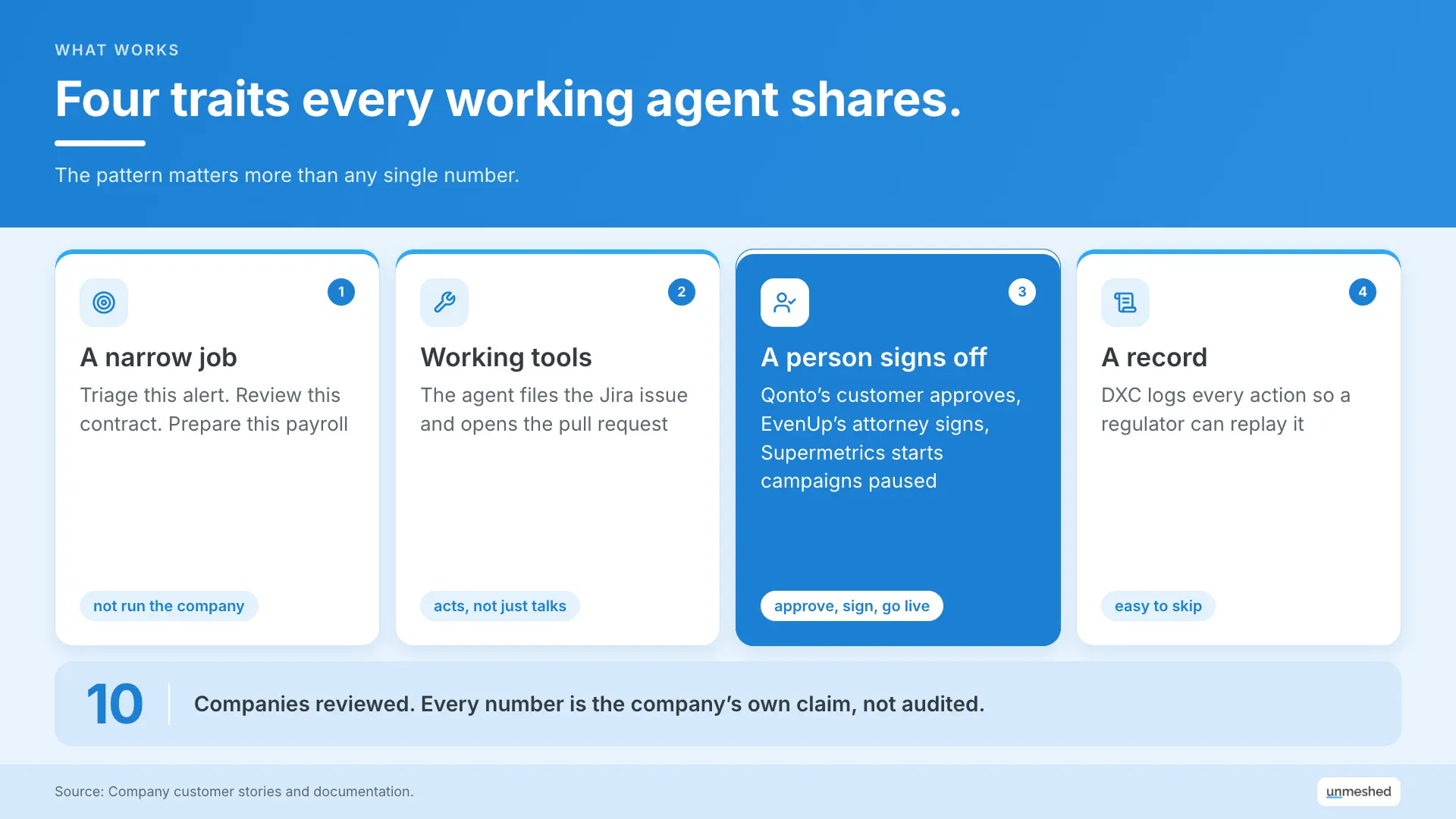
Working agentic AI examples share four traits. The job is narrow, the agent uses tools, a person approves at the point of consequence, and every action leaves a record. Qonto, EvenUp, Supermetrics, and DXC all show it. The pattern matters more than any single number.
Here they are in plain words.
- A narrow job: Triage this alert. Review this contract. Prepare this payroll. Nobody told an agent to run the company.
- Working tools: The agent files the Jira issue and opens the pull request. It does the work, and talks too.
- A person at the point of consequence: Qonto's customer approves, EvenUp's attorney signs, and Supermetrics starts campaigns paused.
- A record: DXC logs every action so a regulator can replay it. Carvana's fixes land in a pull request anyone can read.
That last trait is easy to skip and hard to add later. It's the reason we wrote about agent infrastructure in the first place.
5. What Are the Best Enterprise AI Agents to Start With?
The best enterprise AI agents for business to start with have a narrow job, clear data, and a low cost of being wrong. Document review, ticket triage, alert investigation, and drafting for a person to check are common first picks. Money movement and customer commitments come later, with approvals.
We haven't tested these products, so we won't rank vendors. We can rank jobs by how bad a mistake is, using the examples above.
| Starter Job | Cost of a Mistake | Example | Keep a Person On |
|---|---|---|---|
| Alert and ticket triage | Low | Carvana, Zendesk | The fix |
| Drafting and review | Medium | Spellbook, EvenUp | The final sign-off |
| Campaign and report setup | Medium | Supermetrics | Going live |
| Claims and document intake | Medium to high | DXC | Material decisions |
| Payments and payroll | High | Qonto | Every approval |
Start at the top and work down. You learn what your agent gets wrong while it's cheap to learn.
6. Why Do Some AI Agent Projects Fail?
Reuters reported that Gartner expects over 40 percent of agentic AI projects to be canceled by the end of 2027. Reasons we see in the examples above are broad jobs, no approval points, no record of what the agent did, and no way to measure quality.
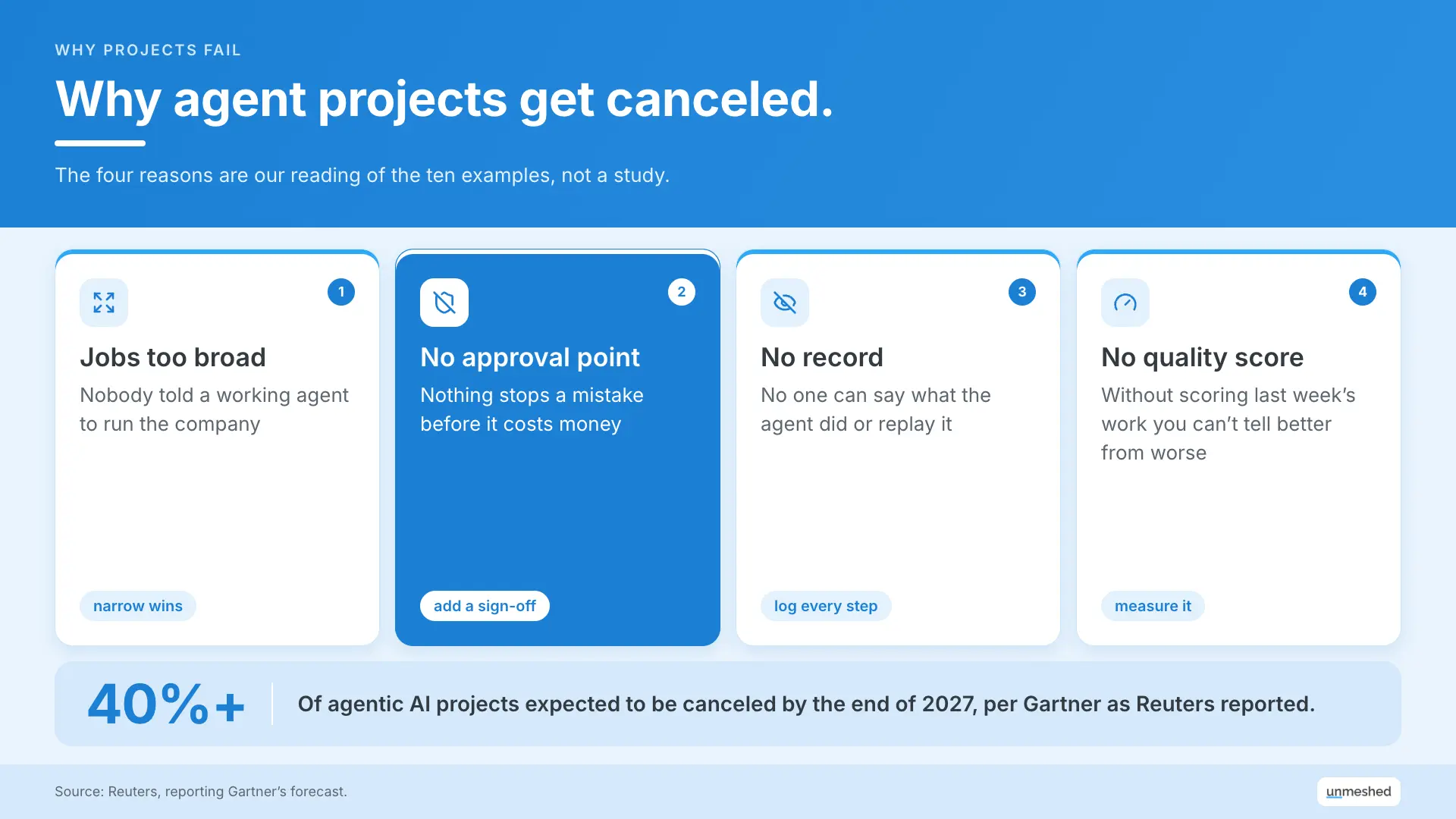
That forecast is Gartner's, as Reuters reported it. The reasons are our reading of the ten examples, not a study.
Quality is the one teams forget. If you can't score what the agent did last week, you can't tell if it got better or worse. We cover that in our post on agent evals.
7. What AI Agent Use Cases Fit Your Business?
AI agent use cases for business fit best where work is repeatable, text-heavy, and checked by a person at the end. Support, legal review, finance admin, engineering operations, insurance claims, and marketing reporting all show up in the ten examples. Pick the one where your team loses the most hours.
| Team | Use Case | Example | Approval to Keep |
|---|---|---|---|
| Support | Answer chats, triage tickets | Klarna, Zendesk | Escalation to a person |
| Legal | Review and draft documents | Spellbook, EvenUp | Attorney sign-off |
| Finance | Prepare payroll and invoices | Qonto | Approve before sending |
| Engineering | Investigate alerts, open pull requests | Carvana, GitHub | Code review |
| Claims | Classify and read documents | DXC | Expert checkpoint |
| Marketing | Report and adjust campaigns | Supermetrics | Go live approval |
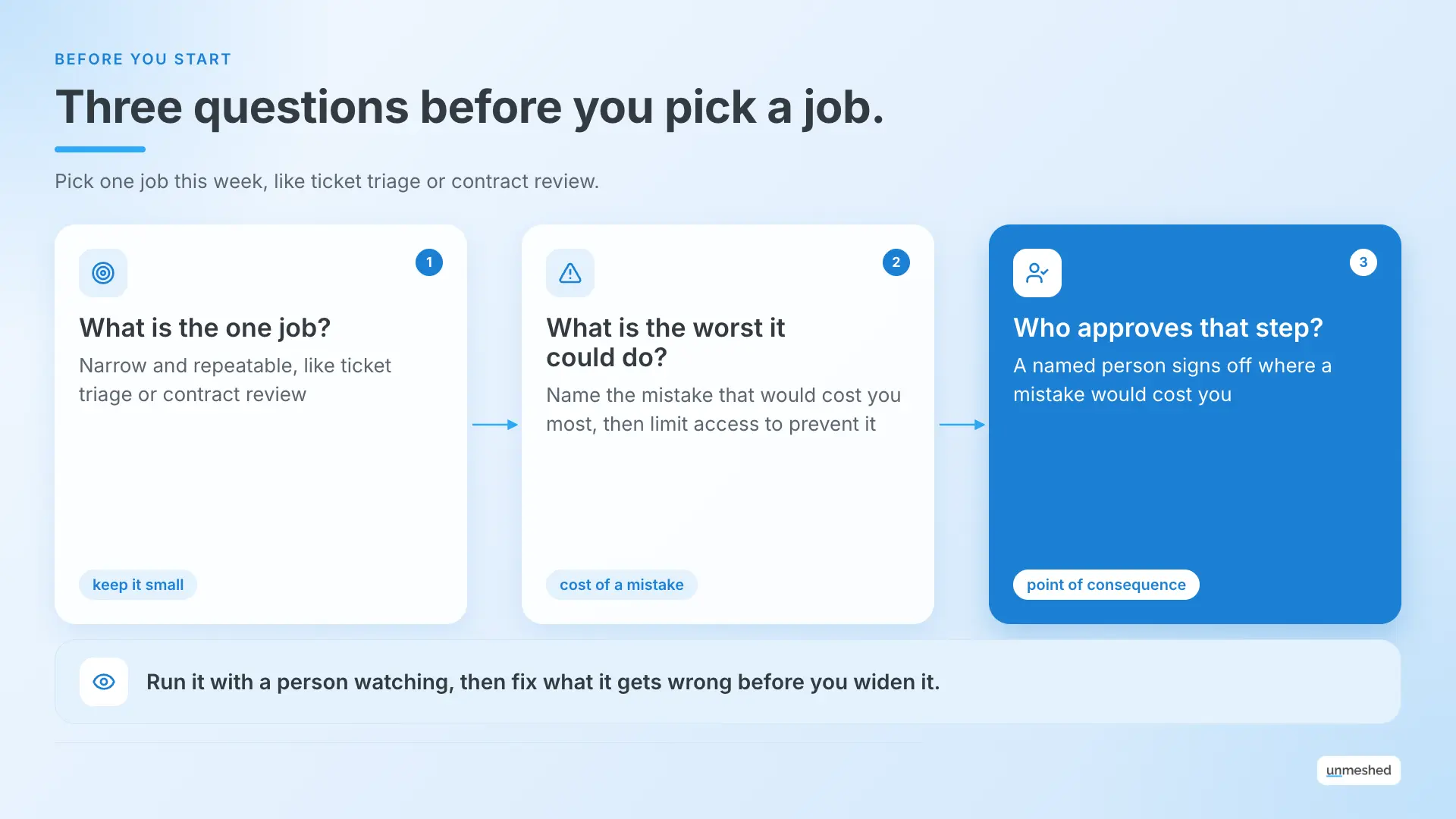
Before you start, ask three questions. What is the one job? What is the worst thing the agent could do with it? Who approves that step?
8. How Does Unmeshed Fit With AI Agents for Business?
Unmeshed runs the steps around your AI agents for business. It lets an agent call tools, pauses for a person to approve, retries failures, and keeps a record of every step. We don't build the agent or the model. We make sure it runs with limits and a log.
Most of the traits in the last section are plumbing. Approvals, retries, and a record don't come with the model. Somebody has to build them.
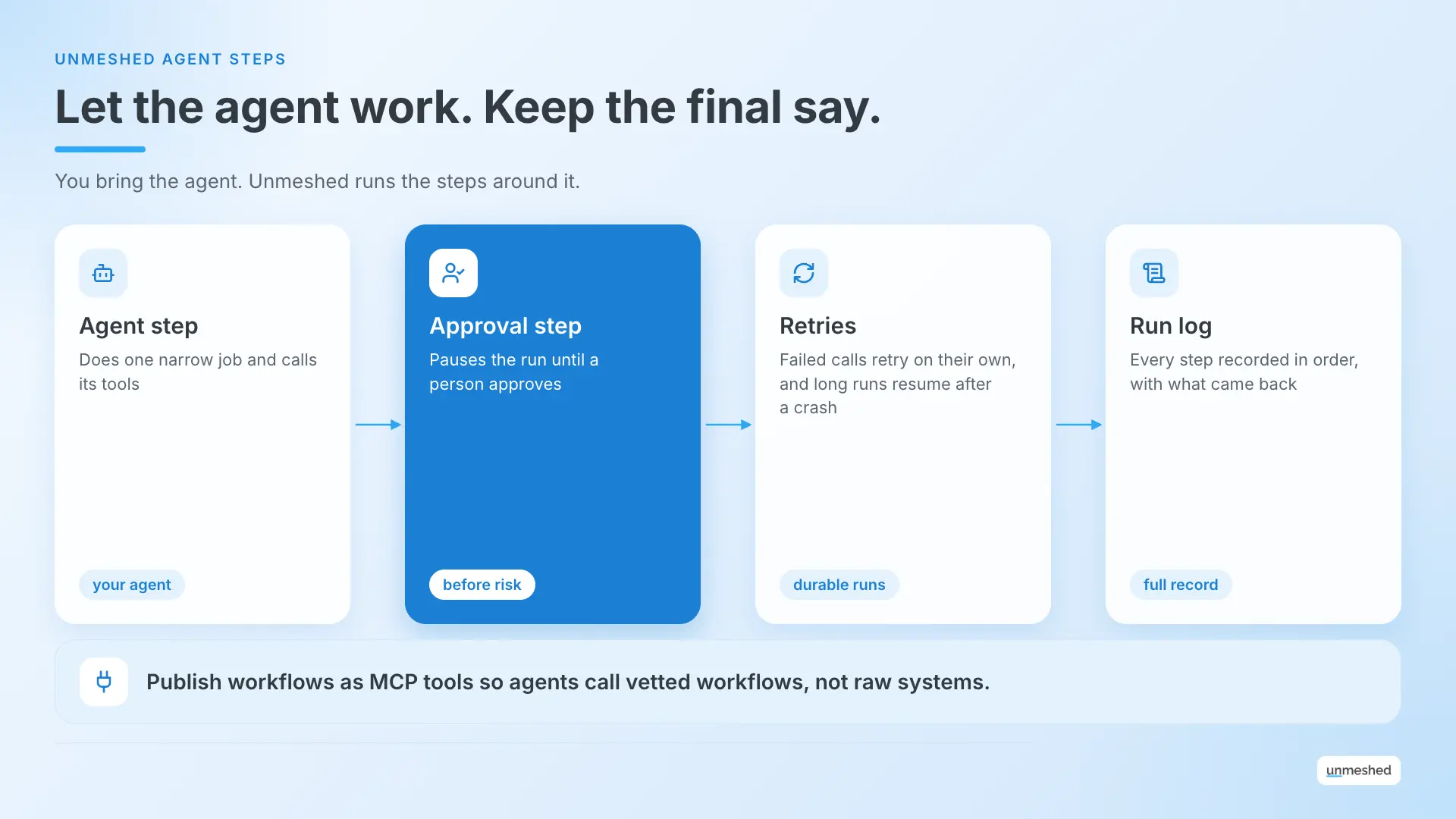
- Agent steps in workflows: Build agentic workflows where an agent step sits next to ordinary steps, so the agent has a defined job.
- People where it counts: Add approval steps so the workflow stops and waits for a person before something risky happens.
- Runs that survive: Durable execution means a long run picks up where it stopped after a crash or a wait.
- A record of every step: You can see what the agent did, in what order, and what came back.
- Tools through MCP: You can publish workflows as MCP tools, so an agent calls a vetted workflow instead of raw systems. See our MCP page.
Our agent governance page covers the control side in more detail. We come from the team behind Netflix Conductor, and we've kept the focus on running things reliably.
Now the limits. We aren't a model provider, and we aren't a finished agent product. You bring the agent. You still decide the job, the limits, and who approves.
Let The Agent Work. Keep The Final Say.
Add approval steps, retries, and a full run log to any agent, so a person signs off where a mistake would cost you.
Add My Approval StepConclusion
AI agents for business work best when the job is narrow, and a person stays at the point of consequence. Qonto's customer approves the payroll. EvenUp's attorney signs the draft. Supermetrics starts every campaign paused. None of that comes from a smarter model. It comes from how each company runs the agent.
That's the part we care about at Unmeshed, back to the bike. Most teams will want training wheels on day one, and that's fine. What matters is that you can take them off slowly. With us, your agent runs as a workflow step. A person approves anything risky, failed calls retry on their own, and every step leaves a record. So when the agent has earned it, you loosen one approval and leave the rest alone.
Pick one job this week, like ticket triage or contract review. Run it with a person watching, see what the agent gets wrong, and fix that before you widen it. You'll learn more from that one small run than from any list of examples, ours included.
Frequently Asked Questions
Sources
- 1.Klarna AI assistant handles two-thirds of customer service chats in its first month, Klarna
- 2.Zendesk built custom agents on Claude and reached 1 million agent executions in 7 weeks, Claude
- 3.Spellbook customer story, Claude
- 4.EvenUp customer story, Claude
- 5.Qonto customer story, Claude
- 6.Carvana turns Slack alerts into production fixes with Claude Tag, Claude
- 7.DXC brings Claude to the insurance backbone running billions of policies, Claude
- 8.How Atlassian builds AI agents teams can trust with Claude and Google Cloud, Claude
- 9.Supermetrics lets marketers manage ad campaigns from a conversation with Claude, Claude
- 10.About GitHub Copilot agents, GitHub Docs
Piloting an agent right now?
Tell us the job. We'll show you where it needs a person.
Share the task your agent handles. We'll point out which steps to approve, which to retry, and which to log.